


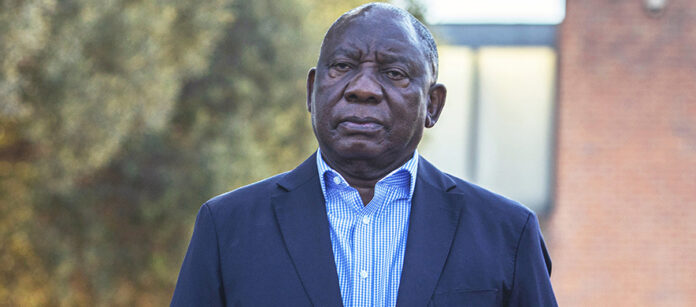
President Cyril Ramaphosa has admitted that the government has not done enough to maintain water infrastructure and provide reliable water services, saying poor municipal management has contributed to South Africa’s worsening water crisis.
In his weekly newsletter released on Monday, Ramaphosa said expanding access to safe drinking water was one of the most meaningful ways to honour the legacy of former president Nelson Mandela, whose birthday was commemorated over the weekend.
Severe water challenges
The President acknowledged that while access to piped water has improved significantly since the advent of democracy, many communities continue to experience water shortages, deteriorating water quality and failing infrastructure.
“We must acknowledge that in too many municipalities, government has not succeeded to maintain infrastructure, to manage water services properly and to respond with sufficient urgency,” Ramaphosa wrote.
He said ageing infrastructure had collapsed in some parts of the country, resulting in worsening water shortages and declining water quality.
Ramaphosa used the newsletter to highlight the launch of the National Water Access Acceleration Programme in Hammanskraal, where government recently handed over boreholes and commissioned the Klipdrift Package Water Treatment Plant.
The programme aims to speed up access to water in underserved communities by using decentralised water supply solutions such as boreholes, groundwater development, rainwater harvesting and the rehabilitation of existing water schemes instead of relying only on major infrastructure projects.
According to the president, the initiative is intended to reduce the time it takes to provide communities with reliable access to clean water by introducing solutions suited to local conditions.
Notable progress
Ramaphosa said South Africa had made notable progress in expanding water access over the past three decades, citing Census 2022 figures showing that more than 82% of households now have piped water either inside their homes or within their yards. He added that the proportion of households without access to piped water had more than halved since 1996.
To strengthen government’s response, Ramaphosa said the National Water Crisis Committee had been established earlier this year to coordinate interventions across all spheres of government.
He said the committee was focused on improving municipal water and sanitation services, increasing investment in infrastructure, reforming water institutions, strengthening the regulatory framework and tackling corruption and criminality in the sector.
Drawing comparisons with government’s efforts to resolve the electricity crisis, Ramaphosa said long-term reforms were needed to address the country’s water challenges.
‘Sustainable, long-term reform’
“Our response to the water crisis focuses on sustainable, long-term reform,” he wrote.
Government has allocated R156 billion over the next three years for water and sanitation infrastructure as part of its broader public infrastructure investment programme.
Ramaphosa also said public hearings on the Water Services Amendment Bill would begin soon. The proposed legislation is expected to strengthen enforcement and make it possible for municipal managers who fail to manage water infrastructure properly to be held personally liable.
He warned that government would use available legal measures, including criminal proceedings where necessary, against municipalities and officials who fail to comply with water and environmental legislation.
The President said National Treasury was assisting municipalities to improve their financial sustainability and ensure that revenue generated from water services was reinvested into maintaining and upgrading infrastructure.
Urgent priority
Ramaphosa said water security remained one of government’s most urgent priorities.
“Households and businesses experiencing shortages and outages have had enough, and underserved communities across the country still waiting for taps to be installed 32 years into democracy are justifiably tired of waiting,” he wrote.
He said government intended to replicate the coordinated approach that helped reduce load shedding by combining immediate interventions with institutional, legislative and governance reforms.
“Our ultimate goal is not merely to get over the current crisis, but to fulfil Madiba’s vision of all South Africans enjoying their constitutionally enshrined right to access to water and of this right being secured for generations to come. Water is dignity and therefore central to Mandela’s legacy,” Ramaphosa wrote.
ALSO READ: R400bn needed to upgrade SA’s failing water systems
- President Ramaphosa acknowledged government failures in maintaining water infrastructure and poor municipal management as key contributors to South Africa's worsening water crisis.
- The National Water Access Acceleration Programme was launched to speed up access to water using decentralized solutions like boreholes, groundwater development, and rainwater harvesting.
- Over 82% of South African households now have piped water access, a significant improvement since 1996, but many communities still face shortages and deteriorating water quality.
- The government allocated R156 billion over three years for water and sanitation infrastructure, with new legislation proposed to hold municipal managers personally liable for mismanagement.
- Water security is a top priority, with a coordinated approach planned to combine immediate interventions and long-term reforms to ensure sustainable access aligned with Mandela’s legacy.


