


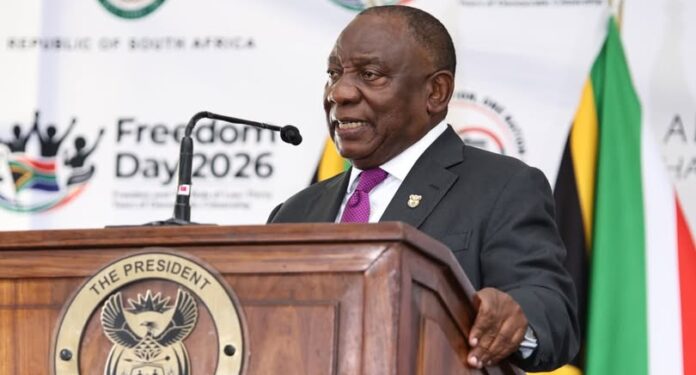
President Cyril Ramaphosa has announced November 4 as the date of the local government elections. Speaking on the sidelines of the Extended Presidential Coordinating Council in Boksburg in Ekurhuleni, Ramaphosa confirmed the much-anticipated date of the local polls.
“Well, the 4th of November 2026 is the date we have set for the local government elections that would have completed a full five years since 2021.
“This is in line with our constitutional construct or architecture that we are keeping to those timelines, and of course, as with any election, everybody expects that they will be returning to the work they have been doing to serve our people. I expect that many of the councillors and mayors who were here will want to be returned to office,” Ramaphosa said.
IEC formalities to follow
From this point, attention shifts to the Electoral Commission of South Africa (IEC), which is expected to formally proclaim the election timetable in the Government Gazette. This will trigger a series of legally binding deadlines, including the opening of candidate nominations, party registration cut-off dates, and the certification of the voters’ roll. The IEC will also intensify voter registration drives, both online and through physical registration weekends, to ensure that all eligible citizens are captured and that addresses on the roll are verified in line with Constitutional Court requirements.
Political parties are now expected to finalise their candidate selection processes, compile proportional representation lists, and submit these to the IEC within prescribed timeframes. Internal party processes, often marked by disputes over nominations, will need to be concluded swiftly to avoid missing deadlines that could disqualify candidates or entire party lists. Parties will also begin rolling out manifestos and campaign strategies while ensuring compliance with the Electoral Code of Conduct, which governs fair campaigning and prohibits intimidation, misinformation and abuse of state resources.
Compliance for independent candidates
Independent candidates, who have increasingly entered the local government space, will similarly need to secure the required number of supporting signatures, pay deposits, and submit all documentation to the IEC. Their participation places additional administrative demands on the commission, which must verify each candidacy against legal requirements.
The voters’ roll will come under particular scrutiny. The IEC is required to publish a provisional roll for inspection, allowing citizens and political parties to object to incorrect entries or omissions. Ensuring the integrity of the roll is critical, as past elections have seen legal challenges over incomplete or inaccurate address data.
Voters must verify their details
For voters, the period ahead will be crucial. Eligible citizens who are not yet registered must do so before the cut-off date, while those who have relocated are encouraged to update their voting districts. Voters will also be expected to verify their details via IEC platforms to avoid being turned away on election day.
Election observers, both domestic and international, are likely to be accredited in the coming months to monitor the process, adding an additional layer of transparency. Security agencies, working with the IEC, will begin planning for safe and orderly voting, particularly in areas historically prone to unrest or contestation.
The months leading up to November 4 will test the readiness of all stakeholders – from the IEC’s administrative capacity to the conduct of political actors and the participation of voters – in delivering a credible, free and fair local government election.
Visit SW YouTube Channel for our video content
- This article has been updated.
- President Cyril Ramaphosa announced November 4, 2026, as the date for local government elections.
- The announcement was made during the Extended Presidential Coordinating Council in Boksburg, Ekurhuleni.
- The election date aligns with the constitutional timeline, marking five years since the 2021 local elections.
- Ramaphosa emphasized the importance of returning elected officials who have served the people.
- He expects many current councillors and mayors will seek re-election to continue their work.


