


At least 97 members of the South African Police Service, who are meant to protect the public from harm, were accused of either rape or sexual violence in a series of shocking incidents spread across the country.
This is contained in the annual report of police watchdog the Independent Police Investigative Directorate (Ipid), for the 2024/2025 financial year, which paints a grim national portrait of how those entrusted with protecting the vulnerable sometimes turn into perpetrators of serious acts of gender-based violence.
Of the 97 cases flagged by Ipid, 95 involve allegations of rape by police officers, with two relating to rape committed in police custody. A further 17 cases of sexual assault were also recorded during the same period.
Fatima Shaik, executive director of People Opposing Women Abuse, said the report triggered “a profound sense of betrayal at the state’s failure to protect women”, adding that when police officers are implicated in sexual violence, it signals more than individual wrongdoing.
“When police officers entrusted with protecting women are implicated in rape and sexual violence, this is not an isolated scandal. It is evidence of a state that has failed to confront violence within its own institutions,” Shaik said.
Siyabulela Jentile, an activist linked to pressure group #NotInMyNameInternational, expressed shock at the revelation, saying the incidents were not just statistics but represented real human beings violated by those who should be protecting them. “The figure of 97 cases must never be understood as a statistic alone,” he said. “Each number represents a violated human being – a mother, a sister, a daughter, a child whose dignity was stripped away by those entrusted with power.”
The report was formally signed off on September 23, 2025, by the acting Minister of Police Firoz Cachalia, weeks after he assumed responsibility for the portfolio.
In his foreword, Cachalia acknowledged that, “public confidence in law enforcement has been eroded by acts of misconduct within the police services.”
The Ipid statistics show that rape by police officers is not isolated to one region but spread across the country, with stark provincial disparities.
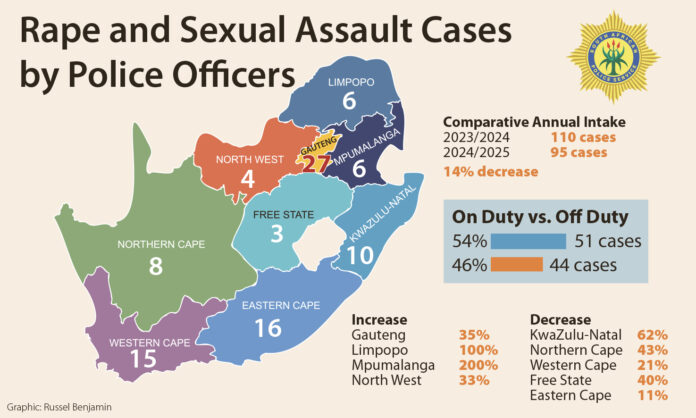
Gauteng recorded the highest incidents, with 27 incidents, followed by Eastern Cape (16), Western Cape (15) and KwaZulu-Natal (10). Northern Cape recorded eight cases, Mpumalanga and Limpopo six each, North West four, and the Free State three.
While the national total reflects a 14% decrease from 110 reported rape cases in 2023/2024 to 95 in 2024/2025, the decline masks sharp provincial spikes.
Gauteng saw a 35% increase, incidents reported in Limpopo doubled, and Mpumalanga recorded a 200% rise, jumping from two to six cases in a single year.
By contrast, KwaZulu-Natal recorded a 62% decrease, the Northern Cape fell by 43%, and the Western Cape by 21%.
Fifty-one incidents (54%) involved officers on duty, while 44 cases (46%) occurred off duty.
On incidents of rape in police custody, Jentile was unequivocal. “Abuse in police custody is among the gravest human rights violations a democratic state can commit. In custody, victims are completely powerless and entirely under state control. Any abuse in such a space is not
only criminal; it is an indictment of the state itself. It represents a total breakdown of duty, ethics and humanity.”
“What is required now is decisive action, not statements. This includes immediate suspension, fast-tracked and transparent investigations, and real consequences for those found guilty.
“Accountability must be visible, consistent and uncompromising; otherwise, we are complicit in the cycle of violence,” Jentile added.
Shaik warned that unresolved cases fuel impunity, noting that thousands of Ipid matters remain under investigation nationally.
“When cases remain unresolved, officers remain in uniform. When officers remain in uniform, impunity becomes policy,” she said.
She said allegations against police officers shatter survivors’ trust in the justice system, often silencing victims before they report abuse. “Many choose silence not because violence has stopped, but because hope has stopped,” she said.
Ipid told Sunday World that dozens of cases where police officers are accused of rape and sexual offences were moving through different stages of the criminal justice system.
The watchdog’s spokesperson, Phaladi Shuping, said the matters span multiple locations and relationships, reflecting the complexity of the cases under scrutiny.
“The cases happened at different places. Some of the complainants are partners, some are complainants in other cases, and some are just ordinary members of the community,” Shuping said.
Richard Mamabolo, spokesperson for police union Popcru, said while the union condemns any acts of sexual violence, the cases cited in the Ipid report remain allegations that are under investigation and must not be confused with findings of guilt.
“We therefore approach the report with a dual responsibility: to condemn sexual violence without reservation, while also upholding the constitutional principle of the presumption of innocence until proven guilty,” he said.


