
The SACP has welcomed the adoption of the 2026/27 Gauteng provincial budget following the postponement of its initial passage because of insufficient support to meet legislative requirements, and its eventual approval at a second sitting on 31 March 2026.
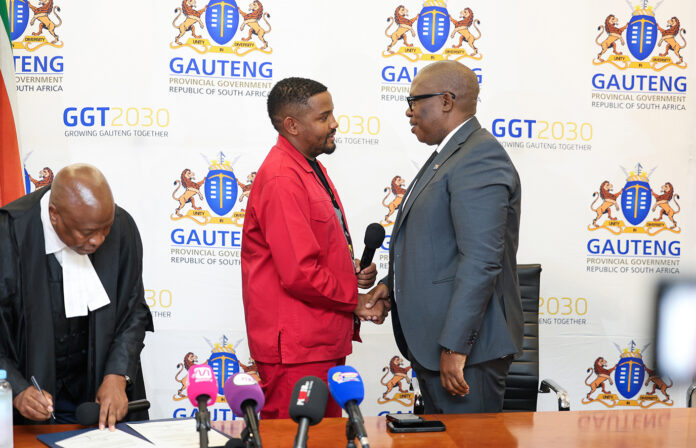
The budget, tabled by former MEC for Finance and Economic Development Lebogang Maile, who has now been replaced by EFF Gauteng leader Nkululeko Dunga, amounts to R179.2- billion for the 2026/27 financial year, with over 80% allocated to health, education, and social development. The total budget over the 2026 Medium Term Expenditure Framework is R549.3-billion.
Instability prevented
“The passing of the budget on the second attempt was a critical intervention to prevent instability at the centre of South Africa’s most strategic provincial economy.” the SACP said in a statement released on Wednesday.
“Had the budget failed again, the province would have faced delayed departmental spending, disruptions to infrastructure projects, interruptions to frontline service delivery, procurement uncertainty and serious pressure on urgent interventions in water, roads, health and education.
Gauteng ‘too important to fail’
“Gauteng cannot afford such paralysis. The province remains the productive centre of the South African economy, contributing more than one-third of national GDP and serves as the country’s main industrial, logistics and financial hub,” the statement read.
The party said the province’s long-term political stability is a strategic necessity as it occupies “a decisive position in the South African economy”.
“A prolonged provincial stalemate would have deepened uncertainty and risked reproducing at provincial level the paralysis already visible in parts of local government. This was the real material choice before the alliance political council to either allow instability to deepen, or act in defence of continuity, governance and the interests of the people of the province,” the SACP said.
Lesufi’s manoeuvre
A move by Premier Panyaza Lesufi to bring in Dunga as finance MEC has drawn criticism even from within the ANC itself. But with the budget stalemate finally resolved, indications will be that Lesufi’s manoeuvre has turned out to be a master stroke.
The SACP’s statement of support comes at a time when its relationship with its alliance partner, the ANC, had seemed to be on the rocks lately. This after the SACP had announced its decision to contest elections independently.
The SACP had also been a vocal critic of the government of national unity. But in Wednesday’s statement, the SACP struck a positive note that signalled that the party has since warmed up to the new setup.
“It is therefore our considered view that the strengthening of the GPU (government of provincial unity), unless proven otherwise through concrete revolutionary practice and material outcomes, must be understood as an intervention located within the strategic tasks of defending revolutionary advance,” the SACP statement said.
- The Gauteng provincial budget for 2026/27, totaling R179.2 billion with over 80% allocated to health, education, and social development, was adopted after initial delays due to insufficient legislative support.
- The budget's passage on a second attempt was deemed crucial by the SACP to prevent economic instability in Gauteng, South Africa’s key economic hub contributing over one-third of national GDP.
- Failure to pass the budget earlier risked delaying government services, infrastructure projects, and urgent interventions in critical sectors such as water, roads, health, and education.
- Premier Panyaza Lesufi's appointment of EFF leader Nkululeko Dunga as finance MEC, replacing Lebogang Maile, was controversial but ultimately viewed as a pivotal move to resolve the budget stalemate.
- Despite recent tensions, the SACP expressed support for the government of provincial unity, signaling improved relations with the ANC and a commitment to advancing revolutionary progress through governance.
“
“Had the budget failed again, the province would have faced delayed departmental spending, disruptions to infrastructure projects, interruptions to frontline service delivery, procurement uncertainty and serious pressure on urgent interventions in water, roads, health and education.
“
“A prolonged provincial stalemate would have deepened uncertainty and risked reproducing at provincial level the paralysis already visible in parts of local government.
A move by Premier
“It is therefore our considered view that the strengthening of the GPU (government of provincial unity), unless proven otherwise through concrete revolutionary practice and material outcomes, must be understood as an intervention located within the strategic tasks of defending revolutionary advance,” the SACP statement said.