


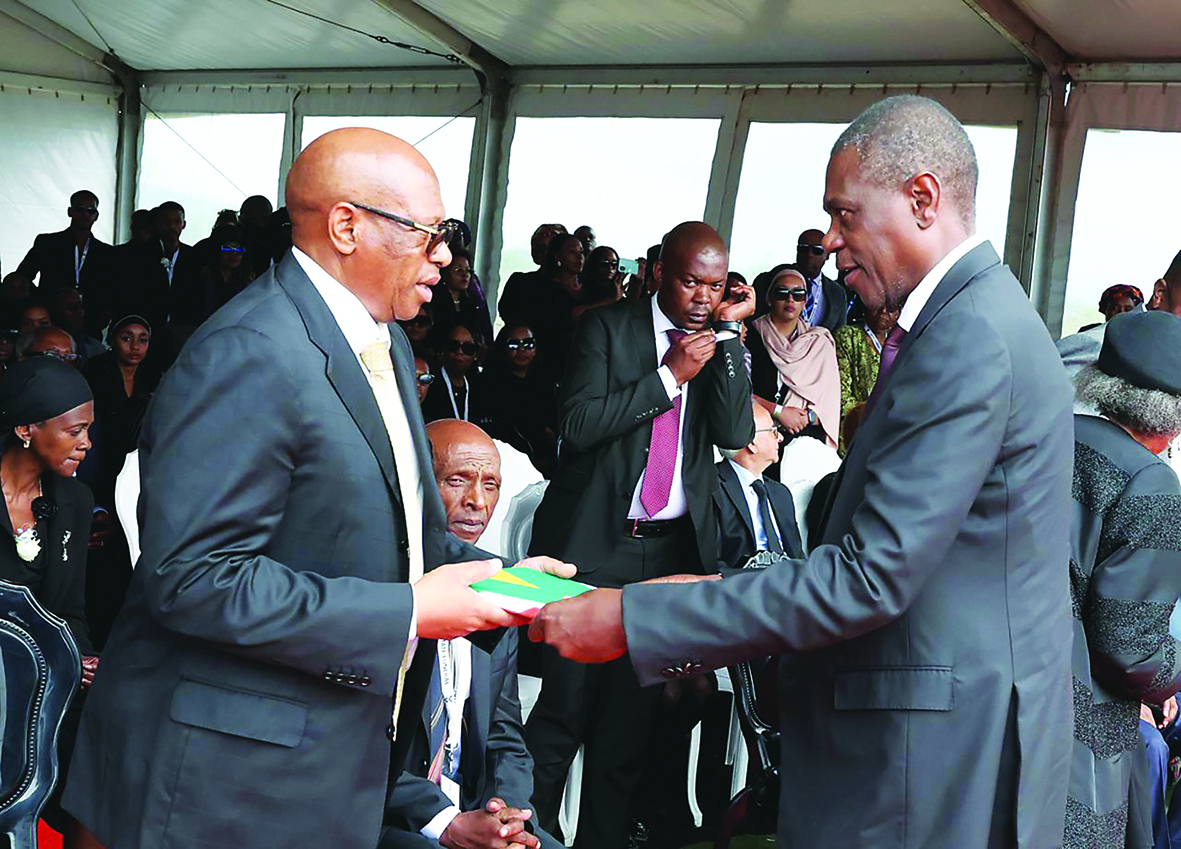
South Africa has bid farewell to one of its most influential women in politics and the global fight for gender equality, Dr Phumzile Mlambo-Ngcuka, with tributes celebrating a life defined by courage, humility, service and the relentless pursuit of justice.
The country’s former deputy president was honoured with a Category 2 State
Funeral yesterday at eXesi village in Middledrift, Eastern Cape.
President Cyril Ramaphosa, his deputy Paul Mashatile, former presidents Thabo Mbeki and Kgalema Motlanthe, Eastern Cape premier Oscar Mabuyakhulu, United Nations Deputy Secretary-General Amina Mohammed, ANC secretary-general Fikile Mbalula, national chairperson Gwede Mantashe and Speaker of Parliament Thoko Didiza were among the dignitaries who said their final goodbyes.
Mlambo-Ngcuka, who was married to advocate Bulelani Ngcuka, the country’s first national director of public prosecutions, was remembered as a woman of extraordinary strength who carried herself with quiet dignity and saw power as an instrument to transform the lives of others rather than a platform for personal glory.
Delivering his eulogy, Ramaphosa described her as a trailblazer who broke political barriers, championed women’s empowerment and used every position she occupied to open doors for people historically excluded from opportunities.
“Sis’ Phumzile was fond of saying that when you have power, you should use it. She held herself to those words. For her, this meant using power not for oneself but for those who had little or none. She understood that power acquires its moral legitimacy through the good it does in the lives of others,” Ramaphosa said.
Mlambo-Ngcuka made history as South Africa’s first black woman minister of minerals and energy, the country’s first woman deputy president and the first African to lead UN Women. Ramaphosa said her greatness was not measured by the titles she held but by what she did with the power entrusted to her.
“Every door that opened for her became a door through which she sought to bring others. Every position she occupied became a platform from which she sought to advance the interests of those who had been excluded,” he said.
Ramaphosa credited her with reforms including the Mineral and Petroleum Resources Development Act and the first Mining Charter, which sought to broaden access to mineral wealth and promote transformation in ownership.
Mbeki, who worked with Mlambo-Ngcuka during his presidency, also paid an emotional tribute, describing her as a key architect of democratic South Africa who played a leading role in the liberation struggle, the transition to democracy and efforts to tackle poverty and unemployment.
“I’m very glad to say again that Comrade Phumzile was very much in the front ranks of those who constituted our people in that Constitutional Assembly carrying out those two tasks,” he said.
- Dr Phumzile Mlambo-Ngcuka was honoured with a Category 2 State Funeral at eXesi village in Middledrift, Eastern Cape.
- President Cyril Ramaphosa described her as a trailblazer who used power to transform lives and championed women's empowerment.
- She was South Africa's first black woman minister of minerals and energy, first woman deputy president, and first African to lead UN Women.
- Ramaphosa credited her with reforms including the Mineral and Petroleum Resources Development Act and the first Mining Charter.
- Former President Thabo Mbeki called her a key architect of democratic South Africa and a leading figure in the liberation struggle.


