
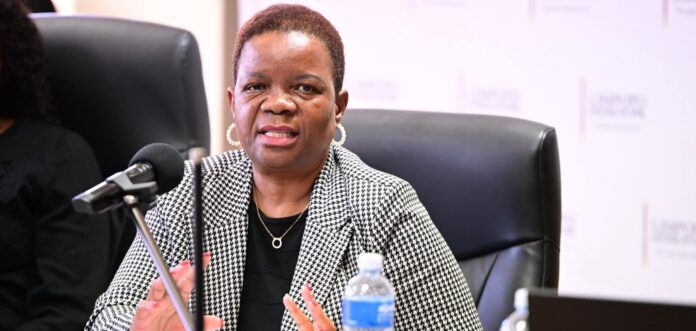
Limpopo Standing Committee on Public Accounts (Scopa) chairperson Esther Mokwele has blamed government officials entrusted with public funds for failing to decisively deal with irregular expenditure, warning that the pattern has left the province financially exposed when natural disasters strike.
Speaking during a Scopa hearing involving the provincial agriculture department, Mokwele lambasted officials within the Limpopo government for what she described as a lacklustre approach to accountability and service delivery.
“It is in the interest of every citizen of Limpopo to see to it that every cent spent is accounted for,” she stated.
Audit outcomes
“And it is not only about cents and rands. It is about service delivery. The audit outcomes must speak to service delivery issues.”
Mokwele said officials in finance units and heads of departments were repeatedly being forced to explain away money lost through irregular expenditure. Despite such conduct constituting an offence under budgetary frameworks and public finance laws.
“We are also concerned that there is non-compliance with the legislation. We have amounts of irregular expenditures and they are increasing every year. It looks like we are tolerating irregular expenditure. We are so comfortable, we are tolerating and we understand,” she said.
Speaking straight to her face, Mokwele told Agriculture MEC Nakedi Kekana that the department remained trapped in a cycle of poor financial control.
“Honourable MEC, Scopa has received audit outcomes and reports from [the Auditor-General]… You have been stuck with unqualified audit opinions for a very long time. You can’t get out of that situation. And some of the responses you have given us confirm that you are stuck because you recycle strategies. And some of the strategies you don’t even implement,” she said.
Contingency for climate change impact
She warned that repeating the same approaches without meaningful reform would continue to yield the same results.
“Doing things the same way every time, you get the same results. You don’t chop strategies every year. As a province MEC, we are meeting as we are faced with a devastating situation because of the floods. The floods have devastating effects, as agriculture is the main economic activity in our province.”
Mokwele said fiscal discipline could not be divorced from the realities of climate change and its impact on food security.
“The fertile soil has been wiped away and we know that naturally agricultural soil is limited. Those farmers who were in production are going to lose because some of their crops are destroyed,” she said. “You may ask yourself why am I raising these issues when we are here to talk about accountability. I’m raising them because they have a direct impact. As a result of climate change, this might not be the last disaster. Our budgets must talk to this issue.”
Mokwele further questioned the department’s communication and community outreach programmes. Particularly around early warning systems for livestock-threatening outbreaks such as foot-and-mouth disease. She expressed doubt about whether farmers were adequately informed on how to respond to symptoms amid what she described as limited communication efforts.