
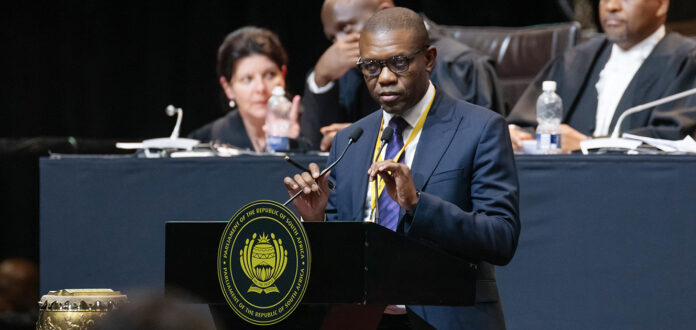
The standing committee on public accounts (Scopa) has signalled an aggressive oversight drive targeting municipalities after Enoch Godongwana, the Minister of Finance, set aside R205-billion for local government infrastructure over the medium term.
Speaking during the finance cluster in parliament on Monday, Scopa chairperson Songezo Zibi warned that Treasury cannot monitor every rand spent across the state.
“Neither the finance minister nor the officials of the Treasury are omnipresent, watching administrative and policy decisions like a hawk to ensure that public funds are used efficiently. There’s simply not enough of them to do that,” Zibi said.
“While there appears to be an expectation that Godongwana can ensure fiscal responsibility across hundreds of government authorities, this expectation is not grounded in how a functioning political system should work. This expectation is unreasonable.”
Godongwana’s budget framework indicates that infrastructure spending will remain above R1-trillion over the medium term, made up of R577-billion by state-owned companies, R217-billion by provinces, and R205-billion by municipalities.
Vow to tighten oversight
An additional R5.8-billion has been allocated to the Passenger Rail Agency of South Africa’s rolling stock renewal programme.
Zibi told journalists that parliament would tighten oversight as funds begin flowing.
“These are significant sums of money, and, given how prevalent mismanagement and criminality are, it is important that parliament and provincial and municipal public accounts committees work very closely with the auditor-general to safeguard them,” he said.
He revealed that Scopa will summon selected municipalities and metros to account for infrastructure spending, maintenance plans, and contract management failures.
“The standing committee on public accounts will, as part of the strategy we adopted last year, be focusing on key institutions across the programme.
“These include national departments, state-owned companies, and some metros and municipalities.”
Scopa is working closely with the auditor-general and has signed a memorandum of understanding with the Special Investigating Unit to strengthen consequence management.
In the coming weeks, the committee will engage municipalities in the Eastern Cape, including Buffalo City metro and OR Tambo district municipality, after receiving concerning briefings from oversight bodies.
“I remain extremely worried about the obstructive role municipal dysfunction is playing in our economic recovery efforts.
“Not only do municipal public accounts committees appear weak and ineffectual, but there also seems to be a culture of impunity regarding key infrastructure projects,” Zibi said.
Poor project management
He warned that economic recovery cannot succeed while local government falters.
“We cannot grow the economy and create jobs if small family-owned businesses and start-ups have to contend with water disruptions and impassable roads, among other challenges.”
Zibi stressed that structural reforms alone will not rescue failing councils.
“So, formulating the agency on its own does not solve the problem. The performance of the municipality and the quality of management remain central.”
On escalating infrastructure costs, Zibi said: “Projects end up costing more because of poor project management on the ground and poor contract management.
“The minister of finance cannot be expected to remedy these operational failures single-handedly. The finance minister is not Superman or Superwoman.”
He concluded with a stark warning: “The issue is not only how much money has been stolen, although that is critically important.
“It is also how much money is lost through inefficiency, poor project management, weak contract oversight, and the absence of consequence management.”