


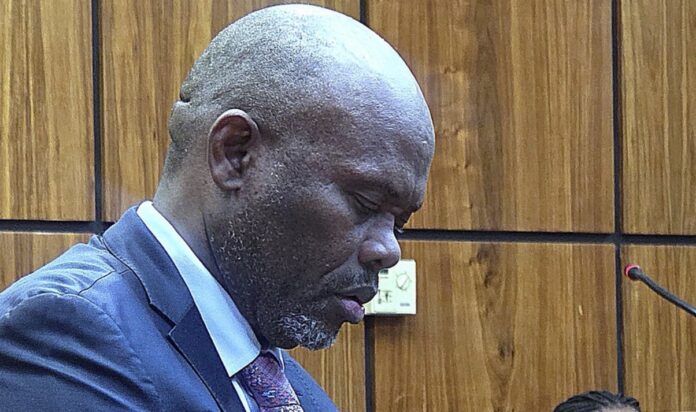
The bail hearing of suspended deputy national police commissioner General Shadrack Sibiya continued in the Randburg Magistrates’ Court on Thursday, with the State detailing allegations of sexual grooming involving a 16-year-old girl, and the events surrounding separate allegations of trafficking and rape.
The State is opposing bail, arguing that the seriousness of the charges, possible witness-related risks, a possible risk of escape and the ongoing investigation weigh against Sibiya’s release.
Sibiya faces five charges: three relating to the alleged sexual grooming of a child, trafficking in persons, and rape. He denies the allegations and intends to plead not guilty.
Investigating officer Detective Sergeant Nokukhanya Ndlovu told the court that the allegations involving the 16-year-old – identified in court papers as ZM, came to light after her father, referred to as Mr M, reported Sibiya’s alleged conduct.
According to Ndlovu’s affidavit, Mr M worked as Sibiya’s bodyguard and provided Sibiya with his daughter’s contact details on 18 July 2026 after asking him to assist with fetching her.
READ: Setumo Stone | How Sibiya’s affidavit puts ‘Mr M’ at the heart of the state’s case
The State alleges that Sibiya subsequently began communicating privately with ZM on WhatsApp.
Ndlovu says the communications began on July 20 and were sexual in nature. The investigating officer alleges that Sibiya initiated a WhatsApp conversation with the teenager at 5.16pm and manipulated her into telling him that she liked him.
Ndlovu said the allegation would ultimately be tested during the trial.
Later that evening, according to the affidavit, Sibiya spoke to the teenager on a WhatsApp voice call lasting approximately 51 minutes.
During the call, Sibiya allegedly asked whether she was sexually active and told her to preserve herself for him rather than engage sexually with anyone else. Ndlovu further alleges that Sibiya instructed the teenager not to disclose their communications.
Alleged requests for intimate photographs
The investigating officer told the court that Sibiya allegedly requested intimate photographs from the teenager, including a photograph of her private parts. Ndlovu also alleges that Sibiya shared more than 10 intimate photographs with the teenager without her having sent them to him. According to the affidavit, the photographs had been stored on the teenager’s phone.
Ndlovu says the teenager believed the photographs had been obtained or accessed without her knowledge. She allegedly questioned Sibiya about how he had obtained the images but did not receive an explanation. According to the affidavit, the teenager became frightened and stopped communicating with Sibiya.
Alleged masturbation video
The State alleges that communication resumed several days later. According to Ndlovu, Sibiya contacted ZM shortly before midnight on July 23 and reminded her about something she had previously promised.
The investigating officer says the exchange culminated in ZM sending Sibiya a video of herself masturbating.
The video was approximately four minutes and 55 seconds long, according to Ndlovu. The court heard that Sibiya responded to the video by describing it as “amazing”.
Ndlovu further detailed messages in which Sibiya allegedly indicated that he had repeatedly watched the video, asked for more and asked whether the teenager was deleting their messages.
The State alleges that the WhatsApp exchanges form part of the evidence supporting the three sexual grooming-related charges.
The allegations have not been tested at trial.
State details events at The Grand
The State also led evidence concerning three women who allegedly ended up at The Grand in Sandton. The evidence relates to the trafficking and rape charges against Sibiya.
According to witness statements, Sibiya addressed the women at the hotel and introduced a drinking game known as “dare or double-dare”. The women allegedly participated in the drinking activity before the group went to The Grand.
The State alleges that the women were then plied with alcohol at the venue and asked to dance and twerk. When one of the women allegedly did not participate, she was given further alcohol.
According to the witness statements, the drinking continued until one of the women passed out. The women were subsequently taken back to the hotel, the court heard. The State also led evidence concerning a conversation about the virginity of one of the women.
The State alleges that these events form part of the circumstances surrounding the trafficking and rape charges. Sibiya denies the allegations.
Recording involving Bishop Maumela
The State also played a recording involving Bishop Maumela and Mr M. According to the State, Maumela called Mr M and asked to speak to the person who had opened a case against Sibiya. The recording was played in the context of the State’s concerns about contact with people connected to its case.
READ: Sibiya’s friend Bishop Maumela withdraws his conspiracy claims
The State is relying on the recording as part of its evidence concerning possible witness interference. The defence has disputed allegations that Sibiya or members of his family attempted to interfere with witnesses.
Sibiya’s legal team also introduced an affidavit from a police officer concerning Mr M, the father of the 16-year-old. The affidavit was read into the record by the defence, including Sibiya’s lawyer, Advocate Estelle Kilian.
According to the affidavit, Mr M showed the police officer a video involving his daughter and sexual activity. The officer described the contents of the video as disturbing.
The affidavit also deals with an intimidation case allegedly opened against the officer by Mr M. The officer disputes Mr M’s version and states that he was himself intimidated and threatened by Mr M. The defence is relying on the affidavit to challenge aspects of the evidence concerning Mr M and the circumstances surrounding witnesses.
The contents of the affidavit remain allegations and have not been tested through cross-examination.
Affidavit from Sibiya’s son
Earlier in the proceedings, the defence also placed an affidavit from Sibiya’s adult son before court concerning Bishop Maumela’s alleged contact with a person linked to the State’s case.
The son said Sibiya was already in custody when Maumela arrived at the family residence on the evening of September 21.
According to his affidavit, Maumela later told him that he had spoken to the complainant but had obtained no information. The son stated that he had not instructed Maumela to contact, threaten or influence any witness.
He also said he had never witnessed his father instructing Maumela or anyone else to threaten, intimidate or influence a complainant or witness. The defence maintains that any contact by Maumela was his own conduct and was not authorised by Sibiya or his family.
Defence withdraws search-warrant affidavits
The defence withdrew affidavits filed in connection with the search warrants from consideration in the bail proceedings. The material related to the defence’s challenge to the validity of the warrants and the searches and seizures conducted pursuant to them.
The State had objected to the late introduction of the documents, arguing that it had not been afforded sufficient time to consider the material and respond. The defence subsequently elected not to rely on the affidavits at that stage of the bail application.
The defence also raised a separate firearm-related matter concerning a firearm allegedly seized during Sibiya’s arrest. Advocate Rashaad Moosa told the court that a docket had been opened and that the defence had been asked to provide a warning statement.
Moosa said the defence required time to obtain full instructions. The magistrate clarified that the matter could not be described as a pending criminal case if Sibiya had not been charged. It remained a docket under investigation.
Sibiya’s lawyers’ correspondence with NDPP
A significant part of the proceedings concerned correspondence between Sibiya’s legal team and prosecution officials before his arrest. The state questioned Moosa about whether Sibiya and his lawyers knew that criminal charges were being contemplated before his arrest.
ALSO READ: Sibiya’s motives behind NDPP correspondence questioned by NPA in bail application
The prosecutor put it to Moosa that Sibiya had already been alerted to looming charges and that correspondence from his legal team was aimed at establishing what authorities knew.
He said that if Sibiya had been informed of specific allegations, he would have brought them to his lawyers’ attention. Moosa said the correspondence had several purposes, including seeking clarity, offering cooperation and addressing concerns about the possibility of a media spectacle surrounding Sibiya’s arrest.
The state questioned whether the correspondence amounted to an attempt to prevent Sibiya’s arrest. Moosa rejected that interpretation, saying the State was conflating avoiding a public spectacle with avoiding arrest.
He said Sibiya had chosen not to flee and wanted to deal with the situation “head-on”. The state also questioned why the defence had approached the National Prosecuting Authority about whether any criminal complaint or charge existed against Sibiya.
Moosa acknowledged that some correspondence used broad wording but said it was intended to obtain clarity and facilitate cooperation.
State argues risks to Sibiya’s release
The state argued that there were no bail conditions that would adequately address the risks it says are presented by Sibiya’s release. The prosecution pointed to the seriousness of the charges, including sexual grooming of a child, trafficking in persons and rape.
The state also raised concerns about a possible risk of escape. The prosecution argued that Sibiya, given his position within the police service, should have known better and understood the consequences of the conduct alleged against him.
The state further told the court that the investigation remains ongoing. It argued that releasing Sibiya while investigations continue could create risks that could not adequately be managed through bail conditions.
Sibiya’s affidavit states that he is not a flight risk, has strong family and occupational ties to South Africa and is willing to surrender his passport and comply with reporting conditions, and has offered R20,000 bail.
Bail hearing adjourned
After hearing the evidence and arguments, Magistrate Hleziphi Mkhasibe adjourned the bail proceedings. The matter will resume on Friday, when the defence is expected to continue its cross-examination of investigating officer Detective Sergeant Nokukhanya Ndlovu.
Ndlovu’s evidence will be tested further when proceedings resume.
Sibiya remains in custody pending the continuation of his bail application.
- Suspended deputy national police commissioner General Shadrack Sibiya faces five charges: three related to sexual grooming of a 16-year-old, trafficking in persons, and rape, which he denies.
- The State alleges that Sibiya groomed the teenager via WhatsApp, including requesting intimate photos and receiving a video of her masturbating.
- Evidence was led concerning three women at The Grand hotel in Sandton, involving a drinking game, alcohol consumption, and circumstances linked to trafficking and rape charges.
- The State presented a recording involving Bishop Maumela and Mr M as part of concerns over possible witness interference, which the defence disputes.
- The bail hearing was adjourned, with Sibiya remaining in custody as his bail application continues, and the defence will further cross-examine detective Sergeant Nokukhanya Ndlovu.
The bail hearing of suspended deputy national police commissioner General Shadrack Sibiya continued in the Randburg Magistrates’ Court on Thursday, with the State detailing allegations of sexual grooming involving a 16-year-old girl, and the events surrounding separate allegations of trafficking and rape.
The State is opposing bail, arguing that the seriousness of the charges, possible witness-related risks, a possible risk of escape and the ongoing investigation weigh against Sibiya’s release.
Sibiya faces five charges: three relating to the alleged sexual grooming of a child, trafficking in persons, and rape. He denies the allegations and intends to plead not guilty.
Investigating officer Detective Sergeant Nokukhanya Ndlovu told the court that the allegations involving the 16-year-old - identified in court papers as ZM, came to light after her father, referred to as Mr M, reported Sibiya’s alleged conduct.
According to Ndlovu’s affidavit, Mr M worked as Sibiya’s bodyguard and provided Sibiya with his daughter’s contact details on 18 July 2026 after asking him to assist with fetching her.
READ: Setumo Stone | How Sibiya's affidavit puts 'Mr M' at the heart of the state's case
The State alleges that Sibiya subsequently began communicating privately with ZM on WhatsApp.
Ndlovu says the communications began on July 20 and were sexual in nature. The investigating officer alleges that Sibiya initiated a WhatsApp conversation with the teenager at 5.16pm and manipulated her into telling him that she liked him.
Ndlovu said the allegation would ultimately be tested during the trial.
Later that evening, according to the affidavit, Sibiya spoke to the teenager on a WhatsApp voice call lasting approximately 51 minutes.
During the call, Sibiya allegedly asked whether she was sexually active and told her to preserve herself for him rather than engage sexually with anyone else. Ndlovu further alleges that Sibiya instructed the teenager not to disclose their communications.
The investigating officer told the court that Sibiya allegedly requested intimate photographs from the teenager, including a photograph of her private parts. Ndlovu also alleges that Sibiya shared more than 10 intimate photographs with the teenager without her having sent them to him. According to the affidavit, the photographs had been stored on the teenager’s phone.
Ndlovu says the teenager believed the photographs had been obtained or accessed without her knowledge. She allegedly questioned Sibiya about how he had obtained the images but did not receive an explanation. According to the affidavit, the teenager became frightened and stopped communicating with Sibiya.
The State alleges that communication resumed several days later. According to Ndlovu, Sibiya contacted ZM shortly before midnight on July 23 and reminded her about something she had previously promised.
The investigating officer says the exchange culminated in ZM sending Sibiya a video of herself masturbating.
The video was approximately four minutes and 55 seconds long, according to Ndlovu. The court heard that Sibiya responded to the video by describing it as “amazing”.
Ndlovu further detailed messages in which Sibiya allegedly indicated that he had repeatedly watched the video, asked for more and asked whether the teenager was deleting their messages.
The State alleges that the WhatsApp exchanges form part of the evidence supporting the three sexual grooming-related charges.
The allegations have not been tested at trial.
The State also led evidence concerning three women who allegedly ended up at The Grand in Sandton. The evidence relates to the trafficking and rape charges against Sibiya.
According to witness statements, Sibiya addressed the women at the hotel and introduced a drinking game known as “dare or double-dare”. The women allegedly participated in the drinking activity before the group went to The Grand.
The State alleges that the women were then plied with alcohol at the venue and asked to dance and twerk. When one of the women allegedly did not participate, she was given further alcohol.
According to the witness statements, the drinking continued until one of the women passed out. The women were subsequently taken back to the hotel, the court heard. The State also led evidence concerning a conversation about the virginity of one of the women.
The State alleges that these events form part of the circumstances surrounding the trafficking and rape charges. Sibiya denies the allegations.
The State also played a recording involving Bishop Maumela and Mr M. According to the State, Maumela called Mr M and asked to speak to the person who had opened a case against Sibiya. The recording was played in the context of the State’s concerns about contact with people connected to its case.
READ: Sibiya's friend Bishop Maumela withdraws his conspiracy claims
The State is relying on the recording as part of its evidence concerning possible witness interference. The defence has disputed allegations that Sibiya or members of his family attempted to interfere with witnesses.
Sibiya’s legal team also introduced an affidavit from a police officer concerning Mr M, the father of the 16-year-old. The affidavit was read into the record by the defence, including Sibiya’s lawyer, Advocate Estelle Kilian.
According to the affidavit, Mr M showed the police officer a video involving his daughter and sexual activity. The officer described the contents of the video as disturbing.
The affidavit also deals with an intimidation case allegedly opened against the officer by Mr M. The officer disputes Mr M’s version and states that he was himself intimidated and threatened by Mr M. The defence is relying on the affidavit to challenge aspects of the evidence concerning Mr M and the circumstances surrounding witnesses.
The contents of the affidavit remain allegations and have not been tested through cross-examination.
Earlier in the proceedings, the defence also placed an affidavit from Sibiya’s adult son before court concerning Bishop Maumela’s alleged contact with a person linked to the State’s case.
The son said Sibiya was already in custody when Maumela arrived at the family residence on the evening of September 21.
According to his affidavit, Maumela later told him that he had spoken to the complainant but had obtained no information. The son stated that he had not instructed Maumela to contact, threaten or influence any witness.
He also said he had never witnessed his father instructing Maumela or anyone else to threaten, intimidate or influence a complainant or witness. The defence maintains that any contact by Maumela was his own conduct and was not authorised by Sibiya or his family.
The defence withdrew affidavits filed in connection with the search warrants from consideration in the bail proceedings. The material related to the defence’s challenge to the validity of the warrants and the searches and seizures conducted pursuant to them.
The State had objected to the late introduction of the documents, arguing that it had not been afforded sufficient time to consider the material and respond. The defence subsequently elected not to rely on the affidavits at that stage of the bail application.
The defence also raised a separate firearm-related matter concerning a firearm allegedly seized during Sibiya’s arrest. Advocate Rashaad Moosa told the court that a docket had been opened and that the defence had been asked to provide a warning statement.
Moosa said the defence required time to obtain full instructions. The magistrate clarified that the matter could not be described as a pending criminal case if Sibiya had not been charged. It remained a docket under investigation.
A significant part of the proceedings concerned correspondence between Sibiya’s legal team and prosecution officials before his arrest. The state questioned Moosa about whether Sibiya and his lawyers knew that criminal charges were being contemplated before his arrest.
ALSO READ: Sibiya's motives behind NDPP correspondence questioned by NPA in bail application
The prosecutor put it to Moosa that Sibiya had already been alerted to looming charges and that correspondence from his legal team was aimed at establishing what authorities knew.
He said that if Sibiya had been informed of specific allegations, he would have brought them to his lawyers’ attention. Moosa said the correspondence had several purposes, including seeking clarity, offering cooperation and addressing concerns about the possibility of a media spectacle surrounding Sibiya’s arrest.
The state questioned whether the correspondence amounted to an attempt to prevent Sibiya’s arrest. Moosa rejected that interpretation, saying the State was conflating avoiding a public spectacle with avoiding arrest.
He said Sibiya had chosen not to flee and wanted to deal with the situation “head-on”. The state also questioned why the defence had approached the National Prosecuting Authority about whether any criminal complaint or charge existed against Sibiya.
Moosa acknowledged that some correspondence used broad wording but said it was intended to obtain clarity and facilitate cooperation.
The state argued that there were no bail conditions that would adequately address the risks it says are presented by Sibiya’s release. The prosecution pointed to the seriousness of the charges, including sexual grooming of a child, trafficking in persons and rape.
The state also raised concerns about a possible risk of escape. The prosecution argued that Sibiya, given his position within the police service, should have known better and understood the consequences of the conduct alleged against him.
The state further told the court that the investigation remains ongoing. It argued that releasing Sibiya while investigations continue could create risks that could not adequately be managed through bail conditions.
Sibiya’s affidavit states that he is not a flight risk, has strong family and occupational ties to South Africa and is willing to surrender his passport and comply with reporting conditions, and has offered R20,000 bail.
After hearing the evidence and arguments, Magistrate Hleziphi Mkhasibe adjourned the bail proceedings. The matter will resume on Friday, when the defence is expected to continue its cross-examination of investigating officer Detective Sergeant Nokukhanya Ndlovu.
Ndlovu’s evidence will be tested further when proceedings resume.
Sibiya remains in custody pending the continuation of his bail application.


