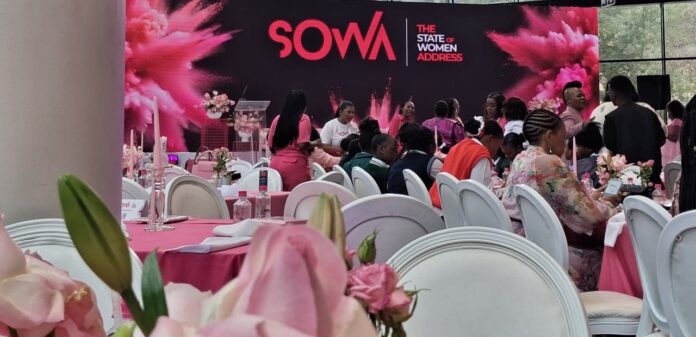
The second edition of the State of Women Address (SOWA), hosted by WomenCan, proved to be more than just a gathering; it was a bold statement. Held this past Saturday at Mercedes-Benz in Sandton, the shades-of-pink-themed event brought together women from all walks of life to reflect on, amplify, and advance the voices, experiences, and impact of women across South Africa.
According to Tumi Mthembu, Founder of WomenCan and CEO of Envision Brand, this year’s edition arrived “bolder, stronger, and hungry for stronger things”. The atmosphere carried that energy from the moment attendees stepped through the doors, each welcomed with a single rose, a gesture meant to honour femininity. The pink palette was deliberately chosen to speak to feminine energies and softness, but the conversations that followed were anything but soft.
What distinguished the sea of pink were the high school girls in their school uniforms, sitting quietly among the prominent speakers, listening, absorbing, and witnessing a space where their futures were being discussed with urgency.
Collaboration powers gathering
WomenCan emphasised that the event was powered by collaboration. Sponsors and partners played a vital role in making SOWA possible, reflecting the collective spirit required to advance women’s affairs. The day was designed to foster dialogue, empower attendees with insights from inspiring leaders, and reshape societal narratives around gender roles and challenges.
As the organisers put it, “By uniting voices from across genders, we create a platform for transformative dialogue and actionable solutions.”
Direction and voice
The event was directed by Nompumelelo Mkhatshwa, a former student leader and FeesMustFall activist who later served as a member of the National Assembly for the ANC. Reflecting on her journey, Mkhatshwa noted that she had been the youngest member of parliament and had sat in boardrooms where progress was consistently hindered by gender. Her presence at the helm of SOWA was a signal of a bridge for generations, from student activism to legislative experience, anchoring the day in a legacy of struggle and a vision for transformation.
Panel discussions: from healing to economic justice
SOWA structured its programme around four central themes, each featuring a balanced mix of voices, including men who are active allies and changemakers.
Healing broken wounds
This panel tackled the invisible weight women carry shaped by systemic inequality, societal pressure, and gendered trauma. Facilitated by media entrepreneur Olwethu Njeleza‑Leshabane, the discussion featured counselling psychologist Bianca van der Walt, businesswoman and media personality Dineo Ranaka, author and entrepreneur Bongani Luvalo (founder of the Cool Dads Foundation), and podcaster and businessman Promise Makunyane.
The conversation moved beyond theory into raw, lived experience. Dineo Ranaka, who has done much of her healing in the public eye, delivered a stark observation: “Men eat all excuses and women do not.” She urged women to “get off the truck”, a metaphor for stepping away from self-sabotage and the weight of unspoken expectations.
Bongani Luvalo brought a male perspective, asking a critical question that resonated across the room, “Am I doing this solely because I’m hired to do it, or because I enjoy it?” He encouraged attendees to be okay with not liking something simply because it is expected, not because of trauma or obligation.
A recurring thread in the session was the question, “Does a woman have to identify with all the roles society has wanted her to?” The panel’s collective answer was a echoing NO.
The economics of equality
Economic empowerment was framed not as a side issue but as a key driver of gender equality, a catalyst for progress and a measure of success. The panel, which included Lerato Sebata (CEO of RIO Group), Teboho Mosoeu (CEO of Seeder Invest), Akhona Mosiane (managing director of GardenRouteMan), and Amanda-John Ncube (Head of the Old Mutual Black Distributors Trust), explored the persistent gender wealth gap and what true economic equality looks like for women in South Africa.
A powerful line emerged from the discussion: “Women must be allowed to rest in order to lead.” The panelists stressed that sustainable leadership requires structural support, not just individualism.
The great breakup
The panel addressed a phenomenon that has quietly reshaped corporate South Africa – women leaders leaving organisations at record rates. Khadijah Mia (global empowerment advocate), Nomzamo Moalusi (marketing and communications manager at Primedia Outdoor), Motshedisi Silindane (The Corporate Heart Guide), and Fikile Mokoena (social performance specialist) unpacked the root causes behind the trend.
Real stories gave weight to the statistics. One of the panelists, Khadijah Mia, shared her experience of returning from pregnancy leave at the peak of her career. A half-day arrangement gradually turned into a full-day workload, and she was eventually shifted to part-time. The discussion highlighted how workplaces often lack humanity, how invisible labour goes unrecognised, and how safety – both physical and psychological – remains compromised.
The panel noted that COVID-19 worsoned these dynamics, but the underlying pattern predates the pandemic. A key insight was that femininity itself is often treated as a weakness, whereas it should be recognised as a strength. The conversation called for policies that accommodate women during times of physical vulnerability, including menstruation and pregnancy, and for a fundamental reimagining of workplace culture.
Reimagining power structures
The final theme turned to political and public-sector representation. Statistics presented showed that women in South Africa are outperforming many of their global counterparts in senior and middle management, yet they still hold less than 30% of executive roles. The panel acknowledged that while there is a pipeline issue, the real challenge lies in breaking what was described as a “broken rung” that prevents women from ascending to the highest levels of power.
The discussion extended to women in the public sector and politics. An example was cited of a woman named Popi who had been elected as a leader, yet the panel noted a familiar tension: policies exist, but change on the ground is not reflected. One speaker emphasised that “a lift needs to be sent down”, a call for women who have broken through to actively pull others up rather than treating their success as an individual achievement.
Questions of access, power, and who is still waiting for a seat at the table dominated the conversation. The panel called for innovative, fresher ideas to reshape economic and political structures, moving beyond tokenism to genuine inclusion.
A call for action, not just conversation
Throughout the day, one phrase echoed across sessions: “Nothing for us without us.” The presence of young girls in uniform served as a reminder that the work being discussed is intergenerational.
From the healing wounds conversation to the economics of equality; from the Great Breakup to reimagining power, SOWA 2026 made clear that celebrating women’s resilience and celebrating women’s achievements must go hand in hand with confronting the structures that continue to hold them back.
Standing in from of the pink queens, one of the school girls said she is grateful she got to attend, saying here takeaway was, “never underestimate your capabilities”.
- The second State of Women Address (SOWA), hosted by WomenCan in Sandton, focused on empowering South African women through dialogue on gender roles, economic justice, healing, and leadership.
- High school girls attended alongside prominent speakers, emphasizing intergenerational engagement and the urgency of addressing women's futures.
- Four panel discussions tackled key issues: healing from gendered trauma, economic equality as a driver of gender justice, the increasing exit of women from corporate roles due to unsupportive workplaces, and the need to break barriers to women's leadership in business and politics.
- The event highlighted the importance of structural change over individual effort, calling for inclusive policies that recognize femininity as strength and the need for women leaders to uplift others.
- The overarching message was a call for action and collaboration under the rallying cry "Nothing for us without us," combining celebration of achievements with confronting systemic barriers.
What distinguished the sea of pink were the high school girls in their school uniforms, sitting quietly among the prominent speakers, ing, absorbing, and witnessing a space where their futures were being discussed with urgency.
WomenCan emphasised that the event was powered by collaboration. Sponsors and partners played a vital role in making SOWA possible, reflecting the collective spirit required to advance women’s affairs.
As the organisers put it, “By uniting voices from across genders, we create a platform for transformative dialogue and actionable solutions.”
SOWA structured its programme around four central themes, each featuring a balanced mix of voices, including men who are active allies and changemakers.
A recurring thread in the session was the question, "Does a woman have to identify with all the roles society has wanted her to?"
Economic empowerment was framed not as a side issue but as a key driver of gender equality, a catalyst for progress and a measure of success.
A powerful line emerged from the discussion: “Women must be allowed to rest in order to lead.”
Real stories gave weight to the statistics. One of the panelists,
Questions of access, power, and who is still waiting for a seat at the table dominated the conversation.
From the healing wounds conversation to the economics of equality; from the Great Breakup to reimagining power, SOWA 2026 made clear that celebrating women’s resilience and celebrating women’s achievements must go hand in hand with confronting the structures that continue to hold them back.