


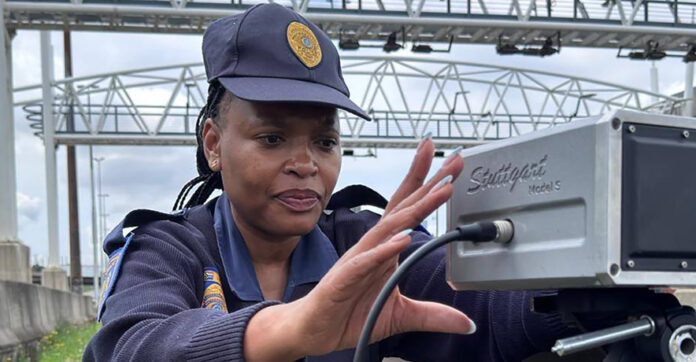
The City of Johannesburg (COJ) is bleeding millions in revenue while scrambling to restore its speed enforcement systems on the roads and keep idling metro police officers engaged in visibility operations to curb lawlessness.
The collapse of services came after private contractor Syntell removed all camera infrastructure when its contract expired four months ago, leaving automated traffic policing offline, costing the city an estimated R17-million in lost revenue. Johannesburg Metro Police Department (JMPD) spokesperson, superintendent Xolani Fihla confirmed to Sunday World that a process was underway to review and appoint a new service provider through the official supply hain management process.
“The contract was not terminated; it reached its end-of-term date…since the contract expired in December 2025, the third-party provider removed their resources and systems.
“Consequently, the previous infrastructure is not currently active for JMPD enforcement until the new procurement process is finalised,” Fihla said.
The COJ has historically outsourced speed cameras and the back-office infrastructure for processing fines, as it does not have the capacity to manage those operations in-house.
Syntell’s services also included the management of the stationary cameras planted across the city. Through a “service-lease” model, the COJ paid the service provider for the use of its hardware, as well as maintenance thereof. Fihla acknowledged that this system has not been without its challenges.
“A key lesson from this contract’s end is that not owning the equipment is a disadvantage. In the future, the city’s strategy is to procure and own its equipment. This ensures that service providers do not hold the city hostage, and it maintains operational continuity when contracts end,” Fihla said.
The three-year contract between JMPD and Syntell was concluded under the helm of the then member of the mayoral committee (MMC) for public safety, the now late David Tembe, and came into effect in December 2022.
At the time, the city had not been able to issue speeding tickets since May 2021, with a calculated revenue loss of about R36-million. Estimates suggest that the COJ used to rake in about R50-million in revenue per annum from speeding fines – an exercise that has since been impeded by this latest setback.
According to Fihla, officers who were previously assigned camera-related duties have been redeployed to roadside checkpoints, crime prevention patrols and traffic management “to ensure there is no vacuum in authority”.
However, insiders at JMPD told Sunday World that while many metro police officers are deployed at various depots, others loiter at the head office, as they cannot be deployed to oversee the speeding violations.
“Since the speed cameras were removed from us by Syntell, many officers have also resorted to setting up illegal roadblocks across the City of Johannesburg to extort money from unsuspecting motorists… most of the speed camera teams are now deployed at various depots and at the head office doing nothing,” said the insider within the JMPD.
The DA’s shadow public safety MMC in the COJ, Solomon Maila, expressed concern that the JMPD has failed to ensure effective speed law enforcement on public roads across the city.
“It is mind-boggling that the department has allowed the Syntell contract to lapse on 23 December 2025 and took no steps to ensure that a new procurement process was set in motion in keeping with the city’s supply chain management policy and the relevant Municipal Finance Management Act regulations.
This apparent dereliction of duty on the part of MMC Mgcini Tshwaku, who has since resigned from the city, confirms his unsuitability for the job in the first place.”
Maila called on city manager Floyd Brink to accelerate the resolution of this issue so the JMPD can carry out its traffic-policing duties according to section 64 of the SAPS Amendment Act 83 of 1998.
Fihla acknowledged that automated enforcement is a significant revenue stream for the city. However, he also emphasised that the JMPD’s primary goal is public safety, not just revenue collection.
The COJ and JMPD reportedly lost about R17-million in revenue since Syntell’s removal of the speed cameras in December.
Tshwaku and the newly appointed MMC, Moshe Koma, did not respond to detailed questions sent to them. Syntell’s CEO Hannu Ehlers did not respond to the questions sent to him at the time of going to print.
- The City of Johannesburg has lost an estimated R17 million in revenue after private contractor Syntell removed all speed camera infrastructure when its contract expired in December 2025.
- The city's automated traffic enforcement system has been offline since then, as a new service provider has yet to be appointed through the official procurement process.
- Previously outsourced speed cameras and fine processing were operated under a service-lease model, but the city plans to purchase and own its equipment in future to maintain operational continuity.
- Some metro police officers have been redeployed to visibility and crime prevention duties, but insider reports suggest many are idle or involved in illegal roadblocks extorting motorists.
- Opposition and insiders criticize the previous MMC for public safety for failing to initiate timely procurement processes, calling on the city manager to quickly resolve the issue to restore proper traffic law enforcement.


