
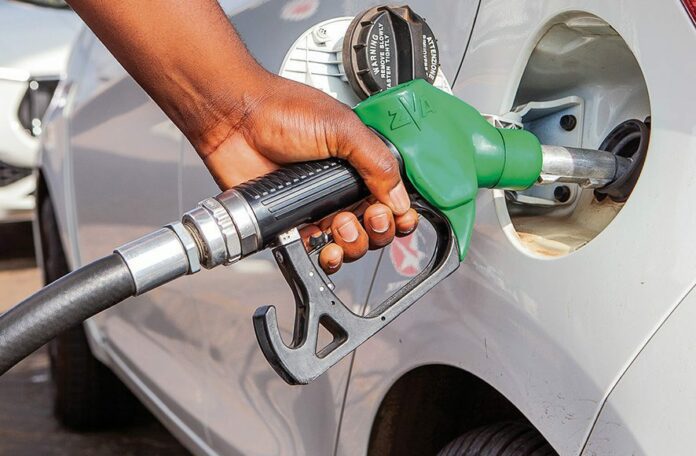

The government has announced a sharp increase in the price of illuminating paraffin, with a hefty rise of R11.67 on Wednesday. Low-income households generally use the fuel for cooking.
The illuminating paraffin price increase comes after Finance Minister Enoch Godongwana and Minerals and Petroleum Minister Enoch Godongwana announced in a joint statement that the fuel levy will temporarily drop by R3.
Petrol up by R3.06, diesel by R7.37 per litre
Mantashe also announced that Unleaded 93 and 95 petrol will increase by R3.06, while diesel 0.0005% sulphur goes up by R7.37 and diesel 0.05% increases by R7.51.
“This will reduce the general fuel levy for petrol from R4.10 to R1.10 per litre and reduce the general fuel levy for diesel from R3.93 to R0.93 per litre for one month. These amounts exclude other levies such as the Road Accident Fund Levy and the Carbon Fuel Levy,” the statement read.
‘Global oil markets are behind sharp increases’
Mantashe explained that global oil markets are largely behind the sharp increases. The average Brent crude oil price climbed from $69.08 to $93.67 during the period under review, mainly due to the war between the United States and Iran.
This has disrupted oil supply routes, particularly through the Strait of Hormuz, pushing up international fuel prices and shipping costs.
Domestic factors have also contributed
Mantashe added that the Rand depreciated from R16.00 to R16.64 against the US dollar, making imported fuel more expensive and adding to local price increases.
Domestic factors have also contributed, including adjustments announced in the February budget, with higher fuel, Road Accident Fund and carbon fuel levies, all of which raise the final price of fuel.
- The government announced a sharp increase of R11.67 in the price of illuminating paraffin, affecting low-income households.
- Despite the paraffin price hike, the fuel levy will temporarily drop by R3 to partially offset rising fuel costs.
- Unleaded 93 and 95 petrol prices will increase by R3.06 per litre, while diesel prices rise by R7.37 to R7.51 per litre.
- The price increases are driven by global factors, including a rise in Brent crude oil prices due to geopolitical tensions between the US and Iran disrupting supply routes.
- Domestic factors such as Rand depreciation and earlier budget decisions on fuel levies and taxes have also contributed to higher fuel prices.
“
Domestic factors have also contributed, including adjustments announced in the February budget, with higher fuel, Road Accident