


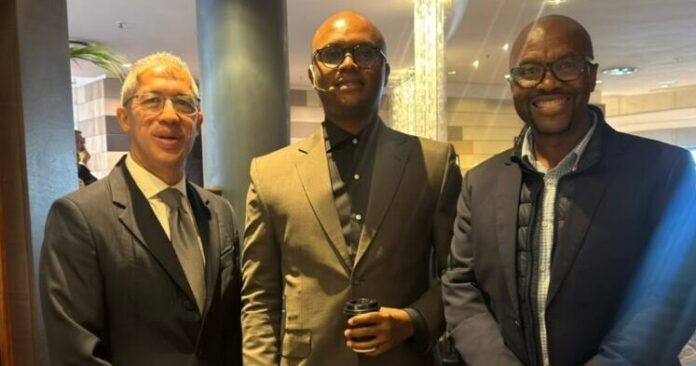
Communications and Digital Technologies Minister Solly Malatsi says South Africa’s communications and digital technology sector is the bedrock and carrier of numerous other industries, enabling opportunities across several sectors.
Malatsi was speaking at “Reimagining Sunday World”, an event to formally reintroduce Cape Town’s thought leaders to the publication under the new ownership of veteran journalist John Bailey.
Sunday World now publishes a special edition of the newspaper for its readers in the Western Cape.
Drive towards sensationalism
Juanita Clark, co-founder and chief executive of the Digital Council Africa, an independent association that serves as a bridge between governments, the technology industry, and stakeholders across the continent, also hosted a fireside chat with Malatsi.
Clark later chaired a panel discussion on “AI, Media, Marketing, Communication and Digital Disruption: Reinventing How Brands Connect in the Age of Intelligence” with Sandile Dube, Abongile Mashele-Head, Thabo Makenete, and Zunaid Mahomed.
Malatsi said that for the communications and digital technologies sector, it was not only important to get its house in order but also to be visionary in terms of interventions to boost the sector.
“What has happened in the shift towards digital media news consumption, unfortunately, is it has imposed on a lot of newsrooms a drive towards sensationalism and clickbait because that’s what drives audiences.
“The misconception is the belief that sensationalism is what attracts readers; it’s what attracts businesses because they look at the audience numbers,” said Malatsi.
There was room, he said, for more substantive, credible news and more informative content, according to the minister.
Bailey, Malatsi said, had been very clear about steering the Sunday World as an authoritative voice in developing stories because there was currently a gap in the market.
Credibility and integrity
Bailey, the chief executive and publisher of the Sunday World, said he and his team have had great fun since the takeover.
“We’ve gone through a complete turnaround strategy from where the publication was, and I’m very deliberate when I say publication. I don’t say ‘a newspaper’, because we need to be mindful that content is being consumed very differently,” said Bailey.
He emphasised that content, whether it be on TV, radio, or in print, had to serve the needs of the audience.
But, importantly for us, it also concerns issues of credibility and integrity. Having been in the industry for more than 30 years, with integrity and credibility in mind, I attach it to the publication.
“So if anything goes wrong with my integrity, it has a direct impact on the publication.”
He said it was important for the media to “hold the line” and keep those in power accountable.
Bailey also emphasised that Sunday World would, for the foreseeable future, not be behind a paywall.
“We want to make sure that we give our advertisers and those who contribute to us as wide a reach as possible.
“It was critical that we were able to tell our story through these different platforms that we have,” said Bailey.
Digital infrastructure
During the panel discussion, the representatives from Meta, Google, Equinix, and Maziv explained how their companies were working alongside the government and the business sector to expand digital infrastructure and the adoption of artificial intelligence.
The panellists also addressed concerns about misinformation, cybersecurity, regulation, and the risk of widening inequality in the digital economy.
Dube, the Southern African MD of Equinox, which is one of the largest data centre operators in the world, said AI had fundamentally shifted the landscape and had become increasingly important for economic growth.
“For this reason, we have to embrace it. We have to understand what the opportunities are that they bring about,” said Dube.
On the global criticism of data centres, particularly their energy consumption, Dube said maintaining the balance as a sector would come about through innovation like renewable energy and advanced cooling methodologies.
- South Africa’s communications and digital technology sector is crucial for enabling opportunities across various industries, as emphasized by Communications Minister Solly Malatsi.
- Malatsi criticized the trend of sensationalism and clickbait in digital media, advocating for more credible, substantive news content, a gap that Sunday World under new owner John Bailey aims to fill.
- John Bailey highlighted a major turnaround for Sunday World, focusing on integrity, credibility, and accessibility by avoiding paywalls to maximize reach and advertiser value.
- Industry leaders from Meta, Google, Equinix, and Maziv discussed collaboration with government to expand digital infrastructure, promote AI adoption, and tackle issues like misinformation, cybersecurity, and digital inequality.
- Equinix’s MD Sandile Dube stressed the importance of embracing AI for economic growth and addressing environmental concerns of data centers through innovation such as renewable energy and advanced cooling.


