


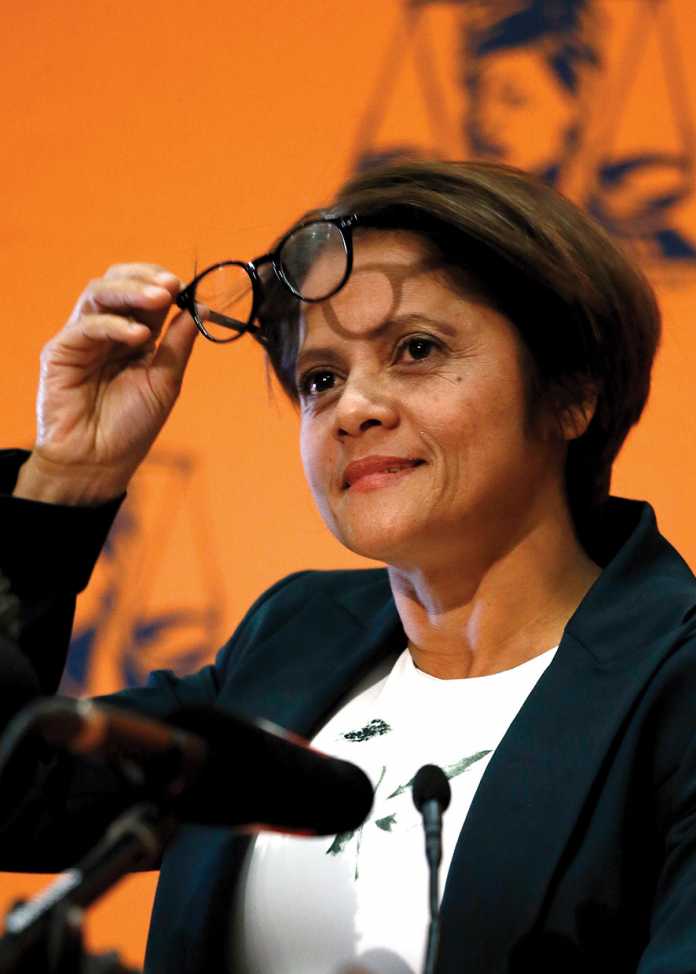
In his objection to Advocate Hermione Cronje’s candidacy for the position of South Africa’s National Director of Public Prosecutions (NDPP), lawyer Barnabas Xulu presented evidence from email correspondence that includes a troubling directive to “tamper with the language”.
This instruction is central to the allegations that Cronje unlawfully shared confidential state information with a fellow advocate, Nasreen Bawa SC, actions that purportedly wasted millions in public funds and delayed a significant international anti-corruption initiative for six years.
The allegations, contained in a formal objection lodged by Xulu but seemingly never reaching Cronje during the NDPP interviews, centre on her alleged conduct in March 2020 while she headed the National Prosecuting Authority’s (NPA) Investigating Directorate (ID).
Conduit in a hostile litigation
Xulu alleges Cronje acted as a conduit, funnelling internal NPA memoranda to her friend and fellow Cape Bar advocate, Bawa, who was then representing the Department of Forestry, Fisheries and the Environment in hostile litigation against Xulu’s firm.
The core of the objection hinges on a chain of emails that Xulu claims demonstrate a covert collaboration to undermine the NPA’s own position in the long-running ‘Bengis matter’. This case, concerning the forfeiture of millions of dollars from a convicted fisheries magnate, was meant to fund anti-corruption projects in South Africa’s fishing sector.
According to the objection, the scheme began on March 9, 2020. Bawa sent an email from her personal address to Cronje’s private Cape Bar account. The email contained suggested questions about the Bengis case, purportedly for the NPA’s Advocate Sibongile Mzinyathi to ask an NPA colleague. A critical line from Bawa instructed Cronje: “You may want to tamper with the language so it seems more internal.”
Trail of questions that were sent verbatim
Two days later, on March 11, 2020, the contents of this email were forwarded from Cronje’s private account to her official NPA address and to Mzinyathi. The questions were then sent, almost verbatim, to an NPA official and to Xulu’s firm, BXI, which was assisting the state. Xulu’s team, believing they were legitimately helping the NPA, provided comprehensive answers.
However, the objection states: “It appears that the information provided was once more leaked from Adv. Cronje to Adv. Bawa SC, who on 25 March 2020 used the same to launch an application to set aside the Bengis order.
“This application, argues Xulu, was directly contrary to an internal NPA memorandum dated March 30, 2020 — which Cronje would have seen — that concluded the original Bengis settlement was “rational and a significant recovery for South Africa.”
Xulu states the resulting litigation “has remained pending over the past 5 years and has been executed at significant cost to the State”. This while also causing the “failure of the NPA and the Department to implement the Bengis Funds Projects over the last 6 years, in contravention of South Africa’s international obligations”. Funds meant for fisheries anti-corruption work remain frozen in a state account.
Pattern of undermining law enforcement
The objection further seeks to link Cronje’s actions to a broader pattern of undermining law enforcement at the fisheries department. It notes that Bawa, as the department’s counsel, contacted the NPA to ask if there were investigations against a former official, Michael Mlengana, and was told there were none. This is a statement Xulu calls an “overt untruth”, as Mlengana was later arrested on charges related to a report BXI had compiled.
Xulu submits that evidence suggests Cronje “caused internal NPA information to be circulated to external litigants outside of authorised communication channels” and “caused her colleagues and BXI to provide answers to questions originating from third parties under the guise of the same being requested by the NDPP, only for the information to be used to bolster the litigation efforts of her friend and colleague at the Cape Bar.”
Xulu argues that Cronje’s alleged conduct contravenes constitutional requirements for independence and ethical administration. As well as the NPA Act, which prohibits interference and the unlawful disclosure of confidential information.
“The person appointed as NDPP must exhibit qualities that safeguard the independence of the prosecuting authority,” the objection reads.
Credibility of the process questioned
In a subsequent letter dated December 14, Xulu demanded the advisory panel withdraw its report to President Cyril Ramaphosa, citing “gross irregularities”. He claims Cronje was not given his December 4 objection before her December 11 interview, preventing her from responding, which “tainted the credibility of the process.” The panel’s conduct, he wrote, means its report “cannot stand legal muster.”
When the allegations concerning the email and her conduct were previously raised with her directly and before a Parliamentary Section 194 enquiry, Bawa did not directly deny them, according to Xulu’s objection. Her responses focused on challenging the authenticity of the evidence and her understanding of the complaint.
She is recorded as stating: “It’s been so illegible that I’m not able to confirm whether it is indeed a communication that passed between myself and Advocate Cronje and, for that reason, dispute the authenticity thereof.”
In a further response, she said: “I have not been able to find the email ostensibly sent to Advocate Cronje in my sent items in order to be able to verify the authenticity of the contents thereof. But at the level of principle, I fail to understand the nature of the complaint. I do recall that there were times when emails were sent to Advocate Cronje’s Cape Bar address. In fact, I have found others due to email difficulties with the NPA server.”
Conflict in knowledge of department’s affairs
The objection details that prior to leading the NPA’s Investigating Directorate, Cronje was a member of the Cape Bar from 2012 to 2019. During this period, she acted as counsel for the Department of Agriculture, Forestry and Fisheries (DAFF) in the Bengis matter before the Western Cape High Court.
In that 2016 litigation, she defended the authority of the department’s appointed officials to represent South Africa in related US proceedings. This professional history is presented as foundational to the later allegations. It suggests that she had established relationships and knowledge of the department’s affairs and the Bengis case years before the alleged 2020 leaks.
- In his objection to Advocate Hermione Cronje’s candidacy for the position of South Africa’s National Director of Public Prosecutions (NDPP), lawyer Barnabas Xulu presented evidence from email correspondence that includes a troubling directive to “tamper with the language”.
- This instruction is central to the allegations that Cronje unlawfully shared confidential state information with a fellow advocate, Nasreen Bawa SC, actions that purportedly wasted millions in public funds and delayed a significant international anti-corruption initiative for six years.
- The allegations, contained in a formal objection lodged by Xulu but seemingly never reaching Cronje during the NDPP interviews, centre on her alleged conduct in March 2020 while she headed the National Prosecuting Authority’s (NPA) Investigating Directorate (ID).
- Conduit in a hostile litigation Xulu alleges Cronje acted as a conduit, funnelling internal NPA memoranda to her friend and fellow Cape Bar advocate, Bawa, who was then representing the Department of Forestry, Fisheries and the Environment in hostile litigation against Xulu’s firm.
- The core of the objection hinges on a chain of emails that Xulu claims demonstrate a covert collaboration to undermine the NPA’s own position in the long-running ‘Bengis matter’.


