


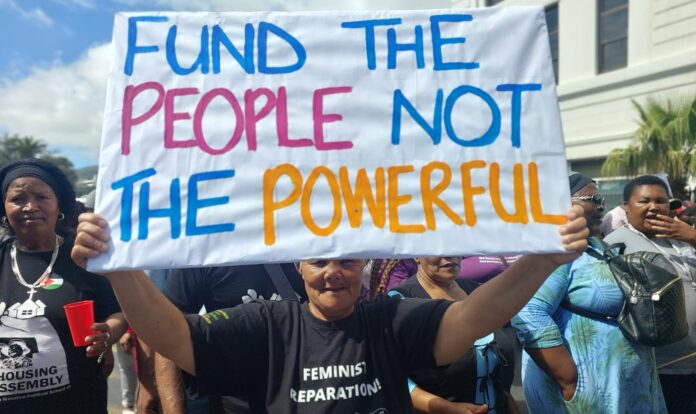
Women farm workers and farm dwellers marched outside parliament in Cape Town on Wednesday morning ahead of Finance Minister Enoch Godongwana’s budget speech, pressing government to introduce a wealth tax on the country’s richest citizens.
The march, led by the Women on Farms Project (WFP), coincided with the tabling of the budget, and sought to amplify calls for a tax on the richest 1% of South Africans to fund redistributive social spending and land reform.
WFP, a non-governmental organisation advocating for the rights of farmwomen, said the budget must confront the structural roots of inequality rather than rely on incremental adjustments.
Direct appeal to Treasury, SARS
Dr Collette Solomon, leader of the civic organisation, said the march was a direct appeal to Treasury and the South African Revenue Service to act decisively.
“Their intergenerational wealth is an untapped tax revenue source that is necessary and just to redress the persistent inequality caused by colonisation, apartheid and racialised capitalism,” Solomon said.
South Africa remains one of the most unequal countries in the world. Research shows that 1% of the population own 55% of the country’s wealth. WFP contrasted this with the reality facing farmwomen, who earn the national minimum wage of R30.23 per hour.
Solomon said the continued coexistence of extreme wealth and working poverty was indefensible. Especially more than three decades into democracy.
“The scale and persistence of such inequality is abhorrent, 32 years after the dawn of democracy,” she said.
Growing public support for campaign
WFP first advanced the demand for a wealth tax in 2022 through its Feminist Reparation Campaign. The project collected 4, 489 signatures. A parallel campaign by Amandla.mobi has since gathered more than 59, 000 signatures. This reflects growing public support for income and wealth redistribution.
While welcoming SARS’ High Wealth Individual Unit, Solomon said enforcement measures alone were insufficient to dismantle entrenched inequality.
“A Wealth Tax will fundamentally address inequality by financing redistributive social spending. Such as a Basic Income Grant and an earmarked budget for land redistribution,” she said.
Research affiliated with Wits University estimates that a wealth tax on the richest 1% could raise between R70-billion and R160-billion a year.
The ground-breaking study by economists Aroop Chatterjee, Léo Czajka and Amory Gethin has laid bare the extreme concentration of wealth in South Africa. And it provided a detailed blueprint for how a national wealth tax could work in practice.
“In a recent paper, we estimated, for the first time, a complete wealth distribution for South Africa. Following international definitions of household wealth and accounting for all forms of assets and debts held by individuals,” states the report, titled, A Wealth Tax for South Africa.
Glaring research findings
Using data from the South African Reserve Bank, household surveys and SARS tax microdata, the researchers constructed a comprehensive picture of who owns what in the country.
Their findings are stark.
“The richest 1% of the South African adult population (350, 000 individuals) own 55% of aggregate personal wealth.” This while the bottom 90% own only 14%. More than half of people in the bottom 90% are in debt. And those who do hold assets own, on average, just R52, 300 in net wealth.
“The study argues that a wealth tax should target only the top 1%. And it must apply marginal rates to wealth above a defined threshold.
“We believe that the tax should therefore cover the top 1% of wealth owners… This ensures that they could easily find sufficient liquidities to pay the tax,” the authors write.
Beyond fairness, the research demonstrates feasibility. With strong third-party reporting from banks, pension funds and asset custodians, the authors contend that implementation is practical and enforceable.
The conclusion is unambiguous: South Africa’s inequality is deeper than that of comparable countries. It has not improved since 1993, and requires bold fiscal intervention. A wealth tax, the study suggests, is not only possible, but essential.
- Women farm workers and farm dwellers marched outside parliament in Cape Town on Wednesday morning ahead of Finance Minister Enoch Godongwana’s budget speech, pressing government to introduce a wealth tax on the country’s richest citizens.
- The march, led by the Women on Farms Project (WFP), coincided with the tabling of the budget, and sought to amplify calls for a tax on the richest 1% of South Africans to fund redistributive social spending and land reform.
- WFP, a non-governmental organisation advocating for the rights of farmwomen, said the budget must confront the structural roots of inequality rather than rely on incremental adjustments.
- Direct appeal to Treasury, SARS Dr Collette Solomon, leader of the civic organisation, said the march was a direct appeal to Treasury and the South African Revenue Service to act decisively.
- “Their intergenerational wealth is an untapped tax revenue source that is necessary and just to redress the persistent inequality caused by colonisation, apartheid and racialised capitalism,” Solomon said.


