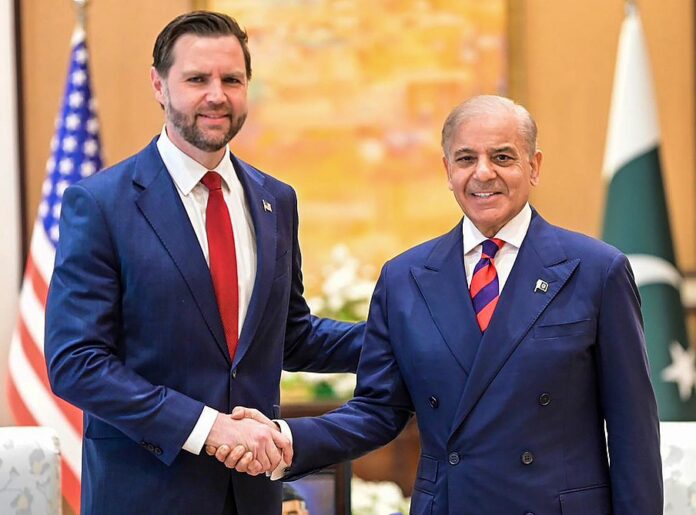

The latest round of peace talks between the US and Iran concluded in Pakistan’s capital early on Sunday without any agreement, exposing deep and persistent divisions on critical issues.
According to Iranian sources, Saturday’s negotiations lasted more than 14 hours.
The Iranian delegation was led by parliament speaker Mohammad Bagher Ghalibaf, while the US team was led by Vice-President JD Vance and included US President Donald Trump’s special envoy Steve Witkoff and son-in-law Jared Kushner.
‘US presented its final and best offer’
After the talks, Vance told media that no agreement was reached, noting that the US had presented its “final and best offer”. He added that discussions were conducted in “good faith”, but the proposal had yet to secure acceptance. The US vice-president also said the key question now is whether Iran is willing to demonstrate sustained intent to refrain from pursuing nuclear capabilities, not only in the immediate term but in the years ahead.
Iran’s semi-official Tasnim news agency also confirmed the end of the negotiations, stressing the US’s excessive demands hindered a common framework and agreement.
Earlier in the day, Iran’s Foreign Ministry spokesperson Esmaeil Baghaei said on X that over the past 24 hours, Iran and the US had discussed key negotiation topics, including the Strait of Hormuz, the nuclear issue, war reparations and the lifting of sanctions. He said the success of this diplomatic process depends on the other side’s seriousness and good faith, and on refraining from maximalist and unlawful demands, while accepting Iran’s rights.
Pakistan’s mediation role
Pakistani Deputy Prime Minister and Foreign Minister Mohammad Ishaq Dar said on Sunday that his country will continue to play a constructive role in facilitating engagement and dialogue between Iran and the United States in the days ahead.
“We hope that the two sides continue with the positive spirit to achieve durable peace and prosperity for the entire region and beyond,” Dar said in a televised message.
Officials from Pakistan facilitated this round of negotiations, hosting both delegations for bilateral meetings before direct face-to-face talks began. Unlike previous rounds held in 2025 and early 2026, this round has adopted a compressed format, with only brief pauses between sessions instead of extended breaks for consultations in respective capitals.
Hormuz Strait control remains highly contentious
A central dispute revolves around control of the Strait of Hormuz, a critical global energy corridor.
Iran has reportedly rejected a US proposal for joint management of the strait, insisting on maintaining full control and asserting its right to regulate transit, including the possibility of levying fees on passing vessels.
Trump, however, stated that the strait constitutes international waters and vowed it would reopen soon and “automatically,” with or without Iran’s cooperation, opposing any Iranian-imposed transit charges.
Iranian military officials Sunday reiterated that Tehran maintains full operational control over the waterway, warning that any attempt by foreign naval vessels to pass without authorization would face a firm response. Meanwhile, the US military Saturday claimed its naval vessels had transited the strait as part of operations targeting maritime threats, a claim denied by Iranian authorities.
Conflicting narratives over frozen assets
Another key point of contention concerns Iranian financial assets held abroad.
Iranian sources indicated that Washington had agreed to unfreeze billions of dollars in Iranian funds, reportedly around $6 billion, held in countries including Qatar. These funds are said to be linked to broader discussions on ensuring safe passage through the Strait of Hormuz.
However, US officials swiftly denied any such agreement, underscoring the lack of convergence on financial confidence-building measures.
Nuclear issue exposes fundamental red lines
Washington has maintained that Iran must abandon uranium enrichment entirely, describing it as a non-negotiable “red line” aimed at preventing Tehran from acquiring nuclear weapons.
Iran, for its part, has insisted on retaining a level of enrichment activity and has called for the lifting of restrictions associated with the International Atomic Energy Agency framework.
Diverging positions shape negotiation dynamics
Iranian officials have emphasized that while Tehran is engaging seriously in the talks, progress depends on what they describe as “realistic” positions from the US side. An Iranian source noted that excessive demands from Washington have hindered substantive breakthroughs.
Iranian President Masoud Pezeshkian, in a phone call with French President Emmanuel Macron on Saturday, said Iran had participated constructively and that the outcome would hinge on US decisions.
On the US side, Trump struck a more ambivalent tone, saying he was “not bothered” whether a deal is reached, while asserting that the United States would prevail regardless of the outcome. He also claimed the US had already achieved military advantages over Iran, remarks likely to complicate the diplomatic atmosphere.
Regional tensions add complexity
The broader regional context continues to weigh on the negotiations. Israeli Prime Minister Benjamin Netanyahu on Saturday reiterated that Israel would continue military operations against Iran and its regional allies, signaling that security concerns extend beyond the negotiating table.
Israeli forces have intensified operations in Lebanon, targeting what they describe as Hezbollah infrastructure, while also indicating that further actions against Iran remain under consideration.
Netanyahu also said that the disarmament of Hezbollah is a prerequisite for any ceasefire agreement with Lebanon.
Lebanon’s Health Ministry said Saturday that Israeli strikes during the latest round of fighting have killed 2,020 people and wounded 6,436 others since hostilities escalated.
- The latest US-Iran peace talks in Islamabad ended without agreement after over 14 hours, revealing deep divisions on nuclear, Hormuz Strait control, sanctions, and reparations.
- The US, led by VP JD Vance, presented its "final and best offer," demanding Iran abandon uranium enrichment, but Iran rejected excessive US demands and insisted on full control of the Strait of Hormuz.
- Pakistan played a key mediation role, hosting negotiations and pledging continued facilitation to promote regional peace and dialogue.
- Major disputes remain over Iran’s frozen assets—Tehran claims billions will be unfrozen, but the US denies any agreement—and Iran’s nuclear program, with Washington insisting on complete enrichment cessation.
- Regional tensions, including Israeli military actions against Iran-linked groups and Lebanon’s conflict, further complicate diplomatic efforts toward a deal.