


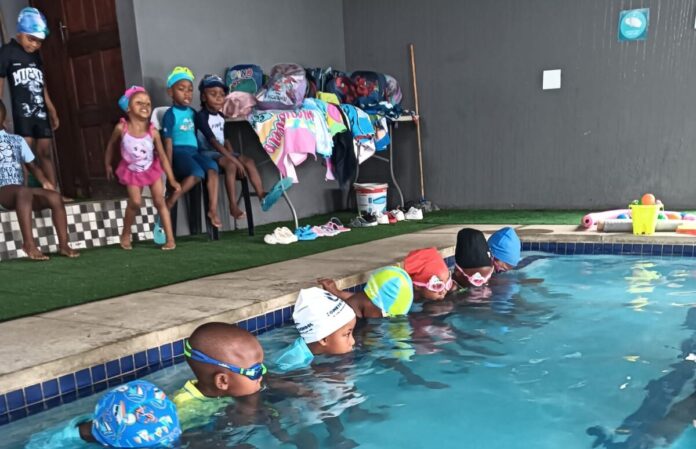
With drowning killing an estimated 1 477 people in South Africa a year, according to the National Sea Rescue Institute, Soweto Swim School has struck a collaboration deal with Los Angeles-based Swim Up Hill Foundation, founded by a decorated US Paralympian with a medal haul that includes a bronze from Tokyo 2020.
The Soweto-based swimming school plans to expand swimming access and water safety education in townships.
The main aim of this collaboration is to address this critical need, as drowning remains the leading cause of accidental death. Jamal Hill has spent the past week on poolside in Soweto, watching children take their first terrified, then triumphant, strokes.
This staggering figure of deaths almost certainly undercounts the true toll. In townships like Soweto, where backyard pools are nonexistent and public facilities are rare, many drowning deaths go entirely unreported.
“Water doesn’t discriminate,” Hill said. “But access to swimming education? That’s a different story.”
The goal is ambitious: teach one million people globally to swim each year. In South Africa, that starts with reaching 10 000 learners by 2027, with two new facilities planned to open over the next two years.
A preventable pandemic
For children under five, drowning is one of the leading causes of accidental death. Curiosity draws them toward water. Lack of awareness and an inability to self-rescue do the rest. In crowded townships, where open water may be a drainage ditch or an unmarked retention pond, the risk is constant.
Tumi Masekela, who co-founded Soweto Swim School with her husband Moses, has seen the consequences firsthand.
“Many township children, including those on the autism spectrum, have never had access to safe swimming facilities,” she said. “We’re not just teaching strokes. We’re giving them a chance to survive.”
The school has spent five years building a modest but heated indoor pool, which, according to them, is a crucial feature in a region where outdoor pools are unusable for months during winter. But capacity has always been the limit. The school believes this partnership and the additional facilities it promises, is an attempt to break that ceiling.
Survival to sport
Hill’s own path to swimming was hardly straightforward. A diagnosis of Charcot-Marie-Tooth disease, a degenerative nerve condition, left him with limited use of his hands and lower legs. He learned to adapt his stroke, competed at the highest level, and now teaches a rapid, culturally relevant method designed specifically for communities that have been ignored by traditional swim programmes.
In the US, Hill’s foundation focuses on the estimated 50 million low-to-middle-income people of colour who cannot swim. In South Africa, the maths are different, but the pattern is the same: swimming has long been treated as a luxury, not a necessity.
“That’s what we’re here to change,” Hill said.
For the Masekelas, the partnership also carries a longer-term vision: identifying talented young swimmers who could one day represent South Africa on the world stage. The country has produced Olympic champions in the pool before. But those champions have rarely, if ever, come from townships.
“This is about saving lives,” Tumi Masekela said. “But it’s also about unlocking potential. And building stronger relations between South Africa and the US through sport – that matters too.”
What lies ahead
Both specify the path will not be easy, as the goal of 10 000 learners by 2027 is contingent on resources that have not yet been secured.
But Hill has learnt to race against odds. And in a dusty corner of Soweto, inside a heated pool that should not exist, children are already learning to float.
“I’m not here to save anyone,” Hill said. “I’m here to teach them how to save themselves.”
- Soweto Swim School in South Africa has partnered with the US-based Swim Up Hill Foundation, founded by Paralympian Jamal Hill, to expand swimming access and water safety education in townships with high drowning rates.
- Drowning kills an estimated 1,477 people annually in South Africa, with many cases unreported, especially in township areas lacking swimming facilities.
- The collaboration aims to teach 10,000 South Africans to swim by 2027 and plans to open two new swimming facilities to address capacity limits and seasonal challenges.
- The initiative focuses not only on survival skills but also on identifying talented township swimmers to potentially compete internationally, promoting sport and cross-cultural ties.
- The project faces funding challenges but aims to empower learners with the ability to save themselves, combating the long-standing view of swimming as a luxury rather than a necessity.


