


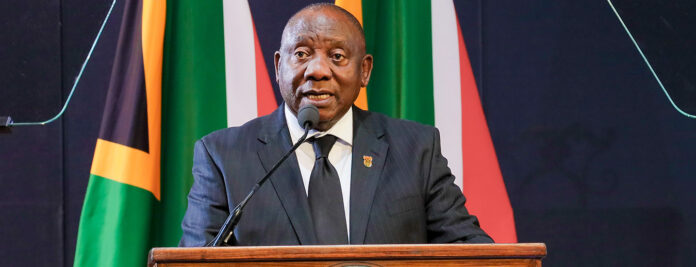
President Cyril Ramaphosa plans to lead a delegation of government representatives, academics, young people and business leaders to Silicon Valley in the United States after the elections, to explore how South Africa can harness artificial intelligence (AI) while guarding against its dangers.
Speaking at the Black Wednesday commemoration lunch, Ramaphosa said he had been immersing himself in understanding AI and wanted the delegation to engage directly with major players in the technology industry to establish how the country could benefit from its rapid development.
“After the elections, I will be leading a group of people from government, from universities, young people and all, and business, and will take along some of my comrades as well to the Silicon Valley, just to go and meet those big moguls of artificial intelligence, to get to understand exactly how it functions and how we can utilise it to our own benefit,” he said.
The planned visit comes as governments and industries grapple with the opportunities and risks presented by increasingly sophisticated AI tools, from automating tasks and analysing information to generating realistic images, videos and audio.
Ramaphosa said AI offered extraordinary possibilities for journalism, government and organisations, but warned that its misuse could threaten public trust and democratic processes.
ALSO READ: Eight US states sue OpenAI, claiming ChatGPT harms young users
For South Africa, he said, AI could help journalists analyse large volumes of information, identify patterns, translate content into different languages and make information more accessible to audiences.
These capabilities could be particularly significant in a country with 12 official languages, where access to information across linguistic communities remains an important consideration.
However, the president cautioned that the same technology could be used to manufacture convincing but false content, with potentially serious consequences ahead of the November 4 local government elections.
Ramaphosa recounts fake hospital image
Ramaphosa illustrated the dangers of manipulated content by recounting how a photograph circulated showing him lying in a hospital ward alongside Deputy President Paul Mashatile. He said he had never been hospitalised, although Mashatile had been incapacitated by a medical condition and had since returned home.
“And they put us in a hospital ward, lying next to each other, and many people believed it, and many concluded there is no leadership in South Africa,” he said.
The incident, he argued, demonstrated how false information could shape public perceptions before journalists had an opportunity to establish the facts.
ALSO READ: AI cannot be allowed to hide behind humans
Ramaphosa said:
“A fabricated reporting, a recording rather, can spread across social media before journalists have had an opportunity to check it and establish it as truth.”
He warned that by the time the truth emerged, the damage could already have been done.
Technology must not come at the expense of truth
Ramaphosa said disinformation could undermine confidence in democratic institutions, inflame divisions and distort the choices voters make.
He argued that the growing sophistication of AI made credible, independent and professional journalism even more essential.
“Technology may change how information is produced and distributed, but it does not diminish the importance of truth, of accuracy, fairness and accountability,” he said.
The president also condemned the harassment and intimidation of journalists, particularly women who face threats and abuse on digital platforms.
He said political leaders had a responsibility to condemn such conduct unequivocally, including when perpetrators claimed to support their own organisations.
“No journalist should ever have to fear for their safety because they are doing their job,” he said.
Ramaphosa’s planned Silicon Valley engagement signals an interest in understanding the technology at the centre of these opportunities and risks.
The key question for South Africa will be how lessons from the world’s major technology companies can translate into practical benefits for local communities, public services, businesses and newsrooms, while protecting citizens against AI-enabled disinformation.
- President Cyril Ramaphosa will lead a delegation of government officials, academics, young people, and business leaders to Silicon Valley after the elections to explore the benefits and risks of artificial intelligence (AI) for South Africa.
- Ramaphosa emphasized that AI could aid journalism by analyzing large volumes of information, identifying patterns, translating content across South Africa’s 12 official languages, and increasing accessibility.
- He warned that AI technology could also be used to create convincing but false content, which could harm public trust and democratic processes ahead of the November 4 local government elections.
- Ramaphosa recounted a fabricated image showing him and Deputy President Paul Mashatile in a hospital ward, illustrating how false information can spread rapidly and distort public perception.
- The president condemned the harassment and intimidation of journalists, especially women, and urged political leaders to unequivocally reject such conduct while highlighting the importance of credible, independent journalism in the AI era.


