


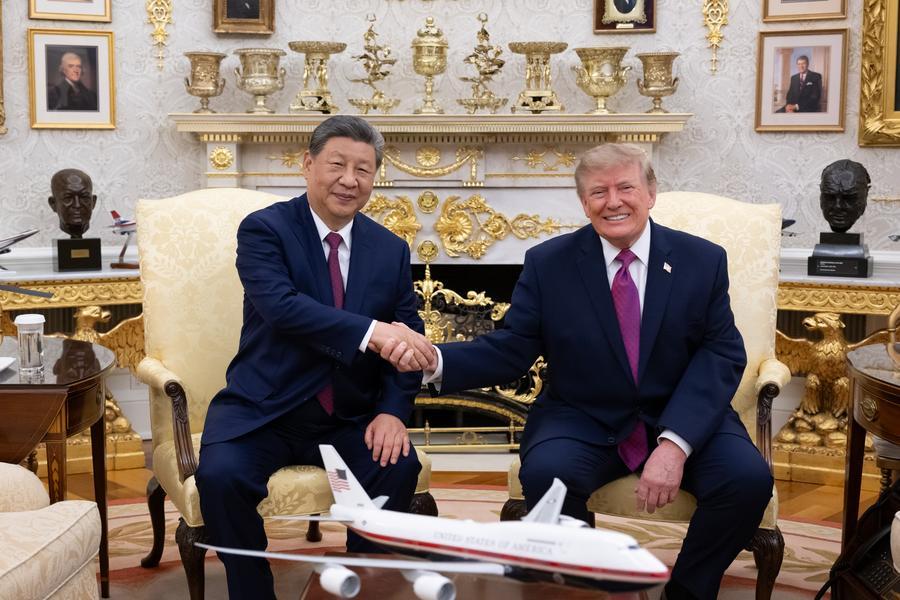
Chinese President Xi Jinping paid a state visit to the United States from Wednesday to Friday, during which he held in-depth exchanges with U.S. President Donald Trump, and the two leaders reached many common understandings on major issues concerning China-U.S. relations as well as world peace and development.
Observers from various countries who have closely followed the visit said it has boosted confidence that the vision of building a constructive China-U.S. relationship of strategic stability based on respect, fairness and reciprocity will be translated into concrete actions taken in the same direction, bringing greater benefits to the people of both countries and around the world.
U.S. scholar Robert Lawrence Kuhn said that the headline achievement of the Xi-Trump summit is that it sends a strong signal that the leaders of the world’s two major countries, while acknowledging competition, can meet in harmony and with good spirit.
READ: Bond market selloff rumbles on ahead of Trump and XI talks
“A stable, constructive China-U.S. relationship is now a global good, affecting international peace and economic stability,” said Kuhn.
During his visit, Xi pointed out that “the Thucydides Trap can be overcome” and “achieving the great rejuvenation of the Chinese nation and making America great again can go hand in hand.”
These demonstrate China’s broader vision: viewing China-U.S. relations from the perspective of the development of both countries and the world as a whole, rather than pursuing a zero-sum game, said Gu Qingyang, associate professor at the Lee Kuan Yew School of Public Policy at the National University of Singapore, adding that they also embody the cooperative logic of Chinese culture.

While meeting with Trump, Xi said the two countries need to work toward a relationship featuring cooperation as the mainstay, moderate competition, manageable differences, and promises of peace.
Cavince Adhere, a Kenya-based international relations scholar, said that stronger China-U.S. cooperation is essential for global development by restoring predictability to the world’s two largest economies, lowering trade barriers, and creating room to address shared challenges.
“Keeping competition within manageable bounds can help create the conditions for overall stability in bilateral relations and for cooperation in areas such as trade and the economy, climate change, and public health,” said Adhere.
READ: Trump rejects Iran’s ‘seven-day’ proposal to reopen Strait of Hormuz
During their meeting, the two presidents also reached a common understanding on maintaining dialogue and strengthening cooperation in the field of artificial intelligence (AI). “This consensus is not the end of the challenges; rather, it marks the beginning of an exploration of the right path forward,” said Jinrui Zhang, senior AI scientist at Shell in the Netherlands.
By working together to prevent misuse and abuse, China and the United States can help chart a clear course for the responsible and orderly development of AI, said Zhang.
Franjo Maletic, a Croatian scholar, told Xinhua that it is “good news” the two leaders met twice within less than six months. He stressed that face-to-face dialogue remains crucial to managing the relationship between the world’s two largest economies.
Such meetings have injected new optimism into the international community, marking a positive step toward global stability and cooperation, said Maletic.
Greg Cusack, a former U.S. state legislator from Iowa, also described the frequent meetings between the two leaders this year as “very encouraging.”
If China and the United States deepen their cooperation to demonstrate leadership on some of the most important challenges facing humanity today, it would “mark a major turning point in world affairs, something that future historians would celebrate as monumental and probably instrumental” in avoiding global catastrophes, he said. ■
- Chinese President Xi Jinping visited the U.S. from Wednesday to Friday and held in-depth exchanges with U.S. President Donald Trump, reaching many common understandings on China-U.S. relations and global issues.
- Observers praised the visit for boosting confidence in building a constructive China-U.S. relationship based on respect, fairness, and reciprocity.
- Xi emphasized overcoming the "Thucydides Trap" and achieving the rejuvenation of China while making America great again, promoting cooperation over zero-sum competition.
- The two leaders agreed to maintain dialogue and strengthen cooperation in artificial intelligence to ensure responsible and orderly development of AI.
- Scholars noted that frequent face-to-face meetings between Xi and Trump in 2026 mark a positive step towards global stability, economic predictability, and cooperation on shared challenges.
Chinese President Xi Jinping paid a state visit to the United States from Wednesday to Friday, during which he held in-depth exchanges with U.S. President Donald Trump, and the two leaders reached many common understandings on major issues concerning China-U.S. relations as well as world peace and development.
Observers from various countries who have closely followed the visit said it has boosted confidence that the vision of building a constructive China-U.S. relationship of strategic stability based on respect, fairness and reciprocity will be translated into concrete actions taken in the same direction, bringing greater benefits to the people of both countries and around the world.
U.S. scholar Robert Lawrence Kuhn said that the headline achievement of the Xi-Trump summit is that it sends a strong signal that the leaders of the world's two major countries, while acknowledging competition, can meet in harmony and with good spirit.
READ: Bond market selloff rumbles on ahead of Trump and XI talks
"A stable, constructive China-U.S. relationship is now a global good, affecting international peace and economic stability," said Kuhn.
During his visit, Xi pointed out that "the Thucydides Trap can be overcome" and "achieving the great rejuvenation of the Chinese nation and making America great again can go hand in hand."
These demonstrate China's broader vision: viewing China-U.S. relations from the perspective of the development of both countries and the world as a whole, rather than pursuing a zero-sum game, said Gu Qingyang, associate professor at the Lee Kuan Yew School of Public Policy at the National University of Singapore, adding that they also embody the cooperative logic of Chinese culture.
While meeting with Trump, Xi said the two countries need to work toward a relationship featuring cooperation as the mainstay, moderate competition, manageable differences, and promises of peace.
Cavince Adhere, a Kenya-based international relations scholar, said that stronger China-U.S. cooperation is essential for global development by restoring predictability to the world's two largest economies, lowering trade barriers, and creating room to address shared challenges.
"Keeping competition within manageable bounds can help create the conditions for overall stability in bilateral relations and for cooperation in areas such as trade and the economy, climate change, and public health," said Adhere.
READ: Trump rejects Iran's 'seven-day' proposal to reopen Strait of Hormuz
During their meeting, the two presidents also reached a common understanding on maintaining dialogue and strengthening cooperation in the field of artificial intelligence (AI). "This consensus is not the end of the challenges; rather, it marks the beginning of an exploration of the right path forward," said Jinrui Zhang, senior AI scientist at Shell in the Netherlands.
By working together to prevent misuse and abuse, China and the United States can help chart a clear course for the responsible and orderly development of AI, said Zhang.
Franjo Maletic, a Croatian scholar, told Xinhua that it is "good news" the two leaders met twice within less than six months. He stressed that face-to-face dialogue remains crucial to managing the relationship between the world's two largest economies.
Such meetings have injected new optimism into the international community, marking a positive step toward global stability and cooperation, said Maletic.
Greg Cusack, a former U.S. state legislator from Iowa, also described the frequent meetings between the two leaders this year as "very encouraging."
If China and the United States deepen their cooperation to demonstrate leadership on some of the most important challenges facing humanity today, it would "mark a major turning point in world affairs, something that future historians would celebrate as monumental and probably instrumental" in avoiding global catastrophes, he said. ■


