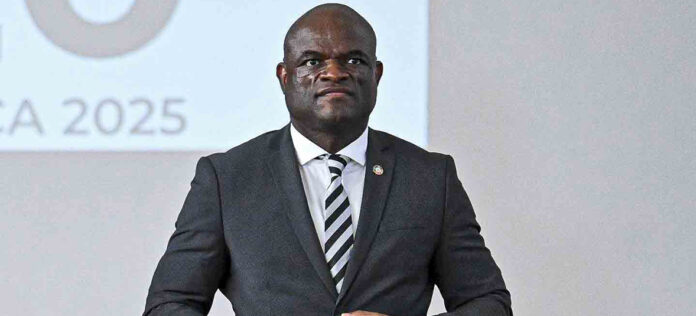
Northern Cape Premier Zamani Saul has used the parliamentary debate on President Cyril Ramaphosa’s State of the Nation Address (SONA) to defend the government’s record while accusing opposition parties of election-year denialism and political brinkmanship.
Speaking at Cape Town City Hall on Wednesday, Saul praised Ramaphosa for delivering what he called a “decisive and action-oriented” address, describing the president as a leader who remains focused despite mounting political distractions.
“What is admirable about the president is his consistent display of gravitas despite an avalanche of distractions,” Saul said, adding that Ramaphosa appeared “deeply in touch with the general mood of South Africans”.
However, Saul argued that the SONA debate was unfolding in an election season that had pushed opposition parties into what he called “politics of self-deception”, rather than substantive engagement with national priorities.
“In a chorus yesterday and today, the opposition parties deceptively see nothing, hear nothing and feel nothing that is positive in the country,” he said.
He accused opposition benches of twisting facts, creating “alternative truths”, and focusing on headlines rather than long-term developmental trends.
“This is called bluffing,” Saul charged, describing it as a crude form of modern-day political brinkmanship.
Clean audit outcomes
Saul positioned the Northern Cape as proof that progress is possible despite the country’s challenges, arguing that his province reflects deliberate and outcomes-based governance.
“In the Northern Cape our governance model is results-driven, people-centred and achieves outcomes,” he said.
He highlighted improved accountability, noting that the province has increased clean audit outcomes from two in 2019 to nine out of 13 auditees today.
On the economic front, Saul said the Northern Cape’s gross domestic product (GDP) has grown steadily from R117-billion in 2019 to R166-billion in 2025, lifting per capita income to $6 800—above the national average.
He welcomed the latest Stats SA labour force report showing the province recorded the largest decline in unemployment in the country, with a 4.1% reduction in quarter four of 2025, translating into 18 000 new jobs.
The Northern Cape now has the second-lowest unemployment rate at 27.1%, below the national rate of 31.4%.
Saul outlined ambitious targets of reaching a GDP of R200-billion by 2030 and creating an additional 60 000 jobs, driven by the province’s Industrial Corridor strategy.
He welcomed Vedanta Zinc International’s R21-billion pledge toward the Namakwa Special Economic Zone, with phase two expected to generate 2 500 construction jobs and 1 000 permanent jobs.
Green industrial beneficiation
The premier said the Northern Cape is central to South Africa’s renewable energy future, producing nearly three times more renewable power than it consumes and hosting 60% of national projects.
Saul argued that the province, home to 80% of global manganese resources, is well- positioned for green industrial beneficiation.
Saul also cited rising matric results, improved health indicators, declining HIV positivity rates, and falling mortality figures as evidence of provincial progress.
He said South Africa’s challenges require delivery rather than political theatrics.
“The antidote for politics of self-deception is focus and hard work,” according to the premier.
- Northern Cape Premier Zamani Saul has used the parliamentary debate on President Cyril Ramaphosa’s State of the Nation Address (SONA) to defend the government’s record while accusing opposition parties of election-year denialism and political brinkmanship.
- Speaking at Cape Town City Hall on Wednesday, Saul praised Ramaphosa for delivering what he called a “decisive and action-oriented” address, describing the president as a leader who remains focused despite mounting political distractions.
- “What is admirable about the president is his consistent display of gravitas despite an avalanche of distractions,” Saul said, adding that Ramaphosa appeared “deeply in touch with the general mood of South Africans”.
- However, Saul argued that the SONA debate was unfolding in an election season that had pushed opposition parties into what he called “politics of self-deception”, rather than substantive engagement with national priorities.
- “In a chorus yesterday and today, the opposition parties deceptively see nothing, hear nothing and feel nothing that is positive in the country,” he said.