


World Menstrual Hygiene Day is in a week, and period poverty is not a thing of the past; girl children miss school, women miss work and they miss out on life because affording a sanitary pad in South Africa is a problem.
Statistics show that 8-million girls or women suffer from period poverty, and that 4-million of them are in school, where one in three schoolgirls miss between four and five school days each month and up to 60 school days each year due to a lack of sanitary pads.
“School is the one place that should be safe and empowering for young women. This project will ensure that they stay in school,” said Babalwa Latsha, director at MENstruation Foundation.
From absent to empowered
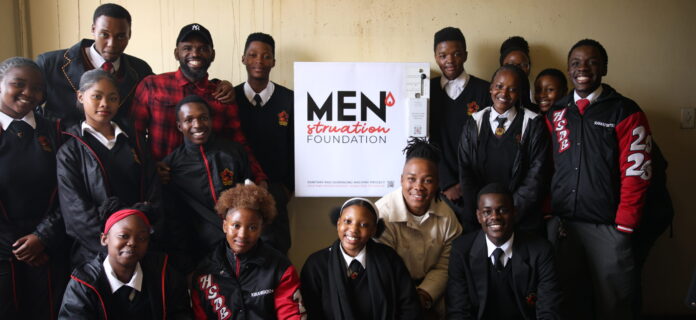
The MENstruation Foundation officially launched a sanitary pad dispensary machine at Hoërskool Die Burger, a high school in Roodepoort, Gauteng, on May 22. The vending machines are placed in under-resourced schools and universities, and they dispense free, biodegradable pads to keep young women in the classroom instead of missing school.
This, according to MENstruation in collaboration with Joe Public, marks a decisive step towards ensuring that no learner ever has to miss class simply because she cannot access basic sanitary products. The launch forms part of the foundation’s broader Period Paper campaign, set to roll out on World Menstrual Hygiene Day (May 28 2026), aimed at confronting stigma and bringing national attention to period poverty.
This for the girls in the room was deeply personal; something they had lived through.
Period poverty in school has proved to be a huge problem. Girl children missing out on so many school days means the school’s performance is also affected and shaping their future is more complex than it seems. The school principal welcomed the initiative and spoke to these challenges and what it looks like in reality in these classrooms across the country.
“For some of our learners, access to sanitary products is not guaranteed. We see the impact on attendance, confidence and dignity,” the principal said. “This changes that.” Statistics support that urgency: nationally, one in three schoolgirls miss up to 60 school days each year due to a lack of sanitary pads.
Not a girl issue: a humanity issue
Acclaimed actor, MC and activist Sivuyile Ngesi, MENstruation co-founder, lives by the adage, “If men bled once a month, sanitary pads would be free!”, and aims to turn this conviction into infrastructure.
“Period poverty is not just a women’s issue, it’s a humanity issue,” Ngesi said. “No girl should miss school because of her period. That should never be the reason a dream is delayed.”
The non-profit organisation strives to eliminate period poverty in South Africa and beyond, beginning with one goal: stop girls from missing school simply because of their period. The pad dispensers placed across 200 schools and universities offer free, dignified access to menstrual care, according to MENstruation.
Girl child validation
Babalwa Latsha, director of the foundation and captain of the Springbok Women’s rugby team, gave a message both personal and powerful.
“I come from Khayelitsha [in the Eastern Cape], and I know what it feels like to be affected by period poverty,” Latsha said. “But I also stand here today as a Springbok.”
“Your dreams are valid. Where you come from does not limit where you can go. Period poverty should never be the thing that stops you. School is the one place that should be safe and empowering for young women. This project will ensure that they stay in school.”
A learner from the school echoed that reality with quiet honesty. “Sometimes we don’t have enough at home. Now we don’t have to worry. We can come to school and focus,” she said. “It may seem like something small, but for us, it changes everything.”
The MENstruation Foundation is not operating at a small scale. According to the organisation, it distributes more than 1-million free sanitary pads every month. Its Paarl facility produces 216 000 pads in a single eight-hour shift. The new dispensary machine at Hoërskool Die Burger offers free, biodegradable pads with no stigma, no shame, and no questions asked. “We will not stop until there is no period poverty in South Africa,” the Foundation states.
World Menstrual Hygiene Day
The foundation, in partnership with Joe Public, aims to raise awareness of the dangers of using newspapers during periods, as there have been reports of young girls using newspapers as a tampon, which has multiple health dangers. The aim is getting newspapers in the country with a big blood stain on the day and raising awareness beyond what people already know. The Period Paper campaign will push period poverty from the margins to the centre of national conversation.
Today’s conversation for the girls at Hoërskool Die Burger has produced a practical, life-saving result. Girls were missing school. Now, they don’t have to.
Visit SW YouTube Channel for our video content
- In South Africa, 8 million girls and women suffer from period poverty, with 4 million schoolgirls missing up to 60 days of school annually due to lack of sanitary pads.
- The MENstruation Foundation launched a free sanitary pad vending machine at Hoërskool Die Burger to provide biodegradable pads in under-resourced schools, aiming to reduce absenteeism and stigma.
- The foundation’s Period Paper campaign, launching on World Menstrual Hygiene Day (May 28, 2026), seeks to raise national awareness about period poverty and combat harmful practices like using newspapers as menstrual products.
- MENstruation co-founder Sivuyile Ngesi emphasizes period poverty as a humanity issue, advocating that no girl should miss school because of her period.
- The foundation distributes over 1 million free pads monthly, operates large-scale production, and is committed to eliminating period poverty nationwide to ensure girls stay in school and pursue their dreams.


