


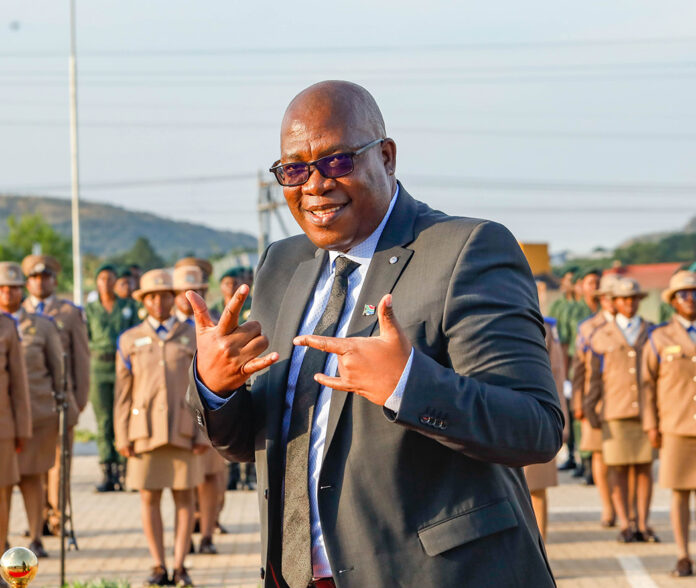
Lazzy Mokgosi 6/10
North West Premier Lazzy Mokgosi’s 2025 was an exercise in grim equilibrium. His success is measured not in transformation, but in the avoidance of total collapse.
He may have secured a grant, touted an audit, or stage-managed a crisis response—minor triumphs in the ledgers of political survival. But the province is far from where it should be. The relentless truth is this: some taps remain dry, roads crumble, and hospitals decay.
Factional warfare within his party rages unabated, a testament to his precarious control, while the spectre of corruption is a constant, eroding shadow.
Simultaneously, demonstrating firm fiscal stewardship by achieving improved audit outcomes would rebuild trust with citizens and the national government alike.
By decisively managing the inevitable crises with transparency, Mokgosi redefined his leadership from mere survival to proactive renewal.
The arithmetic is cold and unambiguous: a rating of six out of 10. This is a passing grade for leadership, signifying that while he may have successfully navigated the corridors of power, he has to win the trust of the people he governs.
Ronald Lamola 7.5/10
Minister Ronald Lamola’s 2025 would be a masterclass in dignified navigation through an ocean of contradictions.
His highlights would be performances: articulate advocacy for the Global South, legally precise condemnations at the International Court of Justice, and the impeccable hosting of summits.
He would be the acceptable, reasonable face of a foreign policy that is, at its core, deeply ambiguous.
The low lights, however, would reveal the architecture of failure beneath the polish. South Africa’s “non-alignment” would calcify into strategic irrelevance, pleasing no major power.
His principled legalist persona would be brutally exposed as separate from, and subordinate to, the ruling party’s more partisan alliances.
The recent successful G20 Summit would be a major diplomatic win.
Lamola would excel as a competent custodian of South Africa’s complex decline on the world stage.
He would eloquently explain our position, expertly manage our standing, and legally justify our moral compromises.
A rating of 7.5 reflects not failure, but the proficient stewardship.
The ship is well-captained.
Pieter Groenewald 6/10
Minister Pieter Groenewald’s 2025 was defined by a steady, scandal-free effort to prevent a buckling prison system from collapse. His focus was on targeted interventions rather than transformation.
A key achievement was clearing the notorious lifer parole backlog through intensive, specialist-driven reviews.
This resulted in fewer releases and revoked paroles, signalling a shift toward stricter, risk-averse oversight.
Groenewald championed broader parole reforms, advocating for electronic monitoring and specialist-heavy parole boards to combat rising reoffending rates.
His most intractable challenge remained severe overcrowding, with facilities holding 163 179 inmates against a 107 067-bed capacity. Internally, approved raids uncovered contraband and staff collusion, leading to disciplinary action.
While not eradicating entrenched gang networks, these were attempts to reassert authority over internal decay.
The crisis persists, but 2025 stands as a year of genuine, if incremental, confrontation with the system’s deepest flaws. He gets a 6/10.
John Steenhuisen: 4/10
Minister Steenhuisen failed on what should have been his most important task this year, dismissing the propaganda that there is a slaughter of white farmers in South Africa.
But he has been missing in action in a matter that could have made his the most popular politician in 2025.
The disinformation that has pitted South Africa against the US has been one of the most unfortunate political and diplomatic developments of 2025.
Steenhuisen should have been central in the many voices needed to change the narrative, because his voice as a white man would carry more weight.
But his ineptitude in this regard was badly exposed. His party’s foes would have a field day at the DA congress next year attacking him on this front
But it was not all doom and gloom for the leader of the blue party who, despite push and pull inside the DA to get out of the GNU, ensured stability. In internal DA party wars, he proved to be a tough nut to crack against aggression by a faction led by experienced and barely a loser federal council chairperson Helen Zille.
Thami Ntuli: 6/10
Ntuli, just like Lesufi, has managed to survive a complicated government of provincial unity.
But his overreliance on the ANC for survival sometimes forces him into an untenable position of making concessions he should not make.
A case in point would be two ANC MECs who were implicated in the scandals of having their family members benefiting from the multibillion-rand schools’ nutrition programme.
In any serious province, most probably Gauteng, these individuals were likely to be shown the door, but Ntuli kept them because of their influence within the ANC, which is key to keeping him premier.
However, it was not all bad for the man who has managed to maintain a positive working relationship with provincial police commissioner, Lt-Gen Nhlanhla Mkhwanazi, with the duo often seen launching crime-fighting projects.
Ntuli has also shown interest in resolving problems even if some might outlive him as premier such as his launch of the five-year financial recovery plan to restore fiscal stability intended to save R1.5-billion a year and deal with the R10-billion debt crisis facing the provincial government.
Oscar Mabuyane: 8/10
While he sometimes faces harsh and misguided criticism from many who unfairly compare Eastern Cape with urban provinces such as Gauteng and Western Cape, Mabuyane has held the province together with the limited resources at his disposal.
In a deliberate attempt to attract private investment, the province has become a construction site with several mega road projects underway epitomised with the completion of the billion-rand worth Ndabakazi interchange linking the R409 with the N2.
It was also this year that a vehicle service logistics facility, supported by a R750-million investment from Isuzu, was launched in Gqeberha, marking a significant milestone in the industrial trajectory of the province.
Mabuyane’s government is also still on track in its target of completing about 27 schools of a 100 that get started every year.
In the health sector, the massive hospitals of Madwaleni, Zithulele and Bambisani that combined are worth R2-billion are all reaching finalisation and will ease the pressure on hospitals in the cities. The province is on a steady rise and is meeting its minimum targets.
Panyaza Lesufi: 8/10
That he finishes the year still a premier after formulating the government of provincial unity excluding the DA is a massive win for the man from Thembisa.
Lesufi governs at the messy of the somewhat difficult MKP and EFF but to date, not once have the two parties threatened to collapse the government.
This sort of political management skills is to be commended.
But above that Gauteng, under Lesufi continues to lead the way in clean governance and service delivery.
In 2025, serious crime in Gauteng dropped by 7.9% while the murder rate decreased by double digits – 10.8%.
Also, this was the first full year since Lesufi placed the community safety portfolio in his office to directly deal with crime and it immediately showed positive signs.
Under his leadership, the provincial government achieved eight clean audits in the 2024-25 financial year, having sustained clean audits in four departments five years on the trot.
This was also the year in which Lesufi subjected provincial government top officials to lifestyle audits.
Mmamoloko Kubayi 5/10
Justice Minister Mmamoloko Kubayi navigated a year of pointed scrutiny and digital deception in 2025, her tenure defined by a struggle to maintain credibility while confronting systemic failures.
The year opened with allegations of exorbitant travel, specifically a claim that a single night in Beijing cost R200 000.
She countered, submitting corrected figures to parliament showing costs of R13 500 per night for a seven-day visit, and R94 400 for four nights in San Francisco—a move framed as transparency.
This was followed by brazen impersonation scams. More seriously, a fraudulent WhatsApp campaign falsely claimed she had authorised the prosecution of Deputy President Paul Mashatile. Amid these distractions, she pursued a modest justice agenda: convening stakeholders to address court backlogs and taking disciplinary action against senior officials whose delays impacted critical processes like the Madlanga commission. Ultimately, 2025 revealed a minister responsive to acute scandals, yet achieving only incremental progress against the justice system’s deep-seated decay. She gets a 5/10.
Dean Macpherson: 6.5/10
Macpherson had three major issues to contend with in the main in this very strategic and key portfolio of public works and infrastructure. He aced two, namely the fight against corruption and the economically crippling construction mafia scourge while he blundered with his posture on the Expropriation Act.
In the construction mafia space, Macpherson did what most of his predecessors failed to do, which is directly and tactically dealing with this crime.
In KwaZulu-Natal, where these mafias were running amok collecting protection fees or stopping mega construction projects, not a single project was stopped by construction mafias.
He also proved a committee champion to fighting corruption, at least if his heroics in the Independent Development Trust are anything to go by.
Earlier this year President Cyril Ramaphosa signed the Expropriation Bill into law to allow for the expropriation of private property in the public interest,
Macpherson was the first to say that will not happen under his watch as public works minister.
Maqueen Letsoha-Mathae 6/10
Despite her challenges, where she is fighting for her political survival, Free State Premier Maqueen Letsoha-Mathae is working strategically with her team of MECs to change the fortunes of the province.
Free State is facing challenges of governance as its municipalities are collapsing due to lack of leadership.
The premier is also dealing with challenges of pushbacks from her comrades who are trying to remove her from power, claiming she is incompetent.
However, despite all the challenges, Letsoha-Mathae is soldiering on and pushing the boundaries to grow the economy..
Even amid the allegations of corruption levelled against her by businessman Patrick Phuthi, Letsoha-Mathae is upbeat about achieving the best for the province.
Her strategy to make Free State a hub of opportunities seems to be a work in progress. One of the achievements was when she reopened the Lesotho Highland Water Project in Clarens in July.
Currently, the water is flowing at full capacity through the 38km tunnel that channels Lesotho’s water to SA.
Visit SW YouTube Channel for our video content


