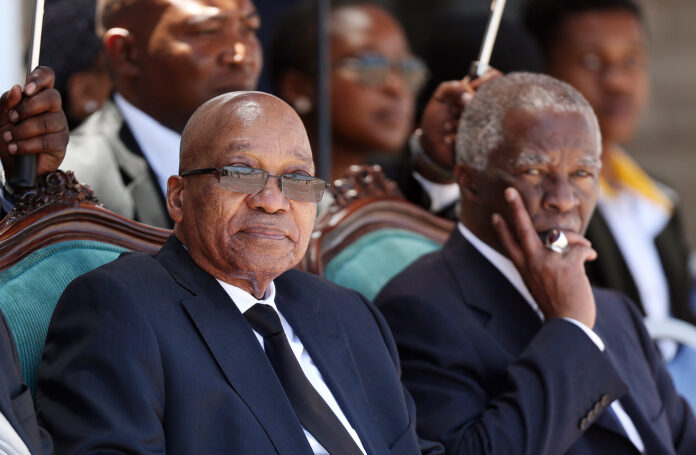

Human rights activists have accused former presidents Thabo Mbeki and Jacob Zuma of stalling the process to restore justice to dozens of unresolved TRC-related cases after suffering a legal setback in the Johannesburg High Court.
The court on Monday dismissed the pair’s application to review a decision by Justice Sisi Khampepe, clearing the way for her to continue chairing a commission probing the alleged obstruction of apartheid-era prosecutions.
In a majority judgment penned by Acting Deputy Judge President Thifhelimbilu Mudau, with Judge Selby Baqwa concurring, the court found that Zuma and Mbeki had failed to comply with Section 47 of the Superior Courts Act by not obtaining consent from the chief justice before instituting proceedings against a judge.
“The applicants were required to obtain the chief justice’s consent before instituting these review proceedings. They failed to do so. This failure is fatal,” the court ruled.
The outcome has been hailed by victims’ families and activists as a turning point in a decades-long struggle for accountability, where justice has often lingered in limbo, promised in principle and postponed in practice.
The Foundation for Human Rights said the judgment ensures the commission can proceed without interference, describing it as a victory for both the rule of law and the families who have waited years for answers.
Step toward truth and justice
Executive director Zaid Kimmie said the ruling sends a clear message against attempts to delay accountability.
“This judgment confirms that the commission can continue its work without obstruction and that efforts to delay or derail accountability processes will not succeed. For victims’ families, the ruling is an important step toward truth and justice,” he said.
The commission, established by President Cyril Ramaphosa in May 2025, is investigating whether there were systematic efforts from 2003 onwards to block the investigation and prosecution of apartheid-era crimes.
For families linked to cases such as the Cradock Four and the PEBCO Three, the inquiry represents one of the last institutional avenues to confront a past that has long evaded closure.
The court reinforced the principle that judicial officers must be protected from undue legal pressure, warning against “vexatious litigation, personal attacks, and attempts to influence or intimidate” those tasked with upholding justice.
It also confirmed that Khampepe, though retired from the Constitutional Court, remains entitled to such protections while serving as chair of the inquiry.
While Mbeki and Zuma may still pursue further legal options, activists argue the ruling has shifted momentum from delay to direction, from obstruction to obligation, in a process that seeks not only legal answers but also moral reckoning.
- The Johannesburg High Court dismissed former presidents Thabo Mbeki and Jacob Zuma's application to review a decision allowing Justice Sisi Khampepe to chair a commission probing obstruction of apartheid-era prosecutions.
- The court ruled that Mbeki and Zuma failed to obtain necessary consent from the chief justice before initiating legal proceedings against a judge, deeming their application invalid.
- Human rights activists and victims’ families hailed the judgment as a breakthrough in the ongoing struggle for accountability and justice in unresolved TRC-related cases.
- The commission, established by President Cyril Ramaphosa in May 2025, investigates systematic efforts from 2003 onwards to block apartheid-era crime prosecutions, offering hope for closure to affected families.
- The ruling reinforces judicial protections against undue legal pressure and signals a shift from attempts to delay justice toward meaningful accountability and moral reckoning.
Human rights activists have accused former presidents
In a majority judgment penned by
“
Executive director Zaid Kimmie said the ruling sends a clear message against attempts to delay accountability.
“
For families linked to cases such as the Cradock Four and the PEBCO
It also confirmed that
While