


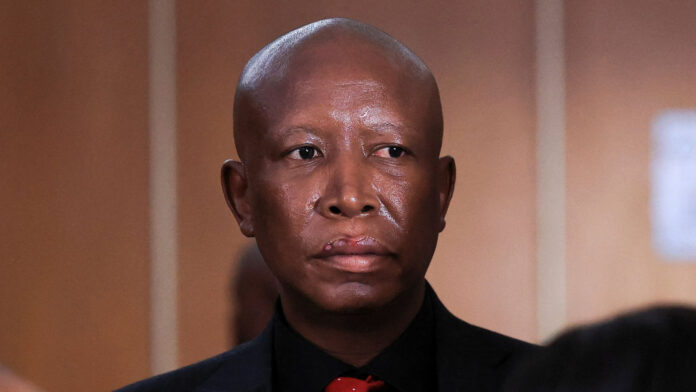
Julius Malema’s legal letter to Ngizwe Mchunu follows a well-known path in South African defamation law. It sets out the statements complained of, explains why they are harmful, and demands a retraction, apology, and payment.
On paper, it aligns with how courts approach these disputes—but it remains a claim, not proof.
The starting point in law is simple. A statement is defamatory if it harms a person’s reputation.
South African courts have long accepted that allegations of criminal conduct meet this test almost automatically.
In National Media Ltd v Bogoshi, the court shifted the law but kept that core principle. It held that publication of defamatory material is not automatically unlawful but depends on whether it was reasonable.
At the same time, the judgement made clear that care is required. As the court put it, liability turns on whether publication was “reasonable in the circumstances”.
That standard becomes stricter when the allegation is serious.
Malema’s letter leans heavily on this point. It says the statements were presented as facts, not opinions.
That matters because courts draw a clear line between the two. Opinions are given more freedom. Facts must be supported.
Careless factual claims
The Constitutional Court confirmed this balance in Khumalo v Holomisa. In that case, the court said: “The law of defamation seeks to balance the protection of reputation with the right to freedom of expression.”
It also made an important point about false statements, noting that they have limited constitutional value, especially when they cause harm.
Put simply, the law allows strong political speech—but not careless factual claims.
On that basis, Malema’s argument is legally coherent. If the statements are indeed false and presented as fact, the law tends to favour protection of reputation.
Courts have repeatedly treated allegations of crime as especially damaging.
This is also reflected in NEHAWU v Tsatsi, where the court found that linking someone to wrongdoing is inherently harmful.
In plain terms, saying someone is involved in crime is not a minor insult — it goes to their integrity.
But the letter has limits.
It does not prove that the statements are false. It does not show what evidence exists or does not exist. It does not quantify harm beyond asserting it.
That is normal at this stage. A demand letter is meant to set out a position and force a response.
If the matter goes further, the legal burden shifts.
Truth in the public interest
Once a statement is shown to be defamatory, the person who made it must justify it. South African law allows a few defences, but each has strict requirements.
The first is truth in the public interest. This is the strongest defence, but it requires solid proof. Courts do not accept rumours or speculation. If Mchunu cannot show clear evidence, this defence will not hold.
The second is fair comment. This protects opinions, even harsh ones, but only if they are based on true facts and clearly expressed as opinions. If the statements sounded like facts, this defence becomes difficult.
The third is a reasonable publication, developed in Bogoshi. This is often the fallback. It allows for protection even if a statement is wrong, but only if it was published responsibly.
That means there must have been some basis for the claim and some effort to verify it.
The courts have been clear that the more serious the allegation, the higher the standard. Saying someone is linked to drug dealers is not a casual remark. It demands careful checking.
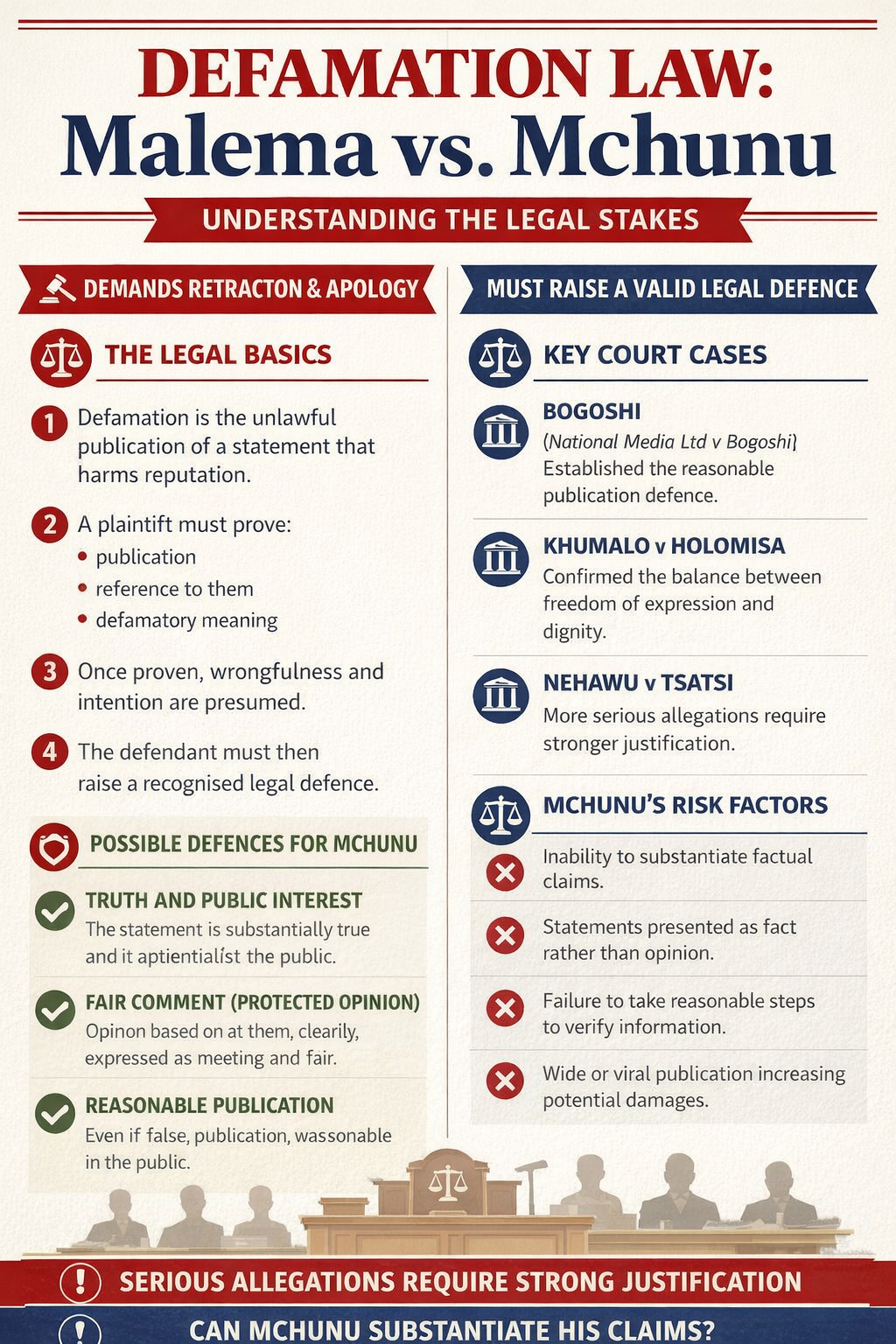
This is where the risk for Mchunu lies.
If there is no strong evidence and no clear attempt to verify the claim, the law is unlikely to protect him.
As the courts have made clear, freedom of expression does not extend to reckless statements presented as fact.
His lawyers would likely start with a basic question: what proof exists?
If there is none, the safest advice is to limit the damage. That usually means removing the content, issuing a retraction, and offering an apology in careful terms.
This does not necessarily admit everything, but it reduces the risk of damages and legal costs.
If Mchunu believes he has a basis for the claims, the approach changes. His legal team would need to prepare to defend the statements by showing what information he relied on, what checks were done, and why it was reasonable to speak out.
Even then, it is a difficult path. Courts are cautious when dealing with allegations of crime, especially in a political context where reputations matter.
Online publication can amplify harm
There is also the question of scale. The statements were shared on social media and spread widely. Courts are increasingly aware that online publication can amplify harm.
A claim that might once have reached a small audience can now reach thousands or more in a short time.
That does not change the law, but it affects how seriously the harm is viewed.
For now, this remains a legal threat, not a case.
Malema’s letter is a strong opening move. It fits within established legal principles and puts clear pressure on Mchunu to respond.
But the outcome, if it goes further, will depend on something much simpler: whether the claims can be proven, or at least justified.
Until then, the law’s message is consistent and clear—you can say a lot in politics, but if you make serious claims as facts, you must be able to stand behind them.
- Julius Malema’s legal letter to Ngizwe Mchunu accuses him of defamatory statements alleging criminal conduct, demanding a retraction, apology, and payment based on South African defamation law principles.
- Courts treat serious allegations of crime as inherently damaging and require such statements presented as facts (not opinions) to be proven or reasonably justified.
- Defenses like truth in the public interest, fair comment, or reasonable publication require solid evidence or responsible verification, especially for serious claims linked to crime.
- The letter currently is a claim, not proof, and the burden of evidence lies with Mchunu, who risks legal consequences if he cannot substantiate or responsibly published the statements.
- The wide social media dissemination of the allegations increases the perceived harm, emphasizing the need for careful handling; the case remains a legal threat unless formal proceedings begin.


