


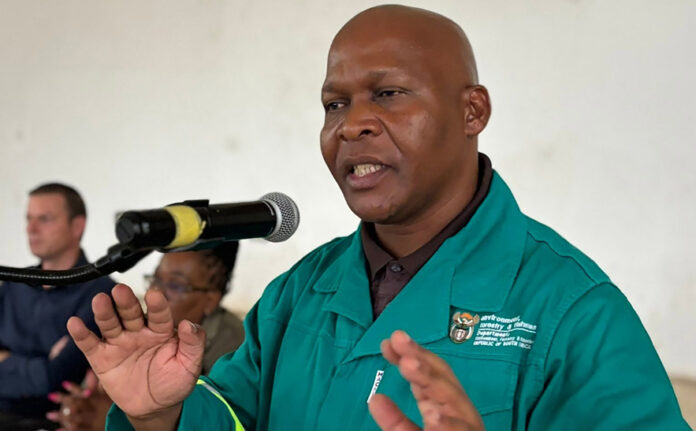
Controversial Matjhabeng executive mayor Thanduxolo Khalipha’s political career was given a lifeline after the Bloemfontein High Court determined there was insufficient evidence to uphold his conviction for assault and two counts of crimen injuria.
Khalipha, one of seven ANC mayoral candidates for Matjhabeng, has his sights set on retaining the mayoral chain, and the convictions were a potential obstruction.
November 2024 conviction
Khalipha, who also wears the hat of ANC provincial organiser, was convicted in November 2024 after being found guilty of common assault and two counts of crimen injuria arising from an incident in February of the same year involving two municipal employees, Frank Moreroa and Sphamandla Msomi, who were employed as his bodyguards.
The conviction put him in the ANC firing line alongside former ministers Sisisi Tolashe and Bheki Cele for disciplinary action for allegedly bringing the party into disrepute.
In a legal own goal, the state conceded in heads of argument filed in the court that it had failed to prove Khalipha’s guilt beyond reasonable doubt and that his appeal against the convictions be upheld.
Khalipha’s legal team pulled apart the conduct of Magistrate Shaun Malander of the Odendaalsrus Magistrate’s Court, who in 2024 sentenced him to a R5 000 fine or three months’ imprisonment for assault and R1 000 or one month behind bars on each of the two crimen injuria counts. Malander also declared him unfit to possess a firearm in terms of section 103 of the Firearms Control Act.
State concedes
When Khalipha appealed the convictions, the state effectively abandoned its defence.
“After careful reading of the record, as well as the appellant’s [Khalipha’s] heads of argument, the respondent [state] must concede that the convictions and sentences cannot be supported. It is conceded that the respondent did not discharge its onus to prove the appellant’s guilt on any of the charges.”
The state further submitted that the appeal against the convictions should be upheld and the convictions set aside.
Khalipha’s legal team interrogated the prosecution’s evidence, highlighting apparent contradictions and failure to establish the essential elements of assault and crimen injuria beyond reasonable doubt.
Assault allegation
The assault allegation arose after Khalipha allegedly touched or slapped Moreroa while he was driving a vehicle. Khalipha’s version was that he was attempting to get Moreroa’s attention and instruct him to stop because he was driving at speed while people were still in the vicinity. The defence argued that the contact was neither unlawful nor intended as an assault.
More damaging to the prosecution’s case, according to the appeal papers, was Moreroa’s own testimony. He told the court that Khalipha was not a dangerous person and that he did not regard the mayor as a threat. The defence argued that this evidence undermined the state’s case that the contact amounted to unlawful assault.
The appeal papers also highlighted contradictions between Moreroa and Msomi over the alleged insulting words hurled at them. The defence argued that these contradictions were material and that the magistrate failed to properly deal with them.
“To be found guilty of crimen injuria, there has to be serious infringement of one’s dignity,” the state says, adding that the test is subjective.
Appeal
Khalipha’s legal team also took aim at Malander, who it claims made “concerning” remarks during proceedings relating to the application for leave to appeal.
For one, the magistrate mentioned that he had discussed his ruling with other “learned colleagues” and former senior colleagues before handing it down.
According to the appeal papers, Malander had reportedly said he had made every effort to prepare the judgment because he was aware the matter could proceed to the higher courts. This conduct, his legal team told the court, compromised the appearance and reality of judicial independence.
Sentencing
During sentencing, Malander also made references to former president Nelson Mandela and the ANC, something which Khalipha’s legal team argues was politically charged and had no place in the determination of a criminal case – creating a reasonable perception of bias and undermining Khalipha’s constitutional right to a fair trial.
On the firearm declaration, Khalipha’s lawyers argued that the magistrate simply accepted the prosecution’s request that he be declared unfit to possess a firearm without properly considering whether the statutory requirements had been established by the evidence.
The state said that if the court did not uphold the appeal against the convictions, then the appeal against the sentences should nevertheless succeed, and lesser sentences should be imposed.
Khalipha’s lawyers, however, want the convictions replaced with verdicts of not guilty.
- The Bloemfontein High Court ruled there was insufficient evidence to uphold Thanduxolo Khalipha's November 2024 convictions for assault and two counts of crimen injuria.
- Khalipha was originally convicted for an incident involving municipal employees Frank Moreroa and Sphamandla Msomi, who were employed as his bodyguards.
- The state conceded in court that it failed to prove Khalipha's guilt beyond reasonable doubt and supported upholding his appeal to set aside the convictions.
- Khalipha’s legal team challenged Magistrate Shaun Malander’s conduct and rulings, including politically charged remarks and failure to properly consider evidence for firearm possession.
- The court found contradictions in witness testimonies and determined the evidence did not meet the threshold for assault or serious infringement of dignity needed for crimen injuria.


