
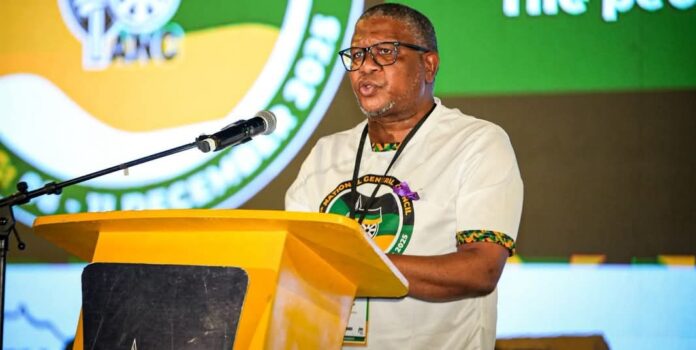
The diagnosis and cure presented by ANC Secretary General Fikile Mbalula on Monday in the party’s midterm report at the national general council in Birchwood Hotel, Ekurhuleni, is being framed as a stark, new roadmap to renewal.
But a cursory probe into the party’s own recent history reveals a different story. The document is less a novel prescription and more a cut-and-paste compilation of failed resolutions from a decade of conferences. Its promises are hollowed out by a consistent record of non-implementation.
Pattern of debilitating repetition
Cross-referencing Mbalula’s treatment plan against ANC policy documents, internal reports, and public pledges since the early 2010s exposes a pattern of debilitating repetition.
The promise: “Implement strict consequence management for factionalism and corruption.”
History: This is the ANC’s eternal refrain. The 2012 Mangaung Conference resolved to “deal decisively with corruption”.
The 2017 Nasrec conference was dominated by the promise of “renewal” and “accountability”.
The outcome? The party’s Integrity Commission remains a toothless advisory body. Figures facing serious allegations continue to occupy high office. And the “consequence” in consequence management has been conspicuously absent.
The promise: “Rebuild branches as activist units with clear programmes of action.”
History: The 2015 “Organisational Renewal” document explicitly stated the goal to “revitalise branches”. And the 2022 National Policy Conference again lamented “branch atrophy”.
Unstable municipalities
Internal audits consistently show a majority of branches are dormant. They are kept alive only for gatekeeping and voting at conferences. The cure for this has been diagnosed at every gathering; the disease only worsens.
The promise: “Stabilise municipalities through professionalisation and fiscal reform.”
History: The ANC’s own 2021 Local Government Review, chaired by former president Kgalema Motlanthe, detailed the identical crisis: politicised appointments, crumbling infrastructure, and financial collapse.
Its recommendations mirror Mbalula’s cure. Yet, in the intervening years, the number of ANC-run municipalities with clean audits has dwindled. This while those under administration have soared. The “Back to Basics” programme of the 2010s was an earlier iteration of this same failed medicine.
The promise: “Scale up public employment programmes and skills training for youth.”
History: The ANC’s 2014 Election Manifesto promised “6 million work opportunities”. The 2019 manifesto promised “no less than 2 million” new jobs for youth within a decade.
Youth unemployment
And the result is a youth unemployment rate that has climbed to catastrophic levels. The Presidential Youth Employment Intervention, launched with fanfare, has made a marginal dent. The promise is recycled; the outcome is static.
This analysis reveals a critical chasm: the ANC is adept at diagnostic rhetoric. But it is terminally incapable of therapeutic execution. The cure is not new; it is an archival document. And the binding thread through a decade of these identical pledges is the erosion of the institutional capacity and political will required to implement them.
Factions at play
The factions competing for state resources have a vested interest in not implementing a cure that would dismantle their feeding troughs. Professionalising municipalities ends lucrative tenders. Enforcing discipline silences rivals. True “internal renewal” would be an act of self-immolation for the dominant patronage networks.
Therefore, Mbalula’s presentation is not a practical plan. It is a ritualistic performance of introspection. A necessary political theatre to placate a frustrated base and concerned allies.
It checks the box marked “We have acknowledged the problem”. The unspoken subtext is that the disease — the system of factionalised patronage — is now the primary organism. The “cure” is merely a nutrient it consumes to grow stronger.
Until the party is willing to surgically remove the tumours it has named, this document, like its predecessors, is destined for the archive of good intentions. A monument to the paralysis of a movement trapped by its own decay.