


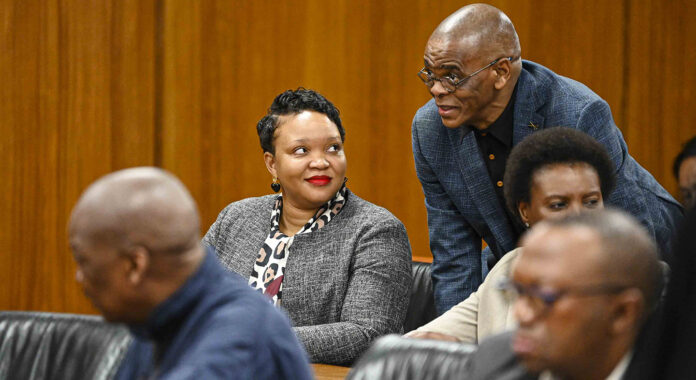
Lawyers for Ace Magashule’s former PA, Moroadi Cholota, have made the Constitutional Court’s recent warning on state abuses a central tenet of their defence to halt her prosecution, arguing it directly frames their allegation that investigators used apartheid-era tactics to secure her extradition.
In written submissions before the Free State High Court in Bloemfontein, Cholota’s legal team connects the apex court’s language on procedural fairness to what they label coercive and degrading methods used by the Hawks and National Prosecuting Authority (NPA).
They contend the court’s caution against abusive state power applies precisely to Cholota’s 2021 arrest and questioning in the United States.
The defence quotes the Constitutional Court’s January 23 judgment, which set a strict threshold for when courts should refuse prosecutions tainted by state illegality, stating jurisdiction should only be declined where proceeding would “condon[e] egregious unlawful conduct by the state”.
They anchor their argument in the court’s own historical warning: “The impunity of the apartheid state, particularly in the context of arrests and criminal proceedings, was an outright violation of fundamental rights which cannot be repeated or justified in our constitutional order.”
The defence asserts this judicial framing informs their characterisation of two Hawks investigators who interviewed Cholota in the US in September 2021.
They argue the court’s emphasis on preventing abuse of process is the lens through which this conduct must be judged.
The filings describe how Cholota was approached at her US residence by FBI agents without prior notice and escorted to meet the South African investigators for a witness interview.
The defence states she received no advance communication or documentation.
“The evidence led by both witnesses showed that Ms Cholota was in fact abducted from her apartment to go and attend the interview,” the submissions state, adding investigators could not explain why she was not informed beforehand. They conclude: “Ms Cholota was ambushed and abducted.”
This element, being taken without notice, is central to the apartheid-era comparison. The submissions cite the Truth and Reconciliation Commission’s records on systematic security branch abuses, including torture and abduction.
They specifically quote former security commander Dirk Coetzee, who told the TRC that “the security branch argued that it was preferable to abduct rather than to officially detain.”
The defence argues the encounter was a coercive interrogation aimed at turning Cholota against former Free State premier Ace Magashule.
They claim investigators first sought self-incriminating statements, then pressed her to implicate Magashule and threatened prosecution when she refused.
Under cross-examination, one investigator conceded a link between cooperation and charging decisions: “If she cooperated and provided her full… cooperation, then I doubt she would have been accused 17.”
Another admission cited reads, “Well, if you read it at that paragraph, it seems so, ja,” in response to the suggestion she was charged for not attributing instructions to Magashule.
The submissions also quote an investigator describing the pressure applied: “I gave her the choice to either work with us and tell us what she knows or get advice, and then we follow the route, her being a suspect.”
A further strand of the analogy focuses on alleged degrading treatment.
The defence states it is common cause that Cholota had not bathed when taken to the interview due to the sudden removal from her apartment, and that investigators proceeded regardless.
To underscore this, the defence cites an international torture ruling noting that severe acts can include prolonged denial of hygiene.
In a quoted affidavit, Cholota directly ties her experience to apartheid-era abuses.
“The above state of affairs is eerily similar to the days of the apartheid government… where innocent people could be unfairly charged, unlawfully arrested and detained, threatened and tortured into making false statements.”
She further warned of prosecutorial overreach: “No employee or citizen should live in fear that the National Prosecuting Authority has the power to conjure trumped-up charges against them.”
The NPA is expected to file its submissions on Monday.
The matter is set for further arguments on Tuesday, with a new judgment expected around February 18.
Visit SW YouTube Channel for our video content
- Lawyers for Ace Magashule’s former PA, Moroadi Cholota, have made the Constitutional Court’s recent warning on state abuses a central tenet of their defence to halt her prosecution, arguing it directly frames their allegation that investigators used apartheid-era tactics to secure her extradition.
- In written submissions before the Free State High Court in Bloemfontein, Cholota’s legal team connects the apex court’s language on procedural fairness to what they label coercive and degrading methods used by the Hawks and National Prosecuting Authority (NPA).
- They contend the court’s caution against abusive state power applies precisely to Cholota’s 2021 arrest and questioning in the United States.
- The defence quotes the Constitutional Court’s January 23 judgment, which set a strict threshold for when courts should refuse prosecutions tainted by state illegality, stating jurisdiction should only be declined where proceeding would “condon[e] egregious unlawful conduct by the state”.
- They anchor their argument in the court’s own historical warning: “The impunity of the apartheid state, particularly in the context of arrests and criminal proceedings, was an outright violation of fundamental rights which cannot be repeated or justified in our constitutional order.” The defence asserts this judicial framing informs their characterisation of two Hawks investigators who interviewed Cholota in the US in September 2021.


