
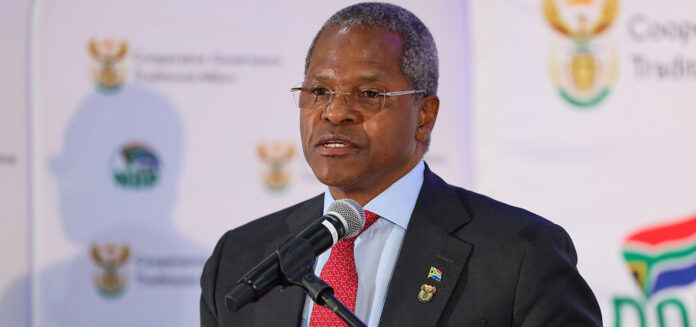
Cooperative Governance and Traditional Affairs (Cogta) Minister Velenkosini Hlabisa has directly accused five provincial MECs from Limpopo, KwaZulu-Natal, Mpumalanga, Free State, and North West of presiding over a systemic collapse in municipal governance, leaving billions in infrastructure grants unspent while basic services fail.
The accusation, detailed in scathing letters to Basikopo Makamu, Thulasizwe Buthelezi, Speed Mashilo, Saki Mokoena, and Gaoage Molapisi, the MECs of Cogta and human settlements, reveals that multiple municipalities are at risk of losing crucial funding, which would be reallocated to other provinces.
The minister’s audit paints a picture of profound dysfunction: rampant project delays, a lack of technical skill, zero consequence management, and the spectre of newly built infrastructure crumbling from neglect.
The crisis centres on the Municipal Infrastructure Grant (MIG), a lifeline for poor communities mandated by the Division of Revenue Act (DORA) to provide water, sanitation, and electricity and to stimulate local economies.
“I am writing to you… to bring to your attention significant and ongoing concerns regarding the performance and implementation of the Municipal Infrastructure Grants,” Hlabisa states in the letters.
“Despite urgent infrastructure needs, some municipalities in provinces are consistently failing to spend their full allocations, resulting in funds being reallocated to other municipalities or even other provinces.
“This points to planning and execution inefficiencies.”
The letters, in which Hlabisa also copied the premiers of Limpopo, KwaZulu-Natal, Mpumalanga, Free State, and North West, respectively, including finance minister Enoch Godongwana, follow a joint damning assessment on November 4.
The review involved Hlabisa’s department, the provincial Cogta, the Municipal Infrastructure Support Agent, and sectors for water and sanitation and treasury. All the letters identified a cycle of failure rooted in incompetence and inertia.
“Numerous projects suffer from significant delays due to inadequate planning, slow supply chain management processes, and issues with contractor performance.
“This leads to uncompleted projects and a lack of consequence management for non-performance,” writes Hlabisa.
Perhaps most alarmingly, he warned that the provinces’ failures are self-perpetuating.
He noted that even completed projects face immediate jeopardy due to poor maintenance.
He singled out a specific, wilful neglect of the law: “Some of these municipalities have shown reluctance to take up the requirement in the DORA to use at least 10% of their MIG allocations to undertake repairs and refurbishment of critical infrastructure.”
The technical breakdown is comprehensive.
Hlabisa cited a “lack of technical expertise and project management capacity”, crippling monitoring systems, and a procurement practice that, while aimed at empowerment, backfires catastrophically.
“Municipalities often select emerging service providers who have limited cash flow.
“While the intention behind this practice may be positive, it has been shown to affect project performance within the municipalities.”
Dozens of municipalities in Limpopo, KwaZulu-Natal, Mpumalanga, Free State and North West were named as performing “below expectations”.
The five municipalities in Limpopo include Sekhukhune district municipality in Groblersdal, and the 11 in KZN include uMkhanyakude in Mtubatuba.
Mpumalanga and Free State have seven municipalities which include Emalahleni in Witbank and Maluti-A-Phofung in Qwaqwa, respectively. North West features 11 municipalities such as Ditsobotla in Lichtenburg and the City of Matlosana in Klerksdorp, among others.
The disclosure reveals deeper rot; Maluti-A-Phofung and Nala have not even submitted their 2024/2025 annual financial statements, a basic requirement of accountability.
The minister’s final warning was unambiguous: continued failure would not be tolerated.
“Some of the municipalities were risking losing funds, which would end up being allocated to other municipalities in other provinces if they failed to do what is right.”
The letters place the crisis squarely on the desks of all MECs of Cogta, provincial premiers, and heads of departments, demanding immediate corrective action to stop the flow of funds intended for South Africa’s poorest communities from being diverted away from various provinces entirely.