


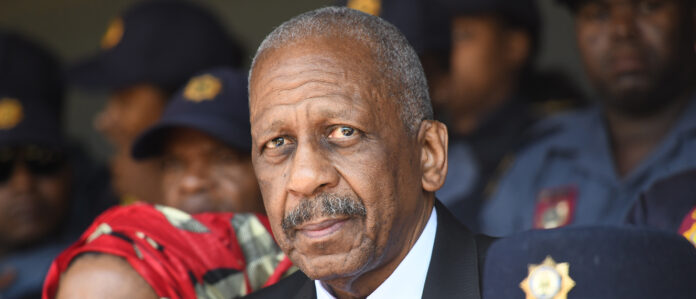
African National Congress (ANC) veteran Dr Mathews Phosa has told public sector leaders that November’s local government elections will serve as a mirror held up to South Africans, testing whether their lives have improved in the two and a half years since the ANC lost its parliamentary majority and was forced into a Government of National Unity.
Delivering the keynote address at TOPCO’s Public Sector Leaders’ Summit at the Indaba Hotel on Tuesday, the former ANC treasurer-general and Mpumalanga premier said the explanations for the ANC’s historic 2024 defeat could be boiled down to two failures: non-delivery by government, and an absence of leadership.
A verdict two and a half years in the making
Phosa said the electorate had grown immune to political promises that arrive late, if at all, and “only in small pockets.”
Voters, he argued, had already delivered their verdict once, in 2024, and would do so again in November — this time at municipal level, where the impact of failing services is felt most directly.
READ: Voter registration drive gathers pace ahead of 2026 municipal elections
He pointed to potholed roads, unreliable water and electricity, unemployment, crime and corruption as the daily evidence voters use to judge government performance. Citing a recent poll, he said Johannesburg’s biggest party had lost close to 40% of its support since the city’s first municipal elections — a figure he used to illustrate how quickly public confidence can evaporate.
‘Constitutions cannot repair roads’
Rejecting the idea that South Africa’s problems are primarily financial, Phosa argued that the country is facing a crisis of governance, leadership, institutional capability and accountability at municipal level.
“Constitutions cannot repair roads. Policies cannot collect refuse. Strategies cannot fix leaking water pipes.”
He argued that only capable people and institutions can translate constitutional promises of dignity and equality into lived reality.
He warned that the consequences of collapsing trust extend well beyond service delivery, arguing that instability, poor procurement and the loss of skilled professionals scare off investment, weaken municipal revenue and choke job creation — deepening what he called a “cycle of deterioration.”
Phosa’s fix: a smaller state and a single-tier system
Phosa used the platform to push a specific reform agenda rather than vague appeals for accountability. Among his proposals:
- A smaller public service and a smaller Cabinet
- Downsizing state-owned enterprises and leaning harder on public-private partnerships
- Opening more commercial sectors — building on moves already underway in education, health and energy — to entrepreneurs
- “Decisive and uncompromising” anti-corruption enforcement
- Reforming the management of the police service, which he said could no longer tolerate senior officers accused of fabricating evidence
- A dedicated delivery agency, reporting directly to the Presidency, tasked with fast-tracking service delivery across all tiers of government
- Scrapping the current two-tier municipal system in favour of wall-to-wall, single-tier local government, which he said would cut duplication and close off avenues for local corruption
He cautioned that without a “stable centre” to anchor these reforms, South Africa risks drifting toward a political landscape where no single party dominates – making coherent governance harder to achieve.
READ: ANALYSIS| DA’s high-stakes conference to test party’s identity in GNU era
‘Find your voices’
Phosa closed with a direct appeal to the room and to voters generally: get involved, scrutinise candidates standing for municipal office, and use the ballot in November.
“We must not complain when things remain as they are — when we continue to be governed by people and parties that are inward-looking, self-serving and corrupt,” he said, urging citizens to “find your voices” and demand ethical leadership and accountability from those elected to serve them.
- This article is a summary of Phosa’s speech delivered August 18, 2026 at the TOPCO Public Sector Leaders’ Summit, Indaba Hotel.
- Dr Mathews Phosa said the November local government elections will test whether South Africans' lives have improved since the ANC lost its parliamentary majority in 2024.
- Phosa identified two main reasons for the ANC's historic 2024 defeat: government non-delivery and leadership failure.
- He criticized the current two-tier municipal system and proposed replacing it with a single-tier local government to reduce duplication and corruption.
- Phosa called for reforms including a smaller public service, downsizing state-owned enterprises, stricter anti-corruption enforcement, and a delivery agency reporting directly to the Presidency.
- He urged voters to actively scrutinize municipal candidates and use the November ballot to demand ethical leadership and accountability.


