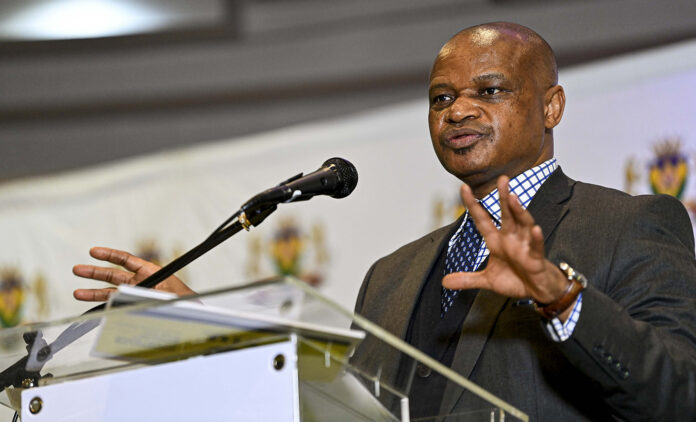

The Pretoria High Court has ruled that only those directly affected may challenge presidential decisions—and that courts will not interfere with how the president appoints key officials unless the decision is irrational.
Judge Etienne Labuschagne, sitting in the Pretoria High Court, dismissed an application to overturn the appointment of Advocate Andy Mothibi, setting out how standing and executive power operate in review proceedings.
The case arose from a challenge by B.X. Zulu and Partners Inc. to both the advisory panel process used to identify candidates for national director of public prosecutions (NDPP) and President Cyril Ramaphosa’s subsequent decision to appoint Mothibi outside that process.
The applicant argued that the process was procedurally flawed—in particular, that its objections to one of the candidates had not been properly dealt with—and that this irregularity affected the legality of the final appointment.
The court dealt first with standing.
None of the candidates were suitable
“The applicant cannot demonstrate that the decision… has adversely affected its own interests,” Labuschagne held, relying on Giant Concerts CC v Rinaldo Investments (Pty) Ltd.
The firm had participated in the advisory process to oppose the candidacy of Hermione Cronje.
The panel ultimately recommended that none of the candidates were suitable. On that basis, the court found the applicant had achieved its objective and could not show any adverse effect.
Without that, the court held, there was no standing to pursue the review. Labuschagne then addressed the status of the advisory panel.
Its recommendation, he said, “is merely a precursor to the executive action itself” and “does not on its own constitute a decision” capable of review under the principle of legality.
The applicant argued that flaws in the panel process should invalidate the president’s decision.
The court rejected the argument, finding that the two were not legally continuous.
“There is a factual break between the first and the second decision,” the judgment states.
Once the panel concluded that none of the interviewed candidates were suitable, its role ended. The appointment of Mothibi was a separate exercise of power.
The court relied on Masetla v President of the Republic of South Africa to characterise the appointment as executive action.
“It would not be appropriate to constrain executive power to requirements of procedural fairness,” the Constitutional Court held in Masetla, a passage applied in this judgment.
The applicant argued that Mothibi had not been subjected to the same public process as other candidates.
The court accepted that the processes differed but held that the differences did not render the decision unlawful.
“It is arguably unfair… [but] the President was acting in a procedurally rational manner in changing tack,” Labuschagne said.
Parties ordered to pay own costs
The court found that the advisory process had been completed and had not produced a suitable candidate.
In those circumstances, the president was not required to restart the process or follow the same method again.
“The president is empowered… to get on with the business of governing the state without undue procedural restraints,” the judgment states.
The application was dismissed. Each party was ordered to pay its own costs in line with the Biowatch principle.
The judgment confirms that standing requires a direct impact on the litigant, that advisory recommendations are not independently reviewable in legality challenges, and that presidential appointments are subject to rationality rather than procedural fairness.
- The Pretoria High Court ruled that only individuals directly affected can challenge presidential decisions, and courts will not interfere with presidential appointments unless the decision is irrational.
- The court dismissed an application to overturn Advocate Andy Mothibi’s appointment as NDPP, ruling the advisory panel’s recommendation is not independently reviewable since it is merely a precursor to the president’s executive action.
- The applicant lacked standing as it could not demonstrate any adverse effect; notably, the advisory panel found none of the candidates suitable, which achieved the applicant’s objective.
- The court affirmed the president’s discretion to appoint outside the advisory panel process, emphasizing that executive power should not be constrained by procedural fairness but must be exercised rationally.
- Both parties were ordered to pay their own costs, with the judgment reinforcing that presidential appointments are reviewed on rationality grounds, not procedural fairness, and advisory panel processes do not create legally reviewable decisions.
Judge Etienne Labuschagne, sitting in the Pretoria High Court, dismissed an application to overturn the appointment of Advocate
“
Its recommendation, he said, “is merely a precursor to the executive action itself” and “does not on its own constitute a decision” capable of review under the principle of legality.
“
Once the panel concluded that none of the interviewed candidates were suitable, its role ended.
“It would not be appropriate to constrain executive power to requirements of procedural fairness,” the Constitutional Court held in Masetla, a passage applied in this judgment.
“It is arguably unfair… [but] the President was acting in a procedurally rational manner in changing tack,” Labuschagne said.
In those circumstances, the president was not required to restart the process or follow the same method again.
“