


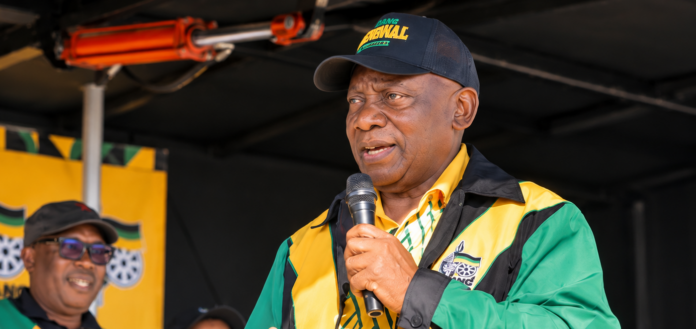
President Cyril Ramaphosa’s traditional voting station in Soweto will become a test of whether the ANC can recover ground in his neighborhood when South Africans vote in the municipal elections on November 4.
At Hitekani Primary School in Chiawelo, where Ramaphosa has repeatedly cast his ballot, the governing party faces an electorate that has grown increasingly difficult to impress.
The school has witnessed the rise of Ramaphoria, the anger of residents protesting over basic services and, more recently, desperate appeals for help from citizens who feel abandoned by the government.
If Ramaphosa returns to the school next month, he will encounter a political landscape far removed from the enthusiastic reception he received seven years ago.
READ MORE: Ramaphosa urges South Sudan leaders to uphold peace deal ahead of December elections
The Presidency has yet to publicly confirm his voting arrangements for November 4.
Hitekani, situated at 4131 Masungwini Street, falls within Johannesburg’s Ward 11, a short distance from Ramaphosa’s childhood home.
The ANC won the ward in 2021, but its support had declined sharply.
The party received 2 724 ward votes, down from 3,998 in 2016. The Patriotic Alliance secured 1 072 votes, while the DA attracted 606.
Of the ward’s 15 888 registered voters, only 7 163 participated in the 2021 elections, representing a turnout of 45.08%.
Those figures leave Ramaphosa’s party with two challenges. It must defend the ward and persuade disillusioned voters to return to the polling stations.
When the cheers turned to boos
Hitekani’s political history offers a revealing account of Ramaphosa’s changing fortunes.
In May 2019, the school became a celebration of his popularity as South Africans voted in the national elections.
Supporters crowded around him, hoping to shake his hand or capture a photograph.
When counting ended, the ANC had secured more than 75% of the valid national and provincial votes at that voting station.
More than 70% of the station’s 1 973 registered voters had participated.
The atmosphere changed dramatically during the municipal elections on November 1, 2021.
READ MORE: Ramaphosa- We call for voters to vote for the ‘real manifesto’
This time, Ramaphosa’s convoy approached a neighbourhood marked by service-delivery protests.
Residents had blocked roads with rocks and debris as they demanded electricity and water.
Some booed the president as he arrived with his wife, Tshepo Motsepe.
The complaints followed him to the school gates.
Ramaphosa acknowledged their frustration, saying residents had legitimate reasons to complain about municipal services.
“We know what the problems are,” he said, promising that the ANC would correct what had gone wrong.
The following municipal election now approaches, with those commitments forming part of the president’s political record.
The unfinished business of Ward 11
In March this year, Johannesburg officials returned to the area to confront some of the problems that continue to trouble residents.
City Power, Johannesburg Water, Pikitup and City Parks participated in an oversight programme covering wards 11, 12 and 13.
Officials identified longstanding concerns involving electricity infrastructure, streetlights, illegal dumping and neglected public spaces.
The city’s environment and infrastructure MMC, Jack Sekwaila, discussed introducing solar-powered lighting to combat theft and vandalism.
Ward 11 councillor Masha Mulelu, an ANC representative, welcomed the intervention but made clear that residents expected results.
“Residents expect to see visible progress on the ground,” Mulelu said.
The municipality has not established in that statement how much of the proposed work has since been completed.
That leaves an important question hanging over the ANC’s campaign in Ramaphosa’s backyard.
READ MORE: SACP weighs option to push for Ramaphosa’s recall
Five years after the president promised improvements, how much has changed?
The school itself has continued to provide a stage for the country’s political frustrations.
During the 2024 national elections, Imameleng Raphuthing travelled from Molapo to Hitekani, hoping to attract Ramaphosa’s attention.
She fell to her knees and pleaded for help, saying she had struggled for years to obtain identity documents and birth certificates for her children.
Her desperate appeal contrasted with the celebrations that accompanied Ramaphosa’s arrival in 2019.
For the president, the familiar polling station carries both personal history and political significance.
The wider ward remains under the ANC’s Masha Mulelu, who won the seat in 2021.
When voters return on November 4, they will determine whether the governing party can hold the area despite declining support and longstanding complaints.
And for Ramaphosa, should he once again walk through the gates of Hitekani Primary School, the occasion will offer another reminder that election day comes with its own report card.
This time, it is the voters who award the marks.
- President Cyril Ramaphosa's traditional voting station is at Hitekani Primary School in Soweto's Ward 11, Johannesburg.
- The ANC's support in Ward 11 declined from 3,998 ward votes in 2016 to 2,724 in 2021, with a voter turnout of 45.08%.
- During the 2019 national elections, the ANC received over 75% of votes at Hitekani, but in the 2021 municipal elections, the atmosphere was marked by service-delivery protests and resident frustration.
- Johannesburg officials identified ongoing infrastructure issues in Ward 11 in March 2024, including electricity, streetlights, illegal dumping, and neglected public spaces.
- Voters on November 4 will decide if the ANC can retain Ward 11 despite declining support and unresolved community complaints.


