


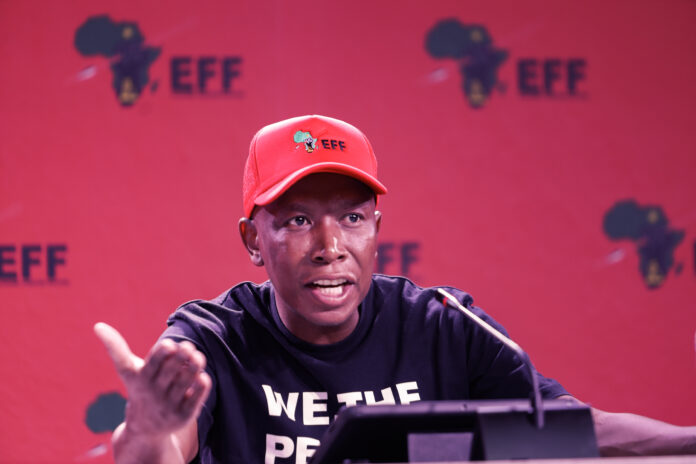
The Independent Electoral Commission (IEC) has accused EFF leader Julius Malema of peddling misleading statements about the integrity of the national and provincial elections.
The IEC’s remarks come after comments made by Malema in a recent podcast, where he alleged that votes cast for his party at Mponegele Primary School in Polokwane, Limpopo, were wrongly allocated to the ANC.
“The electoral commission notes with concern sustained, yet inaccurate, statements regarding the management and integrity of the results of the 2024 national and provincial elections,” the commission said in a media statement.
“The electoral commission is particularly concerned by the persistent false statements by political party leaders, which have the potential to undermine public confidence in the integrity of the impending elections of municipal councils.
“The latest of these statements appears in the podcast featuring the president of the EFF, in which he alleges that the electoral commission swapped votes at his voting station (Mponegele Primary School) in Polokwane, Limpopo. Allegedly, his party votes were attributed to the ANC.
The allegation is not correct. Results slips in the hands of the commission indicate that the Mponegele Primary School vote count is the same as those captured on the commission’s results system.
“The commission wishes to indicate that South Africa’s result collation process is robust and predicated on transparency, extensive safeguards, and checks and balances, which are designed to protect the integrity of the election results.
“The commission is acutely aware that result slips, which are completed at voting stations, represent the ultimate record of the political will of the voters within voting districts.
“Hence, the inherent checks and balances institutionalised in the result collation process,” said the IEC.
The commission stressed that South Africa’s election results process relies on transparency, safeguards, and multiple verification mechanisms to ensure the credibility of outcomes.
Meeting to discuss election readiness
Among the safeguards highlighted by the IEC are the following:
- Vote counting conducted at voting stations in the presence of party agents and observers;
- Completion and signing of results slips by party agents;
- A double-blind system used to capture results electronically;
- Independent audits of captured results and the results system itself;
- Opportunities for political parties to inspect and audit the system;
- Public access to voting station results through Results Operating Centres; and
- The ability for parties and media to photograph and broadcast result slips immediately after completion.
The IEC said results slips completed at voting stations remain the “ultimate record” of the will of voters within each district.
Despite rejecting the EFF’s claims, the commission confirmed that senior officials will meet with the party’s leadership on May 21.
The meeting will focus on election readiness and any concerns the EFF wishes to raise regarding the electoral process.
The commission reiterated that it remains open to engagement with all political parties through political liaison committees to strengthen confidence in South Africa’s electoral democracy.
- This story has been updated
- The Electoral Commission has accused EFF leader Julius Malema of spreading false claims about the integrity of the 2024 national and provincial elections.
- Malema alleged in a podcast that votes at Mponegele Primary School in Polokwane were swapped, wrongly attributing EFF votes to the ANC.
- The commission confirmed that the vote counts at the voting station matched the official results captured in their system.
- The IEC emphasized that South Africa’s election result collation process is transparent and includes robust safeguards to ensure integrity.
- The Electoral Commission warned that such misleading statements by political leaders risk undermining public confidence in upcoming municipal elections.


