


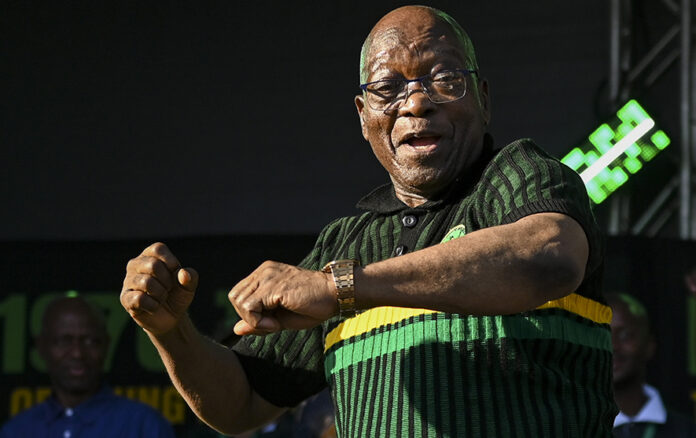
Former president Jacob Zuma has told the high court that “millions” of South Africans support his claim that retired Constitutional Court Justice Sisi Khampepe acted with personal animosity toward him—and that her decision to imprison him sparked unrest that left more than 350 people dead.
In an urgent review application filed in the Johannesburg High Court, Zuma seeks to set aside Khampepe’s decision refusing to recuse herself from a Commission of Inquiry into the Non-Prosecution of Apartheid-Era Crimes and to have her removed from the body altogether.
Zuma asserts that Khampepe harbours deep personal hostility toward him, and the public’s support for his position is substantial.
“Millions of people in South Africa continue genuinely to believe that the judgment was driven by undue vengeance, bitterness, and highly personalised animosity,” Zuma states in his founding affidavit.
July 2021 unrest linked to imprisonment
He goes further, directly linking his imprisonment to the deadly July 2021 unrest.
“The decision reportedly sparked unprecedented levels of public rejection and unrest, which regrettably resulted in the death of 350 South Africans and untold economic damage,” Zuma says.
“But for the judgment, all those would still be alive today.”
The former president uses the claim of widespread public backing to bolster his argument that Khampepe’s continued role in the commission undermines its legitimacy and creates a reasonable perception of bias.
Zuma’s affidavit revisits the circumstances surrounding his imprisonment for contempt of court, arguing that the decision was motivated not by law but by personal hostility.
“Judged from both the tone of these last two judgments and her general demeanour, it was self-evident that Khampepe was motivated by deep-seated personal hatred, animosity, and/or anger specifically directed towards me,” he states.
He argues that Khampepe’s public comments after retiring from the bench have only reinforced this perception.
“Further confirmation of my reasonable suspicions about the malice behind the judgment came in the form of various public media interviews conducted by Justice Khampepe after retirement,” Zuma says.
“I strongly believe that the tone and tenor of the interview confirms that my imprisonment was aimed at ‘teaching me a lesson’ rather than a detached application of law.”
The affidavit frames Zuma’s incarceration as the central event shaping his mistrust of Khampepe and forming the basis for his recusal bid.
The urgent application asks the High Court to review and set aside Khampepe’s January ruling dismissing his application for her recusal from the commission.
Reasonable suspicion of bias
The commission is conducting an investigation to determine whether the Truth and Reconciliation Commission process improperly stalled or blocked prosecutions.
Zuma argues that Khampepe’s previous judicial role in matters affecting him—including his imprisonment—creates at least a reasonable suspicion of bias.
According to the notice of motion and founding affidavit, the main relief sought is to have the recusal decision reviewed and declared unlawful and for Khampepe to be removed as chairperson or commissioner.
He also seeks a declaration that her conduct in dismissing the recusal application was unconstitutional and invalid.
Zuma’s lawyers have invoked both the Promotion of Administrative Justice Act (PAJA) and the constitutional principle of legality, arguing that the decision was procedurally unfair, irrational and influenced by bias.
Central to Zuma’s case is the legal standard governing recusal and judicial bias.
South African courts apply the test of whether a reasonable, objective, and informed person would reasonably believe the decision-maker is biased.
Zuma argues that Khampepe’s prior involvement in his imprisonment, combined with what he describes as her public comments and alleged hostility, meets this threshold.
The application contends that even the appearance of bias is sufficient to justify recusal, particularly in a commission dealing with politically sensitive historical prosecutions.
It also says that PAJA allows for the review of administrative decisions if they were made for a different reason, in bad faith, or with a reasonable suspicion of bias.
Alternatively, the principle of legality allows courts to set aside exercises of public power that are irrational or unlawful.
Zuma wants matter heard on expedited basis
Zuma says the matter is urgent because the commission’s work is time-limited and may be completed before a standard review process concludes.
The papers note that hearings are already under way and that failure to intervene promptly could render the review academic once the commission completes its mandate.
He has asked the court to hear the matter on an expedited basis and to compel the respondents to file the full record of the decision urgently.
The application sets up another legal confrontation between Zuma and senior members of the judiciary, reviving disputes linked to his imprisonment and its aftermath.
By invoking the support of “millions” and tying his incarceration to one of the deadliest episodes of unrest in democratic South Africa, Zuma is seeking to elevate what is formally a recusal dispute into a broader challenge about legitimacy, public confidence and the consequences of judicial power.
Whether the court will accept that these claims meet the strict legal threshold for recusal and judicial review will now be tested in what is likely to be a closely watched hearing.
- Former president Jacob Zuma has told the high court that “millions” of South Africans support his claim that retired Constitutional Court Justice Sisi Khampepe acted with personal animosity toward him—and that her decision to imprison him sparked unrest that left more than 350 people dead.
- In an urgent review application filed in the Johannesburg High Court, Zuma seeks to set aside Khampepe’s decision refusing to recuse herself from a Commission of Inquiry into the Non-Prosecution of Apartheid-Era Crimes and to have her removed from the body altogether.
- Zuma asserts that Khampepe harbours deep personal hostility toward him, and the public’s support for his position is substantial.
- “Millions of people in South Africa continue genuinely to believe that the judgment was driven by undue vengeance, bitterness, and highly personalised animosity,” Zuma states in his founding affidavit.
- July 2021 unrest linked to imprisonment He goes further, directly linking his imprisonment to the deadly July 2021 unrest.


