


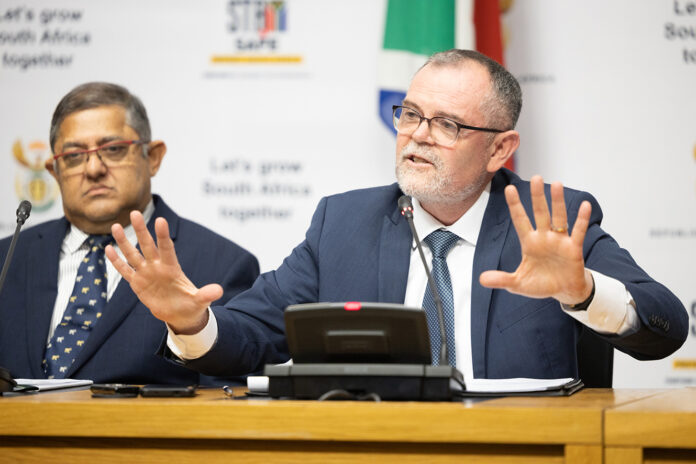
Senior DA official Dion George has resigned from the party, launching a scathing attack on its leader, John Steenhuisen.
George accuses Steenhuisen of being compromised and effectively “captured” by the ANC.
He made the blistering allegations during a wide-ranging interview with eNCA, where he announced that he had terminated his DA membership, which he has held since 1995.
George also stepped down as the party’s chairperson of federal finance and as an MP.
He described the environment within the DA as having become “intolerable”, claiming he was being sidelined for refusing to abandon principle in favour of maintaining the party’s position in the government of national unity (GNU).
According to George, Steenhuisen’s alleged political and financial vulnerabilities have left him unable to meaningfully challenge the ANC from within government.
“The DA has been captured. It has been muzzled and has lost its voice,” George said, arguing that this vulnerability has opened the door to put pressure on the ANC.
He linked this alleged capture to decisions taken by the party leadership, including his recent removal as minister of forestry, fisheries and the environment.
Internal financial governance
George claimed the move was handled without due process, saying he first learned of his removal from a journalist while attending the COP30 climate summit in Brazil in November.
According to George, no formal charges or documentation were ever presented to him, despite repeated requests by his legal team for records relating to the decision.
He further alleged that, after publicly defending himself, he was issued a gag order, while other party figures, including Steenhuisen and newly appointed forestry, fisheries, and environment minister Willie Aucamp, were allowed to continue criticising him without consequence.
At the heart of his resignation, George said, was his belief that Steenhuisen had prioritised staying in the GNU “at any cost”, even if it meant diluting the DA’s policy positions, including what he described as weak resistance to black economic empowerment policies and shifts in foreign policy.
He also criticised the DA’s support for ANC-backed budgets, particularly that of the Department of International Relations and Cooperation, which he accused of aligning South Africa with authoritarian governments hostile to democratic allies.
Furthermore, he said he could no longer remain in a party that, in his view, had relinquished its role as a robust opposition and was now enabling ANC dominance from within government.
George raised concerns about internal financial governance, claiming that efforts to address irregularities were dismissed or “whitewashed” by party structures, something he said reflected a broader erosion of integrity under compromised leadership.
No evidence of misappropriation of funds
However, the DA’s federal legal council (FLC) cleared Steenhuisen after receiving internal complaints.
The FLC found no evidence of misappropriation of party funds relating to the use of his DA-issued credit card.
“The DA deserves leadership of a higher caliber,” George said, adding that the party’s federal conference in April would be a critical moment for its future direction.
In response, the DA confirmed George’s resignation, saying it was regrettable that he had chosen to leave the party before appearing before a pending disciplinary hearing.
In a statement issued by DA federal council chairperson Helen Zille, the party said allegations against George were already before the FLC and should have been addressed through internal processes rather than public platforms.
Zille said the complaints against George related to staffing arrangements in George’s former ministerial office, the alleged use of departmental information for internal party matters, and conduct that had brought the party into disrepute.
She, however, did not defend Steenhuisen but instead wished George well.
Zille added that the disciplinary process would continue as directed by the DA’s federal executive, despite George’s resignation.
- Senior DA official Dion George has resigned from the party, launching a scathing attack on its leader, John Steenhuisen.
- George accuses Steenhuisen of being compromised and effectively “captured” by the ANC.
- He made the blistering allegations during a wide-ranging interview with eNCA, where he announced that he had terminated his DA membership, which he has held since 1995.
- George also stepped down as the party’s chairperson of federal finance and as an MP.
- He described the environment within the DA as having become “intolerable”, claiming he was being sidelined for refusing to abandon principle in favour of maintaining the party’s position in the government of national unity (GNU).


