


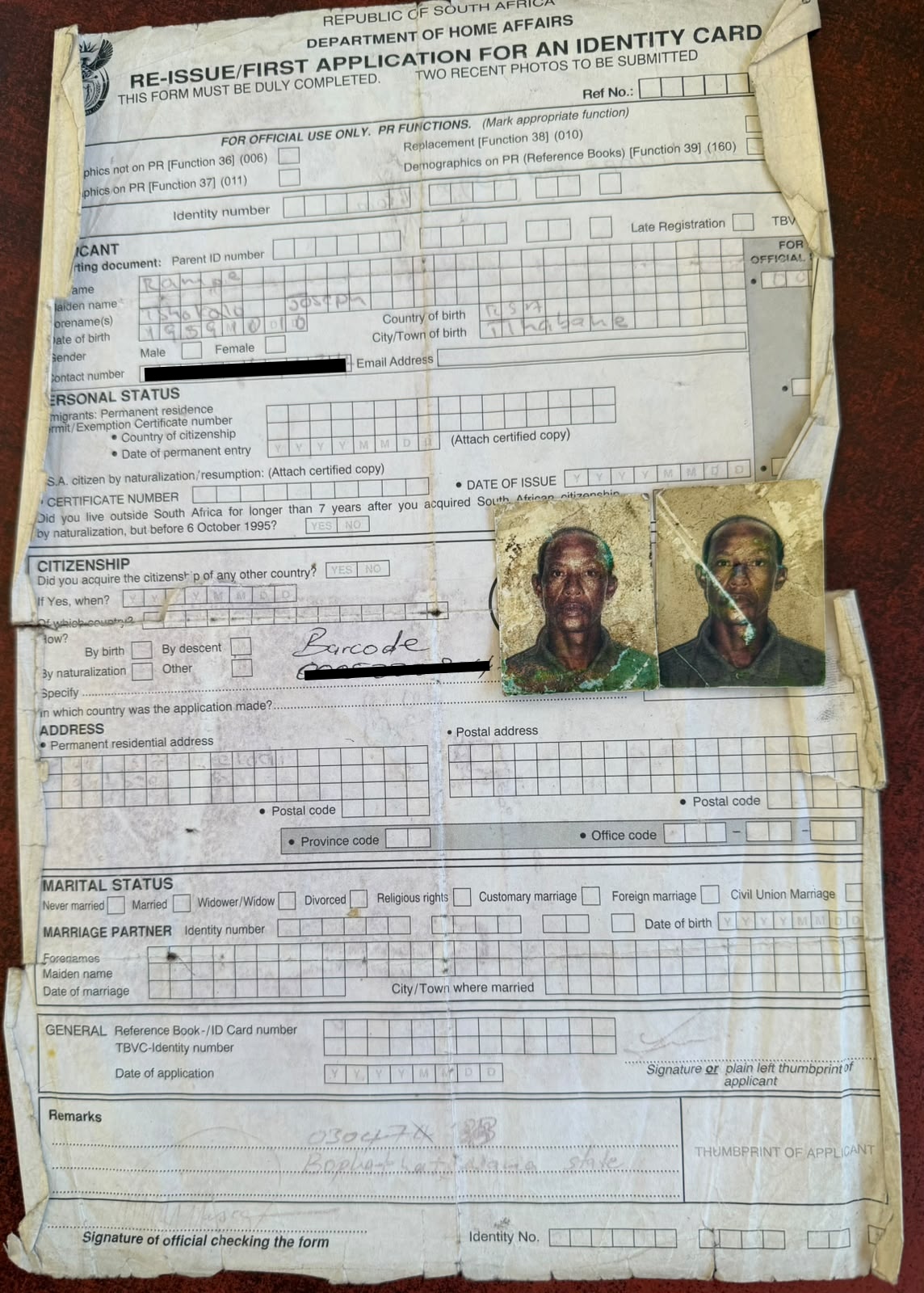
Six years after he began seeking documentation, Tshokolo Joseph Rampe says he is still waiting for the state to recognise him on paper, and all he has to show for his efforts are a Home Affairs application form, two identity photographs and years of official correspondence.
What the 67-year-old from the North West says he still does not have, is the identity document he needs to rebuild his life.
His collection of worn photographs, application forms and emails tells a more immediate story than the government’s modernisation plans.
Millions of South Africans remain without IDs
Last week, Jacinta Ngobese-Zuma’s movement threatened legal action against Home Affairs over the government’s priorities.
READ MORE: Jacinta Ngobese-Zuma expresses distress as anti-illegal immigration groups sign peace declaration
Rampe’s case illustrates the problem raised by Ngobese-Zuma’s March and March movement, and SA First Forum. The organisations want the government to prioritise millions of South Africans without identity documents.
Their lawyers wrote to Home Affairs Minister Leon Schreiber on October 14, demanding answers about delays and government priorities. They challenged plans to introduce online asylum registration while South African citizens continued struggling for documentation.
The lawyers described undocumented South Africans as “persona non grata in the land of their birth”. They demanded a response within 72 hours and threatened court proceedings by October 21 if the department failed to respond.
The organisations want Schreiber to explain how his department allocates resources and tackles the documentation backlog. They also want the government to halt the proposed asylum registration system until it addresses their concerns.
The letter argues that South African citizens should receive greater attention, particularly given the country’s unemployment and inequality.
A life on hold
Rampe’s documents describe an identity problem dating back to 2020. He says the consequences reach far beyond missing paperwork.
“Long delayed issue of ID which will enable me to apply for senior citizen pension and other necessities,” he wrote in a petition.
He described himself as an unemployed single parent living in a dilapidated Wendy house without water or electricity.
“I did not even register for COVID-19 vaccination,” he wrote.
One damaged Home Affairs application bears his personal details and two small photographs. The document does not explain why officials have not issued him an identity card.
Rampe also alleges that police and Home Affairs officials in Brits once tried to deport him. He says they accused him of being a foreigner without producing proof.
“My life is under siege,” he wrote, invoking his constitutional right to dignity.
His struggle eventually moved beyond Home Affairs as he sought assistance from institutions charged with protecting constitutional rights.
Trail of unanswered appeals
Correspondence dated November 21, 2024, shows the Constitutional Court’s acting registrar responding to a submission concerning Rampe’s case.
“Your letter appears to be handwritten,” the registrar wrote, explaining that the court could not accept an insufficiently legible submission.
“Please kindly have a printed letter sent to the court.”
The exchange does not show that Rampe lodged a court application or that judges considered his complaint.
In January 2026, a South African Human Rights Commission official acknowledged receiving documents and requested a reference number.
READ MORE: SAHRC slams ‘sick’ rape threat against Jacinta Ngobese-Zuma
In June, a Public Protector investigator requested a case-management number to check the complaint’s progress.
Home Affairs correspondence similarly requested an identity number to track his application.
The supplied correspondence contains no decision resolving his complaint.
His paperwork nevertheless illustrates how one person can move between government institutions without obtaining a clear answer.
Government sets 2029 target
The problem extends far beyond Rampe.
In 2025, Schreiber disclosed that more than 4.4 million South Africans aged 16 or older lacked identity documents.
That historical figure forms the basis of the campaigners’ latest demands.
On October 1, Schreiber acknowledged that millions remained undocumented 32 years after democracy.
He announced preparations for a national identification campaign beginning in the 2028/29 financial year. The department aims to document every South African citizen by 2029.
Schreiber said digital reforms would free officials for mobile biometric registration and complicated cases. He also promised to review late birth-registration procedures that prevent people from obtaining documents.
The plan leaves an immediate question for people such as Rampe. What happens while the government prepares its national campaign?
A dispute over government priorities
The letter sent on behalf of Ngobese-Zuma’s movement demands a timetable for documenting South Africans and an explanation of asylum-processing priorities.
It asks the department to demonstrate how it intends to address the backlog within a reasonable period.
The organisations also want the government to pilot online documentation services for South African citizens before introducing the proposed asylum system.
Home Affairs plans to introduce a phased asylum registration and appointment system by November 10.
READ MORE: IFP’s Hlabisa slams ‘asylum seekers’ who only come to SA for jobs
The measure follows a Constitutional Court ruling concerning access to asylum procedures.
Government officials say registration receipts will not confer refugee status. The state has separate legal duties towards citizens and asylum seekers.
An absent ID also does not automatically bar someone from applying for an older person’s grant. SASSA offers an affidavit-based application process while applicants pursue identification through Home Affairs.
Rampe’s documents do not show whether he has attempted that process.
Schreiber and Home Affairs spokesperson Thulani Mavuso did not respond to questions.
- Tshokolo Joseph Rampe has been waiting six years for an identity document from Home Affairs, which he needs to rebuild his life.
- Rampe is among millions of South Africans without identity documents, a problem highlighted by activists and organisations demanding government prioritisation.
- Home Affairs Minister Leon Schreiber announced a national identification campaign to document every South African citizen by 2029, with digital reforms and biometric registration planned.
- Activist groups have threatened legal action against Home Affairs for prioritising online asylum registration over documenting South African citizens without IDs.
- Despite correspondence with multiple government institutions, Rampe has not received a clear response or resolution regarding his identity document application.


