


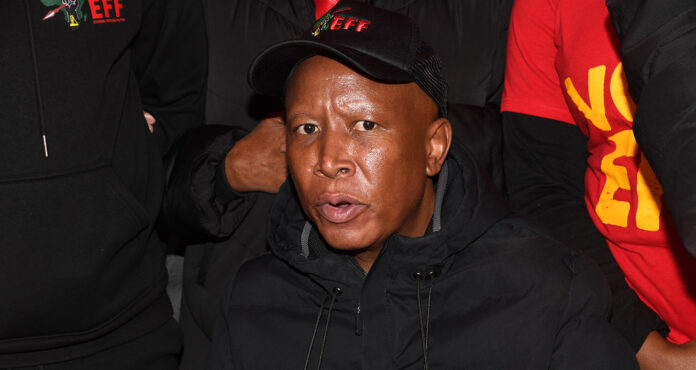
Before balloons drifted into the Thohoyandou sky and campaign songs faded, one question lingered over the EFF’s 13th birthday celebration: can the party finally convert spectacle into local government power?
For a movement that has spent more than a decade building a national profile, Saturday’s rally at Thohoyandou Stadium was different from previous birthday celebrations.
Gone were attacks on political rivals and the judiciary. Instead, EFF president Julius Malema devoted his address to municipal issues, unveiling the party’s 2026 local government election manifesto and introducing mayoral candidates.
The July 25 rally took place a day before the EFF’s official founding date of July 26, 2013.
The atmosphere suggested a party entering political adolescence. Whether that reflects organisational maturity or the reality of a movement yet to secure outright control of a municipality remains for voters to decide on November 4.
Malema’s address centred on service delivery, municipal governance and election readiness.
He unveiled mayoral candidates, including spokesperson Sinawo Tambo for Nelson Mandela Bay, treasurer-general Omphile Maotwe for Tshwane, deputy president Godrich Gardee for Mbombela, national chairperson Nontando Nolutshungu for Cape Town, Hlengiwe Mkhaliphi for eThekwini and Lourence Mapoulo for Polokwane.
Malema praised Limpopo’s organisational work, saying it was the first province to complete nominations for ward candidates.
“We are the first province in the whole of South Africa to complete ward candidate nominations,” he said.
He added that Limpopo was the first province to complete all election preparation tasks assigned to it.
Johannesburg mayoral candidate Dr Tlaleng Mofokeng administered an oath all EFF council candidates are expected to sign.
The pledge commits candidates to loyalty to South Africa and ethical conduct in public office. It includes a promise not to consume intoxicating substances or appear intoxicated in public, which the party presented as an effort to enforce discipline among representatives.
The manifesto launch opened the EFF’s local government campaign as it seeks to position itself as an alternative to the ANC and DA.
Its challenge remains substantial. Despite expanding its footprint and becoming the official opposition in several provinces and municipalities, the party has never won outright control of a municipality. It has instead acted as a kingmaker in coalitions.
Saturday’s event appeared designed less to provoke than to reassure supporters the party is focused on governance. Whether that quieter message resonates more than the confrontational politics that built the EFF will be a defining question of the 2026 elections.
- The EFF celebrated its 13th birthday with a focus on local government power, unveiling its 2026 election manifesto and mayoral candidates.
- Julius Malema emphasized service delivery, municipal governance, and election readiness, introducing candidates for key municipalities.
- Limpopo province was highlighted for completing all election preparation tasks first, including ward candidate nominations.
- EFF council candidates took an oath committing to ethical conduct and discipline, including abstaining from intoxicating substances in public.
- The party aims to shift from confrontational politics to governance-focused messaging, seeking to win outright municipal control in the 2026 elections.


