


The dominance of the ANC in the South African body politic space over the past half a century has established its influence far beyond its own internal affairs.
Its influence is so entrenched in the South African broader society that the state of being of our country almost always mirrors the state of affairs in Africa’s oldest liberation movement. Simply put, when the ANC sneezes, the rest of South Africa catches a cold, especially those closely aligned with the party, such as its so-called tripartite alliance partners – Cosatu and the SACP.
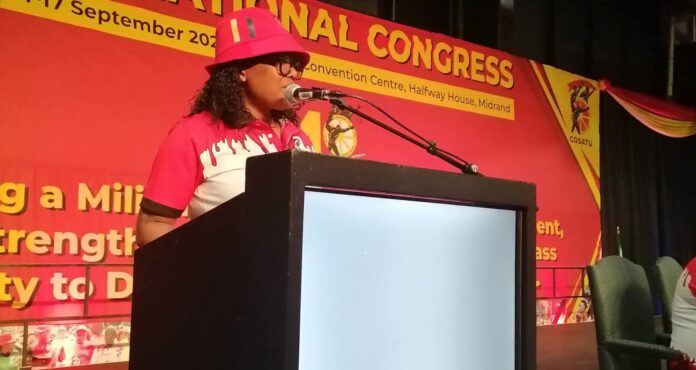
The degeneracy seen in the now adjourned Cosatu congress this week was therefore not a surprise at all. It was always coming, the question was always when, not if.
READ: ANC-led alliance in limbo as Cosatu congress collapses
The disintegration of the mass democratic movement in its entirety is another symptom of the toxicity of the ANC.
The cancer of chaos in the ANC can be located in the notorious 2007 Polokwane national congress, where all sorts of characters that would have never come anywhere close to leading in the organisation pulled a hostile takeover. Since then, it has been a race to the bottom.
It is not an accident of history that Cosatu, which abandoned its national congress this week owing to extreme divisions, led that hostile takeover in Polokwane.
One needs to look no further than MKP to see who is the father of chaos and disorder in the ANC.
It was Cosatu and SACP who led the charge for Jacob Zuma to rise to the summit of the ANC as president.
Since then, both ANC alliance partners have never known peace and have been weakened to almost a point of insignificance, particularly the once mighty and feared Cosatu, which had the power and capacity to put the country on a standstill.
Today, the Cosatu that in 2007 through its affiliate Sadtu halted the education system in the country for three months, is fighting over who must get elected to what position to a point of congress collapsing, something that has become normalised in the ANC.
The degeneration of Cosatu has been systemic, but is directly linked to the ANC’s Zuma era, where all chaos began.
The Cosatu split in 2014 that culminated in the expulsion of Numsa as an affiliate, with others following suit, was the beginning of the end for the trade union federation that is now a shadow of its former self.
The subsequent expulsion of its former general secretary Zwelinzima Vavi a year later added insult to injury and was confirmation that Cosatu had reached a point of no return and that it was headed for a cliff, at which point it might have arrived this week.
Blurring of autonomy
It was from the 2007 era that the lines between ANC and Cosatu were blurred and where it became unclear where autonomy starts and ends. From that point, the two, including SACP by the way, almost became one thing, with government deployments used as sweeteners to weaken the reds by capturing its leaders.
Everything disorderly and chaotic that has been happening in the ANC since 2007 is now happening in Cosatu in real time.
Just earlier this year, the ANC abandoned its conference in the Eastern Cape due to factional fights about who must lead.
Very few would have expected the same fate to befall Cosatu six months later but it has happened. It is the ANC that started the strategic purging of political opponents of the dominant faction through the selectively applied so-called step aside rule.
Nehawu leaders borrowed from that rule book in this abandoned Cosatu congress when they suspended its member, Mike Shingange hoping to disqualify him from standing for Cosatu President, a position which he had been nominated for by NUM and Samwu.
For that political manoeuvre to neutralise opponents by all means necessary, the whole congress collapsed. That is the level of toxicity that is the ANC cancer of chaos; it spreads faster than the Covid-19 virus.
The congress of Cosatu will now be reconvened before October 15 but is unlikely to be any different from the adjourned one. Despite its outgoing leaders putting out a brave face of unity, the divisions are wide enough a knife can cut through the cracks.
READ: Stretch tent or hospital hall, Cosatu congress will reconvene: Zingiswa Losi
Another Cosatu split cannot be ruled out should the hardline stances seen by the warring factions this week continue as expected. That too will be another function of the ANC infectious cancer with the former liberation movement itself having split three times since 2007 – birthing Cope, EFF and MKP.
Who is to say that another Cosatu split is out of the question? Only time will tell as the ANC cancer of disorder and chaos continues to spread.
- The ANC's influence on South Africa's broader society is deeply entrenched, affecting allied organisations like Cosatu and the SACP.
- The 2007 Polokwane national congress marked a turning point in the ANC, leading to a takeover by factions that introduced ongoing chaos.
- Cosatu's decline, including its 2014 split and the expulsion of key members, is directly linked to the ANC's Zuma-era turbulence.
- Autonomy between the ANC, Cosatu, and SACP has blurred since 2007, with political manoeuvres denying opponents fair leadership contests.
- The recent adjourned Cosatu congress due to factional fights reflects the ANC's broader pattern of disorder, with another Cosatu split possible.


