
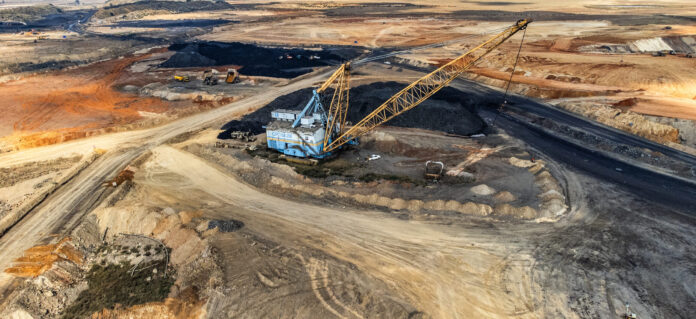
Allegations that police stood by while armed protesters blocked access to a coal operation in Mpumalanga have triggered a political storm, raising urgent questions about selective law enforcement, local factional power and the state’s ability to govern contested economic spaces.
In a legal letter sent to the Police Minister’s chief of staff, Cedric Nkhabinde, as well as national and provincial SAPS leaders, local authorities, and the Department of Mineral and Petroleum Resources, lawyers for Liberty Coal and Liberty Mine Services claim that police did nothing while armed protesters blocked a national road and access to the mine during illegal public gatherings.
The complaint, dated January 21, warns that the company will seek urgent court intervention if authorities do not act. It accuses state officials of allowing a pattern of unlawful conduct to continue unchecked.
Police accused of bias, inaction
At the heart of the dispute is the allegation that police officers were present at a gathering outside Liberty Coal’s offices on January 20 but did not disperse participants or restore access. This despite what the company says was clear non-compliance with the Regulation of Gatherings Act.
According to the letter, “despite the Municipality’s formal prohibition, the SAPS members present have, to date, failed to take the necessary steps contemplated in Section 9(1) and 9(2) of the Gatherings Act to disperse the participants or restore access to the Premises.”
The attorneys further allege that the gathering “cannot be characterised as spontaneous” and that it occurred “on the exact date for which an application was previously and correctly refused by the municipality.”
The allegations go beyond administrative non-compliance. Liberty Coal claims it has evidence that certain participants “openly carried firearms, including high-calibre semi-automatic weapons”. It concealed their faces with balaclavas, and transported weapons in vehicles.
The letter states bluntly that “peace and order were not effectively maintained, despite a SAPS presence”. A claim that, if substantiated, places police conduct under intense scrutiny.
Signs of governance failure
While SAPS had not publicly responded to the allegations at the time of publication, the complaint frames police inaction as central to the escalation of risk. Not merely an operational lapse, but a governance failure.
Adding to the political sensitivity, the company alleges that certain municipal councillors attended at least one of the gatherings. It warn that state officials must avoid “appearing to endorse unlawful conduct.
In Mpumalanga’s coal belt, where local governments, business interests, and political factions often intersect, the presence — or perceived tolerance — of elected officials at disputed protests carries heavy implications. This blurs the boundaries between protest, political mobilisation, and economic leverage.
Liberty Coal’s lawyers outline four separate notices submitted under the Gatherings Act between December 2025 and January 2026 by different conveners, including civic organisations, ward committees, and community groups — targeting the same geographic choke points around the N11 national road and the Pullenshope mining area.
The letter argues that this sequence suggests coordination rather than coincidence. It notes that notices were often submitted shortly after previous applications were refused.
In one instance, the attorneys point to the involvement of entities linked to companies previously associated with the mine. It states that their participation “suggests that these gatherings are being used for collateral purposes to interfere with our clients’ lawful business operations”.
Coal embedded in patronage networks
Coal in Mpumalanga is never just about energy or jobs. It is embedded in local patronage networks, tender ecosystems and political survival. Control over access routes, mining rights, and operational continuity can translate into leverage — economic, political, or both.
Analysts note that protests in mining areas often sit at the intersection of genuine community grievances and factional battles within and around the state. When police enforcement appears uneven, those dynamics intensify, creating space for intimidation and power-brokering outside formal institutions.
Liberty Coal’s attorneys explicitly warn that the constitutional right to assemble is being “invoked as an instrument for unlawful conduct and the advancement of third-party objectives through intimidation”.
The company has demanded confirmation of the appointment of a responsible municipal officer. And it has warned that it “will not hesitate to take urgent and decisive action” if it does not receive a satisfactory response.
- Allegations that police stood by while armed protesters blocked access to a coal operation in Mpumalanga have triggered a political storm, raising urgent questions about selective law enforcement, local factional power and the state’s ability to govern contested economic spaces.
- In a legal letter sent to the Police Minister’s chief of staff, Cedric Nkhabinde, as well as national and provincial SAPS leaders, local authorities, and the Department of Mineral and Petroleum Resources, lawyers for Liberty Coal and Liberty Mine Services claim that police did nothing while armed protesters blocked a national road and access to the mine during illegal public gatherings.
- The complaint, dated January 21, warns that the company will seek urgent court intervention if authorities do not act.
- It accuses state officials of allowing a pattern of unlawful conduct to continue unchecked.
- Police accused of bias, inaction At the heart of the dispute is the allegation that police officers were present at a gathering outside Liberty Coal’s offices on January 20 but did not disperse participants or restore access.