


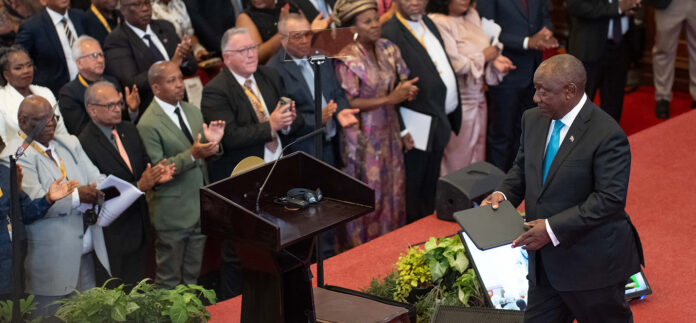
MK Party member of the National Council of Provinces, Edward Nzimande, accused the administration of President Cyril Ramaphosa on Wednesday of offering “rhetoric and illusion” instead of concrete solutions to unemployment, inequality, and service delivery failures.
Speaking during the debate on Ramaphosa’s State of the Nation Address (SONA) last Thursday, Nzimande said the government’s policy direction amounted to “work without justice, promises without delivery, and hope without dignity”.
“But what your SONA is—is rhetoric and illusion, full of illusion. Let me tell the nation what it means: it means work without justice, promises without delivery, and hope without dignity,” Nzimande told the chamber.
Nzimande argued that the president’s economic plan lacked credible implementation details and financial clarity, describing it as “a fallacy” when subjected to serious scrutiny.
“What we have said is that the plan—including its unclassified cost—is a problem,” he said. “Who is to be blamed, if not you and your deputy, for what you have been doing?”
He criticised what he described as the absence of transparent costing and coordination, saying interventions announced in the SONA risked remaining aspirational rather than actionable.
Structural exclusion in the economy
According to Nzimande, the government had failed to confront the structural roots of unemployment and poverty, particularly among young people.
“It is artificial to speak of growth and jobs when trends are showing clearly that the unemployment of youth stands at 43% and is likely to rise by the end of the year,” he said.
“Millions of young people, children from the working class, remain trapped in poverty with no hope of meaningful opportunities.”
He further accused the government of failing to tackle “structural exclusion” in the economy, arguing that the concentration of wealth continued to block meaningful transformation of ownership and productive resources.
“The concentration of wealth means there is little chance to transform ownership of land, capital, and productive resources.
“Growth that benefits only the elite is anti-black and anti-child. The economy must serve the majority, not the entitlement of the few.”
Nzimande also turned his criticism toward the governing coalition’s partners, claiming the government of national unity (GNU) lacked ideological coherence and was undermining transformation.
“The GNU has no shared vision and ideological beliefs. The DA, Freedom Front Plus, AfriForum and your partners want to maintain the status quo.
“You appointed DA ministers in strategic departments with the sole purpose of undermining the developmental agenda.”
He singled out the education sector, arguing that current policy direction had failed to reposition education as a tool to transform social and economic power relations.
“Education has not advanced the fundamental role of government in using education to change societal power structures. Power relations shall continue in favour of the few.”
Decline in service delivery
Nzimande expressed that the president’s appeals for hope and unity seemed hollow in the face of deteriorating service delivery in housing, schooling, and infrastructure, especially in rural and working-class communities.
He said: “You say we must still have hope that we shall have shelter for all. No, Mr President. There is a decline in the delivery of quality housing, and facilities are inadequate across the country.”
He cited conditions in rural provinces, including Limpopo, as evidence of widening inequality between policy promises and lived reality.
“How are we ashamed when villages in Limpopo remain the only living example of underdevelopment, yet you are talking of growth?
“Primary school infrastructure is deteriorating. There is no furniture. Facilities are inadequate across the country.”
The address triggered several interjections and procedural interruptions in the chamber, with presiding officers urging members to allow debate to proceed without points of order.
Despite the disruptions, Nzimande concluded by insisting that the SONA had failed to convince citizens that the government possessed a coherent plan to reverse economic stagnation and social inequality.
“You speak of addressing inequality and injustice,” he said. “But when we critically analyse it further, we have found it to be a fallacy.”
- MK Party member of the National Council of Provinces, Edward Nzimande, accused the administration of President Cyril Ramaphosa on Wednesday of offering “rhetoric and illusion” instead of concrete solutions to unemployment, inequality, and service delivery failures.
- Speaking during the debate on Ramaphosa’s State of the Nation Address (SONA) last Thursday, Nzimande said the government’s policy direction amounted to “work without justice, promises without delivery, and hope without dignity”.
- “But what your SONA is—is rhetoric and illusion, full of illusion.
- Let me tell the nation what it means: it means work without justice, promises without delivery, and hope without dignity,” Nzimande told the chamber.
- Nzimande argued that the president’s economic plan lacked credible implementation details and financial clarity, describing it as “a fallacy” when subjected to serious scrutiny.


