


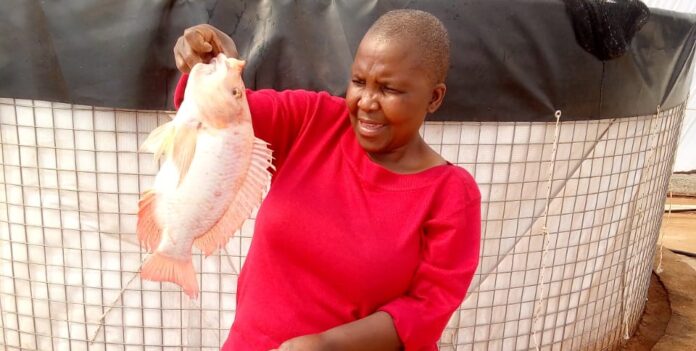
Thirty kilometres outside Ventersdorp, in the North West countryside, a fish farm is quietly demonstrating what economic transformation can look like when government support meets persistence, reinvestment, and a market willing to buy.
At Mathotshe Business Enterprise in Doornkop, Salome Mathobela now produces about 14 tonnes of fish a year.
Her customers include OK Grocer, Jonny Butchery and informal markets. The business also supplies Nile Tilapia to communities in the JB Marks municipality and has expanded beyond fish into vegetable production.
READ MORE: Fish farming creates jobs in rural village
It is not a story of instant success or a giant commercial operation.
It is a smaller story about what happens when a rural producer is given the tools to enter an industry, uses them, puts money back into the business, and begins finding customers.
This week, that journey has taken Mathobela from Doornkop to Tanzania, where organisers selected her to exhibit at an international gathering focused on women and young people in small-scale fisheries and aquaculture.
Her progress has also become a useful test of something government policy often promises but struggles to demonstrate on the ground — whether state support can help create black producers who eventually participate in real markets rather than remain permanently dependent on assistance.
From support to production
The North West Department of Agriculture and Rural Development helped Mathobela with an aquaculture recirculating system consisting of seven ponds, production inputs, a solar system and two vegetable tunnels fitted with irrigation infrastructure and seedlings.
Mathobela, in turn, reinvested in the enterprise by drilling and equipping another borehole for fish production.
The department says she is the first Black woman in South Africa to receive a Nile Tilapia permit. Her enterprise also holds a Mozambique Tilapia permit.
Those details matter because they show the different pieces that have to come together before rural development begins resembling an economy.
A producer needs infrastructure. She needs water and electricity. She needs technical assistance and permission to operate. But eventually she also needs customers.
Without that final step, production does not become a business.
READ MORE: Free State government awards honour young farmers
Agriculture MEC Madoda Sambatha said Mathobela’s progress showed what could happen when rural women received practical support rather than encouragement alone.
“Her achievement demonstrates what is possible when rural women are supported with the right infrastructure, production inputs, technical advice and opportunities,” Sambatha said.
He said the government had helped establish the production base, but Mathobela’s own entrepreneurship was central to what followed.
“Her progress shows that government support, combined with determination and entrepreneurship, can translate into sustainable rural businesses,” he said.
Building a rural economy
That combination is what makes the operation significant beyond Mathobela herself.
The country has often viewed rural provinces such as North West primarily as suppliers of labour and raw agricultural products to larger economic centres.
But farms such as Mathotshe point towards another possibility — local businesses producing food, supplying shops, serving nearby communities and gradually building their own place in formal supply chains.
The numbers remain modest. Fourteen tonnes of fish a year will not transform the North West economy on its own.
But pockets of progress such as these also make up transformation.
A Black woman acquires the permits to enter a specialised agricultural sector. The government provides infrastructure. The farmer adds her own investment. Production grows. Buyers emerge. The enterprise diversifies.
READ MORE: Why fish farming is booming and attracting more people to the sector in Zambia
The Tanzania trip provides another step.
Mathobela is participating from October 6 to 9 in an event titled “Empowering Women and Youth as Ocean Leaders: Untangling the Environmental Investment Challenges in Small-Scale Fisheries and Aquaculture”.
The initiative involves the South African Network for Women in Fisheries and Aquaculture, NRF-SAEON, AUDA-NEPAD and Nelson Mandela University.
Sambatha wants her to return with more than recognition.
He said Mathobela should use the platform to build partnerships, explore markets and investment opportunities and bring knowledge and innovation back to other farmers in the province.
That may ultimately be the more important measure of the project.
- Salome Mathobela's Mathotshe Business Enterprise in Doornkop produces about 14 tonnes of fish annually, supplying customers like OK Grocer, Jonny Butchery, informal markets, and communities in the JB Marks municipality.
- The North West Department of Agriculture and Rural Development supported Mathobela with a recirculating aquaculture system, solar system, vegetable tunnels, and irrigation infrastructure, making her the first Black woman in South Africa to receive a Nile Tilapia permit.
- Mathobela reinvested in her business by drilling and equipping an additional borehole, expanding production capacity and diversifying into vegetable farming.
- Agriculture MEC Madoda Sambatha highlighted Mathobela's progress as an example of how government support combined with entrepreneurship can create sustainable rural businesses.
- Mathobela will exhibit at an international event in Tanzania focused on women and youth in small-scale fisheries and aquaculture, aiming to build partnerships and bring knowledge back to other farmers in the North West province.


