
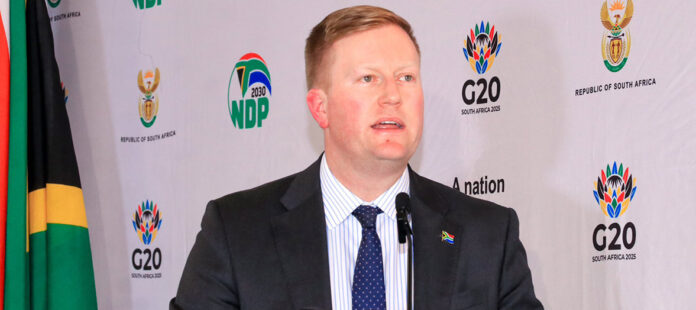
Public Works and Infrastructure Minister Dean McPherson is expected to travel to North West this week to formalise a targeted infrastructure intervention that provincial leaders say will mark a turning point in restoring service delivery and repositioning the province as an investment destination.
McPherson is due to meet North West Premier Lazarus Mokgosi on Friday, February 20, to sign a set of cooperation agreements that will see the presidential infrastructure agency Infrastructure South Africa (ISA) embedded in specific projects and municipalities to fast-track delivery.
The agreements will include a memorandum of understanding between the provincial government and the national Department of Public Works and Infrastructure to resuscitate Pilanesberg Airport, as well as a memorandum of cooperation between ISA and the Ramotshere Moiloa local municipality under the national “Adopt a Municipality”
initiative.
Mokgosi confirmed that the cooperation agreements will focus on infrastructure projects linked to economic recovery and service delivery.
The premier said the provincial government and the national department would sign an agreement “to revive Pilanesberg Airport”. The airport, once fully operational, will serve as a strategic access point for Sun City Resort and the Pilanesberg National Park.
The Department of Public Works and Infrastructure, through ISA, will also sign a memorandum of cooperation with the Ramotshere Moiloa municipality.
“In this regard, the municipality will benefit from various infrastructure projects that are aimed at expediting the provision of services for residents,” Mokgosi said.
He added that Ramotshere Moiloa had been selected under the Adopt a Municipality programme after demonstrating improved governance and financial discipline.
“The municipality has ticked all the right boxes in the form of improved audit outcomes as well as honouring payment arrangements with its creditors,” he said.
Mokgosi said the initiatives marked a turning point in the province’s efforts to create jobs, fight poverty and reposition the North West as “a viable and preferred destination for investments”.
The ISA deployment forms part of a technical intervention model in which the agency is embedded to support, and in some cases effectively run, project preparation and infrastructure implementation in struggling municipalities.
Government officials say ISA will package infrastructure projects, prepare feasibility studies, procure contractors; and monitor implementation and spending.
Under the model, municipalities remain the contracting authorities, but project delivery oversight shifts to ISA and national government structures.
“In practice ISA becomes the central project manager and delivery authority for priority infrastructure, while municipalities remain the contracting authorities,” a government official said.
The intervention focuses on capital infrastructure rather than daily municipal operations, with priorities including water systems, sanitation, roads and economic infrastructure.
Funding is expected to come from established streams, such as the Municipal Infrastructure Grant and other national allocations for water, sanitation, and road infrastructure, with the ISA tasked with ring-fencing and fast-tracking spending that has historically been delayed or mismanaged.
The ISA intervention was initially proposed several years ago but stalled amid tensions between national implementers and local political leadership.
At the centre of the friction was control over infrastructure budgets and procurement.
“The immediate perception was that there was a new pot of money and that procurement decisions would move away from councils. That created resistance,” said a senior provincial official involved in the negotiations.
Local political leaders feared that ISA’s role would shift control of tenders and project decisions away from municipal councils, weakening their influence over contractors and local economic opportunities.
“People believed ISA was arriving with its budget and would bypass councils. That triggered internal battles over who would control projects and spending,” another source said.
In reality, the model relied largely on existing conditional grants, with ISA tasked with ring-fencing and managing implementation to prevent underspending and stalled projects.
“The power is not in a new allocation but in controlling billions already allocated. That is where the contestation came in,” the source added.
Officials say the upcoming signing signals that these political and administrative obstacles have now been resolved, clearing the way for implementation.
On Friday, McPherson’s spokesperson James de Villiers declined to disclose details ahead of the signing. “The signing will be next week Friday in the North West. All your questions will be answered then,” he said.
Visit SW YouTube Channel for our video content
- Public Works and Infrastructure Minister Dean McPherson is expected to travel to North West this week to formalise a targeted infrastructure intervention that provincial leaders say will mark a turning point in restoring service delivery and repositioning the province as an investment destination.
- McPherson is due to meet North West Premier Lazarus Mokgosi on Friday, February 20, to sign a set of cooperation agreements that will see the presidential infrastructure agency Infrastructure South Africa (ISA) embedded in specific projects and municipalities to fast-track delivery.
- The agreements will include a memorandum of understanding between the provincial government and the national Department of Public Works and Infrastructure to resuscitate Pilanesberg Airport, as well as a memorandum of cooperation between ISA and the Ramotshere Moiloa local municipality under the national “Adopt a Municipality” initiative.
- Mokgosi confirmed that the cooperation agreements will focus on infrastructure projects linked to economic recovery and service delivery.
- The premier said the provincial government and the national department would sign an agreement “to revive Pilanesberg Airport”.