


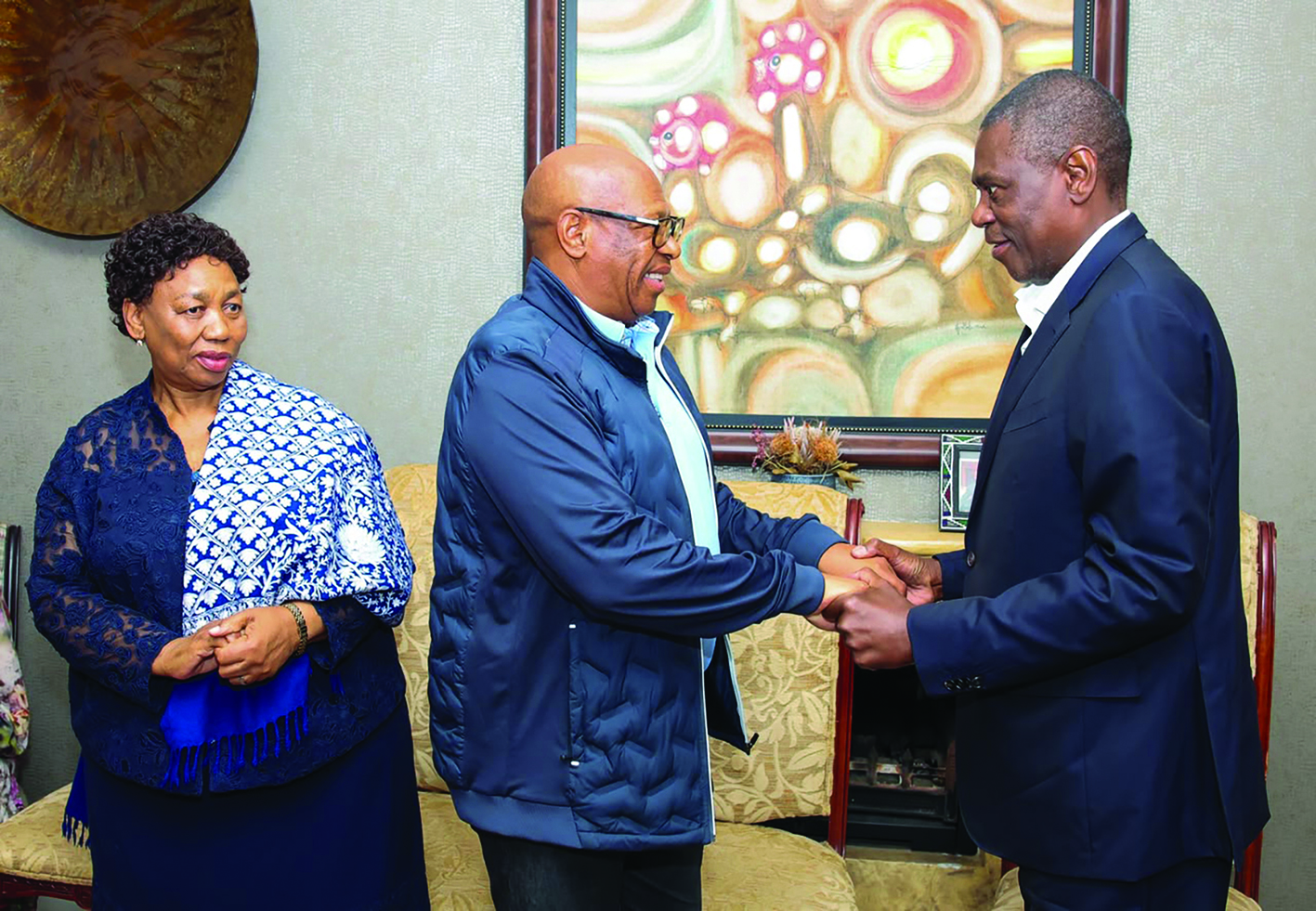
Messages of condolence have poured in from across South Africa’s political and social spectrum after the death of Phumzile Mlambo-Ngcuka, the country’s first female deputy president.
Mlambo-Ngcuka, who was South Africa’s second in command from 2005 to 2008, died on Friday aged 71. She has been lauded for her contribution to government, society and the global community.
Mlambo-Ngcuka will be honoured in a memorial service at Our Lady of Lourdes Catholic Church in Rivonia on Tuesday at 2pm and at a state funeral on Saturday in Middledrift (eXesi) in the Eastern Cape.
Her family said she “passed away following complications of a medical procedure she underwent about two weeks ago”. They were grateful for the messages of condolences.
“In these first hours of grief, it has brought them comfort and solace to hear from so many people who have shared what umama meant to them,” they said.
‘Epitome of a public servant’
ANC secretary-general Fikile Mbalula said the ANC had “not just lost a leader but a mother, a confidant and a deployee par excellence”.
Acting President Paul Mashatile conveyed his condolences to the family on behalf of President Cyril Ramaphosa, the government and citizens.
The EFF called Mlambo-Ngcuka “the epitome of a public servant” who saw education as fundamental to societal development. The party noted that she remained the only woman to have served as deputy president of the country.
The IFP said South Africa and the world had lost “a true patriot and a tireless advocate for women and humanity”.
RISE Mzansi said she was “a giant gone too soon”, recalling that she had urged “a new generation of leaders” to take the country forward.
Work that transcended boundaries
Among her many hats, Mlambo-Ngcuka was also the chancellor at the University of Johannesburg.
UJ vice-chancellor and principal Professor Letlhokwa Mpedi described her death as an immeasurable loss to the university and country. “She was a remarkable leader whose life and work transcended national boundaries, leaving an indelible mark on the advancement of women, education, human rights and social justice. We are deeply honoured to have had her serve as our chancellor.”
UN Secretary-General António Guterres said Mlambo-Ngcuka “was a lifelong champion of the rights and empowerment of women and girls”. “Phumzile believed that gender equality is not a favour to be granted but a right to be claimed. She claimed it fearlessly and brought millions of women and girls with her.”
Her background
Born in Clermont in KwaZulu-Natal in 1955, she worked as a teacher after obtaining her BA in social science and education from the National University of Lesotho in 1980. She later completed a master’s in philosophy in educational planning and policy, obtained in 2003.
In 2013, she completed a doctorate at the University of Warwick, focused on using mobile technologies to support teacher development in resource-poor nations.
Mlambo-Ngcuka was part of the class of 1994 – a special cohort elected to Parliament after the country’s first democratic government – where she served as deputy minister of trade and industry, minister of minerals and energy and, briefly in 2004, minister of arts, culture, science and technology.
She later served as UN under-secretary-general and executive director of UN Women. Through her work at the Umlambo Foundation, she supported teachers and improved learning opportunities for pupils.
- Phumzile Mlambo-Ngcuka, South Africa’s first female deputy president, died at age 71 following complications from a medical procedure.
- She served as South Africa’s deputy president from 2005 to 2008 and was also chancellor of the University of Johannesburg.
- Memorial services are scheduled for Tuesday at Our Lady of Lourdes Catholic Church in Rivonia and a state funeral on Saturday in Middledrift, Eastern Cape.
- Mlambo-Ngcuka was also a former UN under-secretary-general and executive director of UN Women, championing gender equality worldwide.
- Born in 1955 in KwaZulu-Natal, she held degrees in social science, education, philosophy, and a doctorate focused on mobile technologies in education.


