
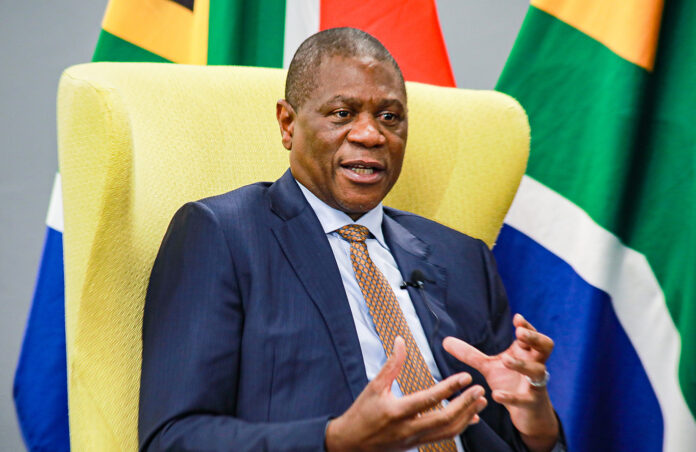
The National Council of Provinces (NCOP) convened in a hybrid plenary session today, December 4, for the annual address by Deputy President Paul Mashatile, focused on the theme “Restoring the dignity of our people through spatial planning, provision of human settlement, water and sanitation”.
The session, however, swiftly transformed from a presentation of government progress into a stark platform for opposition criticism over persistent service delivery failures.
In his address, Mashatile characterised the period under the government of national unity (GNU) as “a highly productive and transformative period for both the executive and parliament”.
Spatial planning
He emphasised efforts to reverse apartheid spatial planning and accelerate the delivery of housing and basic services.
This optimistic assessment was immediately challenged. Economic Freedom Fighters MP Mothusi Kenneth Montwedi delivered a scathing refusal.
“There is nothing productive about this year and all your walking visits. Our people’s living conditions are deteriorating every year. And unemployment is sitting at 42.4% with more than 8 million [people] unemployed.”
He presented a grim counter-narrative, highlighting that over 2 million households remain in “spaceless” informal settlements in areas like Tembisa, Alexandra, and Marikana.
Montwedi’s core accusation was one of political will, not state capacity.
“This is not because the government is not capable,” he argued. He pointed to the successful infrastructure management during recent high-profile events like the G20.
“As we were able to host world leaders and all that is deemed as not working was working… Our government can, but chooses not to do anything about their hardships.”
The debate took a sharper partisan turn with remarks from a representative of the MK party, Edward Nzimande. He labelled the ANC as “Amavaka” — an isiZulu term meaning hypocrisy or empty promises. This was in reference to its role in the government of national unity (GNU). He further criticised the GNU’s handling of environmental disasters and water quality. And he cited the “brutality of floods” and the issue of “raw and untreated water”.
Opposition not buying it
An earlier interjection by Igor Scheurkogel of the Democratic Alliance added a dimension of identity and history. “Who am I in South Africa? I am an Afrikaner, and only in Mzansi, we speak Afrikaans. We need to remember where South Africa comes from.” This underscored the complex social and historical layers underlying the spatial planning debate.
The session laid bare the deep fault lines in South Africa’s governance narrative. The executive presented a story of structured progress and transformation. However, opposition voices painted a picture of neglect and economic decline. And also a deliberate lack of urgency in addressing the daily indignities faced by millions.


