


President Cyril Ramaphosa delivered his State of the Nation Address (SONA) 2026 against a backdrop of rising desperation, where the language of long-term reform clashed sharply with the lived reality of communities scrambling for a basic human necessity: water.
Just hours before the president took to the podium, the South African Human Rights Commission called for the country’s deepening water crisis to be declared a national disaster. It warned that persistent shortages now threaten dignity, health, education and economic activity.
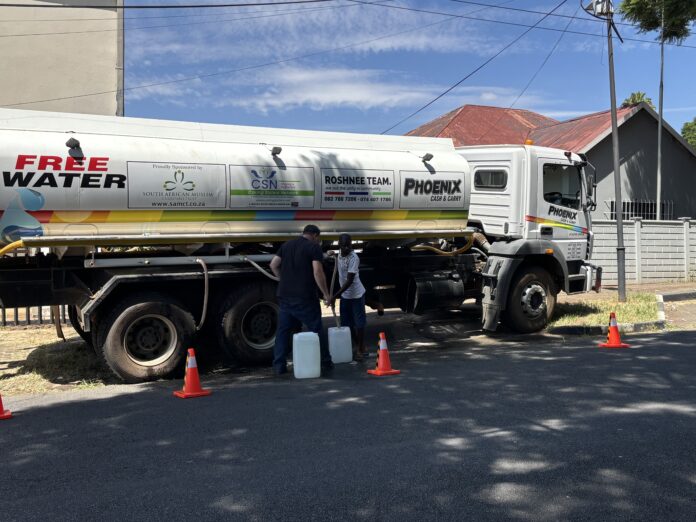
The timing was symbolically potent. Johannesburg, South Africa’s undisputed economic heartbeat, has in recent weeks been affected by widespread water outages. A scenario rural communities say mirrors the neglect they have endured for decades.
It was within this context that Ramaphosa elevated water to the very centre of his 2026 address. He described it as a flashpoint for social instability.
Water ministers instructed to not attend SONA
“In addition to crime, water is now the single most important issue for many people in South Africa,” he told parliament, noting that protests in parts of Gauteng have been fuelled by frustration over “inadequate and unreliable access to basic services such as water”.
In an extraordinary intervention underscoring the severity of the emergency, Ramaphosa instructed ministers responsible for water and sanitation and cooperative governance not to attend SONA. He ordered them instead to focus on stabilising Gauteng’s collapsing water system.
Acknowledging that the crisis is deeply rooted, he cautioned against simplistic solutions.
“There is no silver bullet to address this challenge, which has its roots in systemic failures and many years of neglecting infrastructure,” the president said.
To tighten accountability, Ramaphosa confirmed that legislative reforms were imminent.
“The Water Services Amendment Bill will enable us to hold water service providers accountable for their performance and withdraw their licence if they fail to deliver,” he said, signalling tougher consequences for chronic under-performers.
Response similar to load shedding
Drawing parallels with government’s coordinated response to load shedding, Ramaphosa announced a new high-level structure to drive water interventions.
“Using the same approach that we adopted to end load shedding, we will now elevate our response to the water crisis to a National Water Crisis Committee, which I will chair,” he said.
He went further, warning that the government would not hesitate to use its legal powers.
“We will hold to account those who neglect their responsibility to supply water to our people,” Ramaphosa said. This includes the laying of criminal charges against municipalities and officials under the National Water Act.
Public anger has already spilt into the political arena. Gauteng Premier Panyaza Lesufi was forced to apologise this week after remarking that the water crisis had compelled him to bathe at a hotel. Many residents viewed the comment as tone-deaf in a province where families queue for hours at communal taps or rely on water tankers.
Impending floods a concern
Beyond Gauteng, nature is compounding the crisis. The South African Weather Service has issued warnings of possible storms in Mpumalanga and Limpopo on Friday. This follows severe weather last month that caused damage estimated in the billions of rands. Such violent weather has already battered critical water infrastructure.
In Mpumalanga, the Senteeko Dam, a 26-metre high privately owned irrigation dam near Barberton, is at high risk of imminent failure after heavy January rains eroded and structurally weakened its spillway. Authorities have begun lowering water levels and warned downstream residents, particularly farming communities, to evacuate.
Ramaphosa acknowledged the devastating effects of floods in Mpumalanga, Limpopo and KwaZulu-Natal. He reiterated that government’s response must combine immediate crisis management with long-term infrastructure investment.
The promises echo those made in the 2025 SONA, where Ramaphosa painted a picture of a country pouring unprecedented resources into infrastructure, with water and sanitation positioned at the heart of the recovery agenda.
During the 2025 speech, he promised that his administration would spend more than R940-billion on infrastructure over three years. This included R375-billion by state-owned companies, aimed at revitalising roads, bridges, dams and waterways.
Water infrastructure projects
Ramaphosa also told parliament that the Infrastructure Fund had approved 12 blended-finance projects worth nearly R38-billion across water and sanitation, health, transport, energy and student accommodation. Of that amount, R23-billion had already been secured for seven large water infrastructure projects aimed at expanding bulk supply and stabilising the national system.
Flagship projects include Phase 2 of the Lesotho Highlands Water Project, the uMkhomazi Dam, the planned Ntabelanga Dam in the Eastern Cape and the Polihlali Dam, expected to channel 490 million cubic metres of water a year into the Vaal River system.
Last July, Minister of Water and Sanitation Pemmy Majodina declared water as South Africa’s most urgent crisis. She warned that collapsing infrastructure and failing municipalities were pushing the country towards deeper shortages.
Municipal debts compound water crisis
Delivering her 2025/26 budget vote, Majodina said municipalities owed water boards about R24-billion. This was undermining water security and reliable supply. She announced that 18 defaulting municipalities would have their equitable share withheld until they paid current invoices. Mangaung, Johannesburg and Tshwane had already cleared their debts.
She said government would accelerate major projects such as the R53-billion Lesotho Highlands Water Project Phase 2, the R7-billion raising of Clanwilliam Dam, the R760-million Tzaneen Dam upgrade and the R27-billion uMkhomazi Water Project.
“Water is Life. Sanitation is Dignity. Failure is not an option,” Majodina said.
As Johannesburg’s crisis exposes what rural South Africans have long known, Ramaphosa’s elevation of water to a national priority marks a turning point many hope is not rhetoric.


