


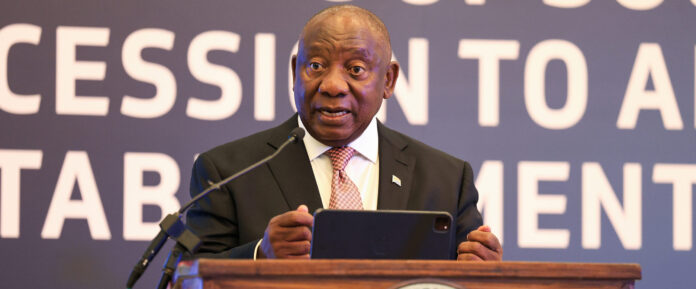
In May 2025, a confidential briefing warned President Cyril Ramaphosa that progress on key economic reforms was lagging. Nearly a year later, one of the measures introduced to address those challenges – a special exemption allowing companies to collaborate in rail and port logistics – has drawn only five formal applications and has yet to produce measurable results.
The government–business partnership briefing privately presented to Ramaphosa stated that “limited progress has been made on actions agreed in previous presidents’ meetings”, highlighting delays across critical sectors.
In logistics, the document noted that rail freight volumes were below target and that port container throughput “has been flat without any volume growth”.
It warned that continued underperformance could lead to “retrenchments in key economic sectors”, “export market share erosion” and place “investor confidence at risk”.
In response, the government had introduced a block exemption to allow companies to collaborate on operational issues such as infrastructure maintenance, freight movement and port efficiency.
However, figures from the Competition Commission show limited uptake. “Since May 2025, the commission has received five (5) applications under the ports, rail and road transport corridors block exemption regulations,” the commission said.
“Four (4) have been finalised and granted with conditions, and one (1) is currently under assessment.”
Transnet confirmed that collaboration initiatives linked to the exemption have not yet reached implementation.
“Transnet has initiated pilot collaboration projects with coal customers… [which] are currently progressing through the approval and contracting phases,” the company said. “Improvements are not yet quantifiable… [the projects] have not yet reached full implementation.”
The presidency, however, said the government had made “significant progress” in implementing economic reforms over the past year. It cited improvements in Eskom’s performance, with an energy availability factor above 65%, and a reduction in loadshedding supported by increased generation capacity.
The presidency also pointed to growth in private investment in renewable energy, saying more than 200 projects were in the grid connection process, and said Transnet had recorded a 4.4% increase in rail volumes in the six months to September 2025, alongside improved port performance.
It said milestones had been achieved, including the allocation of capacity on the freight rail network to third-party operators and the establishment of a private sector partnership at Durban’s Pier 2 container terminal.
“Sustained implementation of economic reform has supported improved business confidence and growing investment,” the presidency said.
“Government remains firmly committed to implementing reforms to shift South Africa’s economic growth trajectory and create jobs.”
The Presidency added that reforms are being coordinated through Operation Vulindlela, with the government-business partnership providing additional expertise to support improvements at Eskom and Transnet.
While the confidential briefing highlighted delays, Ramaphosa’s public messaging has remained positive.
In his 2025 State of the Nation Address, the president said reforms in energy and logistics were gaining traction.
By the 2026 address, he acknowledged ongoing inefficiencies in rail and ports while emphasising the need to accelerate reforms and deepen private sector participation.
The reforms are being implemented in the latter half of Ramaphosa’s administration, with his term as ANC president set to end in 2027 and his second term as head of state concluding in 2029.
The Competition Commission said it has not received complaints or identified abuse of the exemption. “The commission has not launched any investigations… as it has not received complaints or information warranting such action,” it said.
Companies taking part are required to keep records of meetings and submit reports where required, while conduct outside the exemption remains subject to enforcement.
The May 2025 briefing also proposed a “focused three-month sprint” to accelerate reforms in key areas, including logistics.
The exemption forms part of measures aimed at addressing operational constraints in rail and port systems.
- In May 2025, a confidential briefing warned President Cyril Ramaphosa that progress on key economic reforms was lagging.
- Nearly a year later, one of the measures introduced to address those challenges – a special exemption allowing companies to collaborate in rail and port logistics – has drawn only five formal applications and has yet to produce measurable results.
- The government–business partnership briefing privately presented to Ramaphosa stated that “limited progress has been made on actions agreed in previous presidents’ meetings”, highlighting delays across critical sectors.
- In logistics, the document noted that rail freight volumes were below target and that port container throughput “has been flat without any volume growth”.
- It warned that continued underperformance could lead to “retrenchments in key economic sectors”, “export market share erosion” and place “investor confidence at risk”.


