
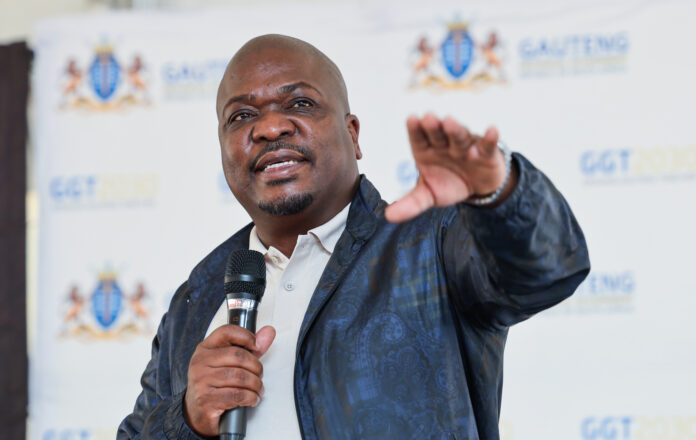
Ekurhuleni mayor Nkosindiphile Doctor Xhakaza has warned that corruption and governance failures in the metro are more deeply entrenched than previously understood, describing the problem as systemic rather than isolated.
Speaking in a podcast interview with Sunday World, Xhakaza said recent revelations, including those emerging from the Madlanga commission, had exposed a pattern of dysfunction that extends beyond individual officials or incidents.
“The rot goes deeper,” he said. “Not just in Ekurhuleni but across municipalities.”
The mayor described the period between 2021 and early 2024 as one marked by widespread governance breakdown, which he said had undermined institutional integrity and public confidence in the city.
“It was a period of wrong things happening,” he said. “A period we must confront and clean up.”
Restoring order in the municipality
Xhakaza said his administration, which took office in April 2024, had been tasked with addressing these failures and restoring order within the municipality.
“The reason I took over is exactly because of these issues,” he said. “The council needed someone to deal with governance lapses and the emerging rot.”
According to the mayor, the challenge goes beyond addressing individual cases of misconduct and requires a deeper process of institutional reform. “You do not just deal with the surface,” he said. “You must uproot the problem.”
This process, he said, has been met with resistance from those who benefited from previous arrangements. “There will be pushback,” Xhakaza said. “Those who benefited from the rot will fight.”
He said this resistance has taken multiple forms, including internal political disputes, legal challenges and efforts to discredit the administration.
“They fight in council, they fight in internal processes, and they fight in the media,” he said.
The mayor also suggested that attempts had been made to create doubt around the clean-up effort, including allegations aimed at undermining his leadership.
“These campaigns are meant to derail the process,” he said.
Despite these challenges, the city has begun implementing measures to strengthen governance and improve oversight.
These include internal systems to track allegations, prioritise serious cases and refer them for forensic investigation.
Disciplinary processes
Xhakaza said the administration had also identified instances where disciplinary processes had been initiated but never completed and were now working to revive them.
“In some cases, processes were abandoned,” he said. “We are now taking them to a conclusion.”
However, he acknowledged that legal and procedural constraints have slowed progress in some cases, particularly where matters are subject to ongoing investigations or commissions of inquiry.
“We must be careful about where issues are before a commission,” he said. “But that does not stop us from acting where we can.”
The mayor emphasised that addressing corruption is essential not only for accountability, but also for restoring the city’s ability to function effectively.
“When systems are compromised, everything is affected — service delivery, finances, public trust,” he said.
He said the administration’s approach combines immediate corrective action with longer-term reforms aimed at preventing similar failures in the future. “These are not quick fixes,” Xhakaza said. “It is a process of rebuilding.”
While some of the benefits of these interventions may take time to become visible, the mayor said the groundwork was being laid for improved governance and stability.
“To correct the situation will take time,” he said. “But the work has started.”


