


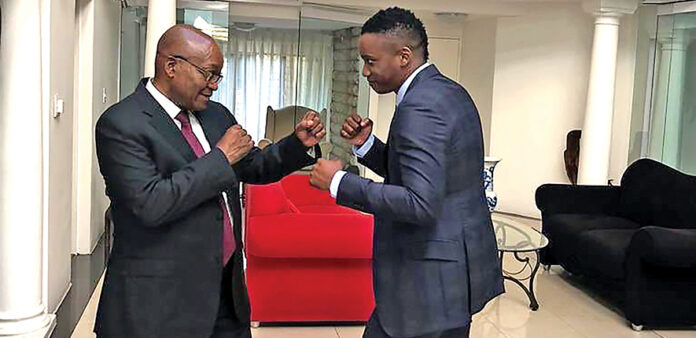
Duduzane Zuma has offered South Africa’s political and business establishment an unusual reason to be grateful for his father: Jacob Zuma, he says, has been holding back revolt among people whose economic frustrations remain unresolved three decades into democracy.
“We should thank our lucky stars for that gentleman for one reason and one reason only,” Zuma told business leaders in Cape Town on Tuesday at a Biznews event.
“He’s held back a lot of revolt in this country.”
The newly appointed MK Party first deputy president did not base the argument on whether his father had been fairly treated through years of political, legal and corruption controversies.
“He’s been hounded for a very long time. Rightfully, wrongfully, I’m not here to speak about that,” he said.
‘A champion for the disenfranchised’
Instead, Zuma pointed to the former president’s continuing authority among sections of the population who, he argued, remain economically excluded.
“A lot of people look to him for leadership, for guidance as an elderly statesman, as an elder in the community,” he said.
“He’s held people back and said, ‘We’ll get through this.’ He’s spoken them through it. He’s guided them through it, and he’s here to do it once again.”
The claim places a different meaning on Jacob Zuma’s political relevance.
Zuma’s influence ‘retrains dissatisfaction’
His continued influence, according to his son’s argument, does not simply mobilise dissatisfaction. It restrains it by keeping a frustrated constituency attached to a political leader and, through him, to organised electoral politics.
Duduzane located that frustration in what he sees as a widening distance between political democracy and economic power.
He contrasted the business leaders, professionals and political figures listening to him inside the conference venue with what he repeatedly called “the masses” outside.
“It’s nice when we all talk in these closed-off rooms,” he said, referring to “people that are in the system, professionals, business people, respectable people”.
“But there’s a reality outside that I think a lot of people are ignoring. And that reality is the reality of the masses.”
Masses ‘reduced to voting capital’
Zuma said the majority had been reduced to an electoral consideration rather than treated as an economic constituency.
“We speak about the masses as voting capital, and that’s it. But their needs are not being seen to.”
He then divided the economy itself along similar lines.
One economy, Zuma said, operated through the democratic state, including government contracts and tenders. He described it as “broadly known as, let’s call it, the black economy”.
A second operated through private capital and the corporate sector.
“We’ve seen great numbers on the JSE. We’ve seen value being built in this country and outside, globally,” he said, before describing that sphere as commonly regarded as the “white side of the economy”.
Between them, he identified a third.
“It straddles both the corporate sector and the public sector. And that would be the criminal economy.”
State vs private economy
His formulation located the political danger he was warning about in the separation between the state, through which the Black majority exercises democratic power, and the private economy, in which much accumulated capital remains concentrated.
In his proposed settlement Zuma openly embraced ideas rarely associated with MK’s more radical economic image, saying he shared common ground with remarks made by the Cape Town mayor.
“When you speak about meritocracy, when you speak about free markets, when you speak about opportunities, when you speak about industrialising, when you speak about safety and security for men, women, and children – that’s what we’re about,” he said.
Then came the qualification.
“But at the same time we have the masses to deal with,” Zuma said.
“We cannot have the situation where we’re only dealing with a certain section of our population and ignoring the masses.”
That warning accompanied an invitation to business.
Zuma did not disown MK policies, including land expropriation without compensation, free education and nationalisation of the South African Reserve Bank. He instead urged the economic constituencies most likely to fear those policies to negotiate.
“As big business, as the white minority in this country, as well as the Indian and coloured minorities, meet us halfway,” he said.
“That’s the only request that I’ll make.”
He said those policies should not be treated as a “scarecrow” and argued that the country could address majority deprivation without violating minority rights.
The appeal carried an unmistakable assertion of political permanence.
‘MK is a player. That’s something that you need to get used to’
“MK is here. It’s an entity,” Zuma said earlier in the speech.
“I know people like skirting around the conversation and discounting MK as a player, but MK is a player. That’s something that you need to get used to.”
He extended that certainty to the November local government elections and the 2029 national contest.
“Come November 2026 and come national elections 2029, we will be here. It’s inevitable. I think we all know this.”
Zuma followed it immediately with an offer to negotiate.
“What is it that we can do to work together to make this country a better place?” He asked, adding that this had to happen “without ignoring the plight of the majority but also not infringing on the rights of the minority.”
“We have to find each other.”
That places his extraordinary claim about his father in a clearer context.
Jacob Zuma is usually presented by his opponents as a political force capable of inflaming dissatisfaction. His son is asking the establishment to consider the opposite possibility: that the former president’s authority among dissatisfied voters has also placed limits on what that anger becomes.
The warning is contained in the constituency Duduzane describes, not in an explicit threat.
People remain poor. They possess votes but insufficient economic power. They feel ignored outside election periods. And, according to Duduzane, many of them still listen when Jacob Zuma tells them to wait and work through politics.
The reassurance, therefore, is Jacob Zuma.
- Duduzane Zuma stated that his father, Jacob Zuma, has held back revolt among economically frustrated South Africans by providing leadership and guidance.
- He argued that Jacob Zuma's influence restrains dissatisfaction by maintaining a connection between frustrated voters and organized electoral politics.
- Duduzane Zuma highlighted a divide between the democratic state's "black economy" and the private sector's "white side of the economy," with a criminal economy straddling both.
- He urged big business and minority groups to negotiate and meet the MK Party halfway on policies like land expropriation, free education, and nationalization of the Reserve Bank.
- Duduzane Zuma confirmed that MK is a permanent political player in South Africa and will participate in the 2026 local elections and the 2029 national elections.


