


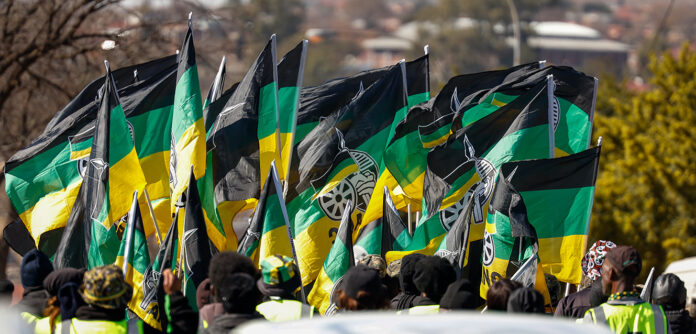
ANC president Cyril Ramaphosa was ushered into a half-empty 20 000-seater Moruleng Stadium in the North West for the official celebration of the party turning 114 this year.
To be fair, the ANC is within its rights to celebrate its birthday. It spent the week deploying leaders on door-to-door campaigns to areas in and around the Bojanala district to listen to people’s concerns and canvass support for the weekend jamboree, where the January 8 statement was delivered by Ramaphosa.
The January 8 statement used to be a highly anticipated affair. Massive stadiums used to be packed as the party kicked off the political programme of the year. But that was when the ANC was the leading party of government, commanding considerable support and in control of all levers of the state.
Times have changed. Electoral support has plunged below 50%, and the party has been forced to govern the country in coalition with the DA and other partners in the government of national unity.
It has no one to blame for this dramatic decline in electoral fortunes but itself, its leaders and its rank and file. For 30 years in power, the party of liberation has failed South Africans at every turn.
Under its watch, crime and corruption have become a permanent cancer over society.
As witnessed through testimony in the Madlanga commission and the parliamentary ad hoc committee probing police corruption, the criminal justice system has been hijacked by criminal and rogue elements, facilitated by the ANC’s own leaders.
Municipalities have collapsed, service delivery has ceased across the country, the economy is stagnant, unemployment is stubborn at 36%, and promised reforms have stalled.
Public schooling is in disarray, and education outcomes are worsening; the health system is on its knees.
South Africans feel unsafe in their homes and on the streets, the public service is largely incompetent and indifferent to the public it should be serving.
South Africans are moving on from this dying party, safe in the knowledge that it has run out of ideas and has no ability or will to solve their problems and improve their lot.
Even its secretary-general acknowledged in December in his mid-term report at the national general council that the ANC was facing an existential crisis.
He cited “declining organisational discipline, functionalism driven by access to resources rather than ideological contestation, the entrenchment of patronage networks, widespread corruption, weakened grassroots structures, and growing distance between leaders and communities.
“Renewal, comrades, is therefore no longer optional. It is an existential imperative for the survival of the organisation and the continuation of the national democratic revolution,” Fikile Mbalula told delegates at the gathering.
Unless it moves beyond rhetoric, gets serious about renewal, and rids itself of the corrupt and the incompetent, the party will be over – literally and figuratively – for the ANC.
- ANC president Cyril Ramaphosa was ushered into a half-empty 20 000-seater Moruleng Stadium in the North West for the official celebration of the party turning 114 this year.
- To be fair, the ANC is within its rights to celebrate its birthday.
- It spent the week deploying leaders on door-to-door campaigns to areas in and around the Bojanala district to listen to people’s concerns and canvass support for the weekend jamboree, where the January 8 statement was delivered by Ramaphosa.
- The January 8 statement used to be a highly anticipated affair.
- Massive stadiums used to be packed as the party kicked off the political programme of the year.


