


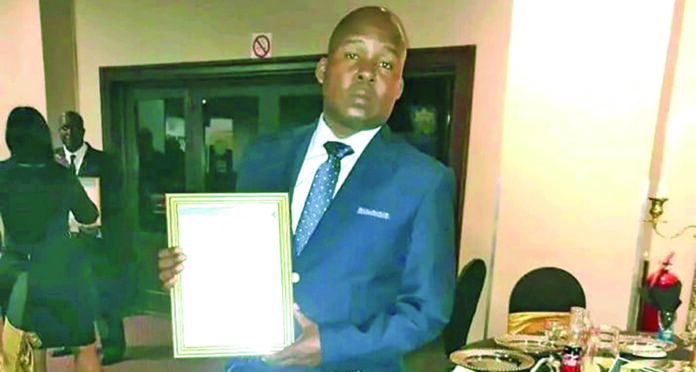
Before Bonginkosi Anthony Dlamini became a convicted police officer serving 17 years for corruption and defeating the administration of justice, he was an award-winning detective whose work had helped crack one of Durban’s most brutal family massacres.
The case began in Umlazi’s G-Section in the early hours of February 25, 2017, when armed men went on a rampage that left a mother and three of her children dead and another daughter raped.
The attackers had first opened fire at a shebeen before storming the family home.
Police responding to the attack became involved in a shootout in which one gunman was killed. Another suspect was arrested days later.
Dlamini was the investigating officer. He linked the suspects to other crimes, including rape and robbery cases that had remained unsolved at station level.
By November 2018, Dlamini was invited to the SAPS National Awards Ceremony in Pretoria, where detectives from across the country were recognised for their work.
Then-national police commissioner General Khehla Sitole presented the awards, with provincial commissioners in attendance, including KwaZulu-Natal police commissioner Lieutenant-General Nhlanhla Mkhwanazi.
Dlamini secured several successful organised-crime convictions during that financial year but the Umlazi massacre case was the investigation that particularly attracted the attention of SAPS national headquarters.
One of the accused was ultimately sentenced to a cumulative 300 years in prison.
It was a high point in a police career that would soon take a radically different turn.
Within two years, Dlamini would be arrested over allegations that he had accepted money to interfere with a witness in another murder investigation.
The state would eventually convince a court that the decorated detective had crossed the line from investigator to participant in a scheme designed to weaken a prosecution.
Dlamini maintains the opposite. From prison, he is trying to reconstruct the events that transformed him from an award-winning organised-crime investigator into a convicted corrupt policeman.
Among the politically sensitive cases Dlamini investigated was the murder of KwaNdengezi ANC leader Thulani Nxumalo.
Dlamini led the investigation and arrested headman Felokwakhe Ndlovu and others, including Celani Selby Dlamini.
Celani’s murder charge was later withdrawn and the state decided to use him as a witness against Ndlovu. The judgment records that Dlamini initially took steps to protect Celani.
Celani told the court that after his release, Dlamini did not want him returning home because he believed Ndlovu’s alleged hitmen could kill him.
Dlamini arranged for Celani to stay at Wema Hostel with relatives and arranged witness protection, but Celani declined after discussing the implications with his family.
When Dlamini again warned Celani in October 2019 that his life was in danger, the state said it was no longer the intervention of a detective protecting a witness. It was part of a plan to frighten Celani out of the murder case. By then Dlamini was no longer in charge of the Nxumalo investigation.
The judgment records that sometime around August or September 2019, a Captain Khumalo contacted Celani and told him he was now investigating the murder.
Celani was confused and phoned Dlamini, who confirmed that he was no longer the investigating officer.
The judgment relies on the fact that Dlamini was no longer responsible for the case when he later approached Celani. What it does not explain in detail is why he had been removed, who made the decision or what had happened inside the political killings structure before he left.
Dlamini says the missing a period is crucial and he wants the Madlanga commission’s ear.
He tells his sympathisers: “I’m not seeking assistance from the Madlanga commission but I wanted to help the commission to understand how [the] PKTT (Political Killings Task Team) operates. My case is one of the examples of how they can fabricate evidence. And I wanted to assist the commission.”
His account is that his relationship with senior members of the task team had deteriorated before the corruption case arose.
He alleges that the conflict included disagreements over investigations and arrests, culminating in a confrontation with General Dumisani Khumalo over an alleged instruction to arrest then-eThekwini mayor Zandile Gumede in a murder investigation.
Dlamini says he refused because he believed there was insufficient evidence.
SAPS national spokesperson Brig Athlenda Mathe says Khumalo would cooperate with the commission.
- Bonginkosi Anthony Dlamini was an award-winning detective who helped solve a brutal family massacre in Umlazi’s G-Section in 2017, leading to multiple convictions including a 300-year sentence for one accused.
- Dlamini was invited to the SAPS National Awards Ceremony in 2018 and secured several organised-crime convictions, but was arrested within two years for allegedly accepting money to interfere with a witness in another murder case.
- Among cases investigated by Dlamini was the murder of KwaNdengezi ANC leader Thulani Nxumalo, where he initially protected a witness, Celani Selby Dlamini, who was later pressured to withdraw from the case.
- Dlamini was removed from the Nxumalo investigation around August or September 2019, and his attempt to influence witness Celani after his removal was central to corruption charges against him.
- Dlamini alleges conflicts within the Political Killings Task Team, including a refusal to arrest eThekwini mayor Zandile Gumede due to lack of evidence, and seeks to testify at the Madlanga commission about alleged evidence fabrication; SAPS spokesperson confirmed cooperation from General Dumisani Khumalo.


