


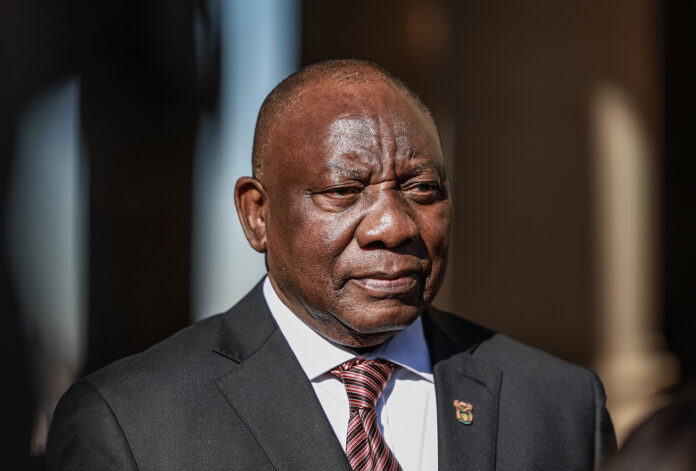
The impeachment process against President Cyril Ramaphosa moved into a decisive new phase on Wednesday after National Assembly Speaker Thoko Didiza announced the composition formula for Parliament’s unprecedented Section 89 impeachment committee.
The announcement marks one of the most significant institutional developments since last week’s landmark Constitutional Court ruling, which revived Parliament’s stalled handling of the Phala Phala scandal and effectively forced lawmakers to restart the impeachment process against Ramaphosa.
Parties to submit names for committee
In a statement issued on Wednesday, Didiza confirmed that political parties represented in the National Assembly had been instructed to submit the names of MPs who will serve on the impeachment committee by Friday, May 22.
The committee will consist of 31 MPs drawn from all 16 political parties represented in the National Assembly.
The ANC will hold nine seats, followed by the DA with five and the MK Party with three.
The EFF will have two representatives, while smaller parties including the IFP, Patriotic Alliance, FF Plus, ActionSA, ACDP, UDM, Rise Mzansi, BOSA, ATM, Al Jama-ah, NCC and UAT will each have one member.
Didiza said the composition model sought to balance proportional representation with broader political inclusion.
“In determining the composition of the impeachment committee, the Speaker considered not only the constitutional principle of proportional representation but also the need for inclusivity and broad participation in this unprecedented parliamentary process,” Parliament said.
Small parties not excluded
The statement added that the arrangement was designed to ensure smaller parties were not excluded “through a strict mathematical application of proportional representation”.
The committee will be tasked with considering whether Ramaphosa committed serious violations of the Constitution or the law, serious misconduct, or is unable to perform the functions of office — the constitutional threshold required for impeachment under Section 89.
The process stems from the long-running Phala Phala scandal, which erupted in 2022 after former spy boss Arthur Fraser accused Ramaphosa of concealing the theft of large sums of foreign currency from his Phala Phala farm in Limpopo.
A Section 89 independent panel chaired by retired Chief Justice Sandile Ngcobo later found that there was prima facie evidence that Ramaphosa may have violated the Constitution and anti-corruption laws.
However, in December 2022, the ANC used its parliamentary majority to block adoption of the panel report, effectively terminating the impeachment process before a full inquiry could begin.
That decision was overturned last week when the Constitutional Court of South Africa ruled that the National Assembly had acted unlawfully and inconsistently with the Constitution in the manner it handled the Section 89 process.
The apex court ordered Parliament to reconsider the matter and ensure compliance with constitutional obligations. Wednesday’s announcement by Didiza is the clearest indication yet that Parliament is now moving swiftly to comply with the court order and formally reconstitute the impeachment machinery.
‘Uncharted procedural terrain’
In another significant development, Didiza confirmed that the Constitutional Court judgment had also been referred to Parliament’s Subcommittee on the Review of Rules to consider amendments to the National Assembly rules governing impeachment proceedings.
The move underscores the procedural uncertainty confronting Parliament as it navigates what Didiza described as “uncharted procedural terrain”.
The impeachment committee is expected to become a major political battleground in the coming weeks, with opposition parties pushing for a full public inquiry into the Phala Phala saga while the ANC attempts to contain further political fallout ahead of this year’s local government elections.
- Parliament’s Section 89 impeachment committee for President Cyril Ramaphosa has been formed, consisting of 31 MPs from all 16 political parties, with the ANC holding nine seats.
- The committee will assess whether Ramaphosa committed serious constitutional or legal violations related to the Phala Phala scandal, which involves alleged concealment of stolen foreign currency at his farm.
- This follows a Constitutional Court ruling that overturned the ANC’s previous blockade of the impeachment process, mandating Parliament to restart proceedings in line with constitutional requirements.
- The committee’s composition balances proportional representation with inclusivity, ensuring smaller parties also participate in this unprecedented process.
- Parliament is also considering amending its rules on impeachment, signaling ongoing procedural adjustments as political tensions rise ahead of local government elections.


