


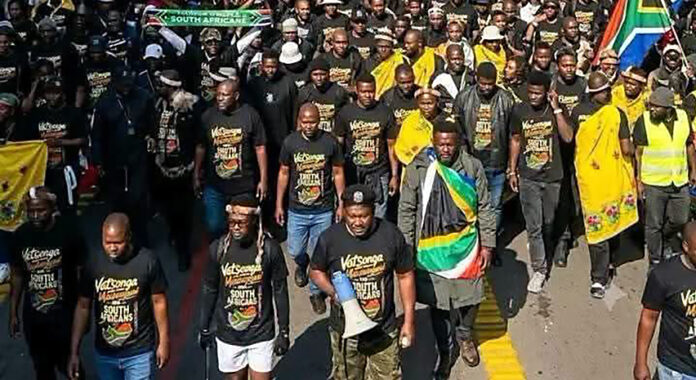
As anti-illegal immigration protests dominate debate, a newly formed Tsonga civic movement says it deliberately rejected party politics because constitutional advocacy offers a stronger platform to defend people increasingly mistaken for foreigners because of their language, surnames and identity.
The Vatsonga-Machangani Civil Movement (VMCM), established this year, says it emerged after Tsonga-speaking South Africans were allegedly profiled, harassed and treated as undocumented foreign nationals because of their language and culture.
Weeks before anti-illegal immigration demonstrations swept parts of the country on June 30, VMCM members marched to the Union Buildings to deliver a memorandum condemning the profiling of Tsonga-speaking citizens as foreigners.
The issue remains topical as organisers prepare another march on July 31, despite public disagreements among figures, keeping questions of citizenship, identity and belonging in the national spotlight.
“The Vatsonga-Machangani Civil Movement emerged in 2026 in response to growing incidents where Vatsonga-Machangani people and other indigenous South Africans were being wrongly profiled, harassed and sometimes treated as foreigners because of their language, surnames or cultural identity,” secretary-general Wandile Maluleke told Sunday World.
Unlike organisations preparing to contest the November 4 local government elections, the VMCM has chosen to remain outside party politics.
“Our focus is on human rights, dignity, equality and social justice, irrespective of political affiliation,” Maluleke said.
“Remaining non-partisan enables us to engage constructively with all political parties, government institutions and civil society while keeping our attention on the issues affecting our communities.”
The decision departs from the legacy of Prof Hudson Ntsanwisi, the former prime minister of the Gazankulu homeland, whose Ximoko xa Rixaka movement became a vehicle for Tsonga political and cultural mobilisation during apartheid.
For many older Limpopo and Mpumalanga residents, Ntsanwisi’s administration became associated with expanded public services, schools and roads, while fostering cultural identity among Tsonga-speaking communities.
VMCM argues that visibility, rather than votes, is its immediate priority.
“The Tsonga voice needs greater visibility because many South Africans still lack awareness about Tsonga history, identity and contributions to the country,” Maluleke said.
“This lack of understanding has contributed to harmful stereotypes, tribal profiling and exclusion.
“It is not a tribal project and it is not founded on division. It is a constitutional civic movement committed to equality, dignity, justice, non-violence and the protection of all South Africans from discrimination.”
Asked whether the election of Tsonga-speaking Mandla Ndlovu as Mpumalanga premier and ANC provincial chairperson meant the community was adequately represented, VMCM welcomed his leadership but said representation alone was insufficient.
“The real measure is whether people experience meaningful progress in economic development, service delivery, equality, safety and social inclusion.”
The movement said Tsonga unity should not be measured by political affiliation and called for cooperation with Venda, Pedi, Lobedu, Ndebele and other communities.
Political analyst Goodenough Mashego said the decision to remain outside electoral politics reflected a deeper historical dilemma over identity.
Mashego, whose oral history research culminated in the book We Are Still Here: From Colonisation to Democracy, said some people were uncomfortable defining themselves because competing historical identities could reopen arguments about belonging.
He said one school embraced Shangaan history linked to the former Gaza Empire in present-day Mozambique, while another, particularly in Bushbuckridge, traced its ancestry to the Amandwandwe in present-day KwaZulu-Natal.
“By taking ownership of that identity at a national level is affirming, at a regional level it is giving voice to sentiments echoed by people with tribal inclinations that they should not be in political power because they are not native,” he said.
Mashego argued that the tension made sustained ethnic political mobilisation difficult.
“Ximoko was more than a political party; it was a cultural movement that permeated many spheres of society. It gave its adherents an identity.”
Many former Ximoko supporters moved to the ANC after 1994 because it became the governing party and dominant political home for Tsonga-speaking voters.
Sunday World sought comment from Ximoko Party spokesperson Dineo Hlongwane on its membership, electoral strategy, support and vision before the elections. Hlongwane said the party would respond but no response was received at the time of publication.
- The newly formed Vatsonga-Machangani Civil Movement (VMCM) rejects party politics to focus on constitutional advocacy against profiling Tsonga-speaking South Africans as foreigners.
- Established in 2026, VMCM aims to address harassment based on language, surnames, and cultural identity, and has conducted protests highlighting these issues.
- The movement prioritizes visibility and awareness of Tsonga history and contributions, emphasizing non-partisanship and cooperation with other ethnic communities.
- Political representation, such as Mpumalanga premier Mandla Ndlovu’s election, is welcomed but deemed insufficient without tangible progress in development and inclusion.
- Political analyst Goodenough Mashego notes the complex identity dynamics underpin Tsonga mobilisation, contrasting VMCM’s constitutional approach with past cultural-political movements like Ximoko.


